
Sun's End Could Destabilize Solar System 100x Faster
New research suggests the Sun's eventual death could destabilize planetary orbits at a pace up to 100 times quicker than previously estimated, potentially ending the solar system's stability much sooner than anticipated.

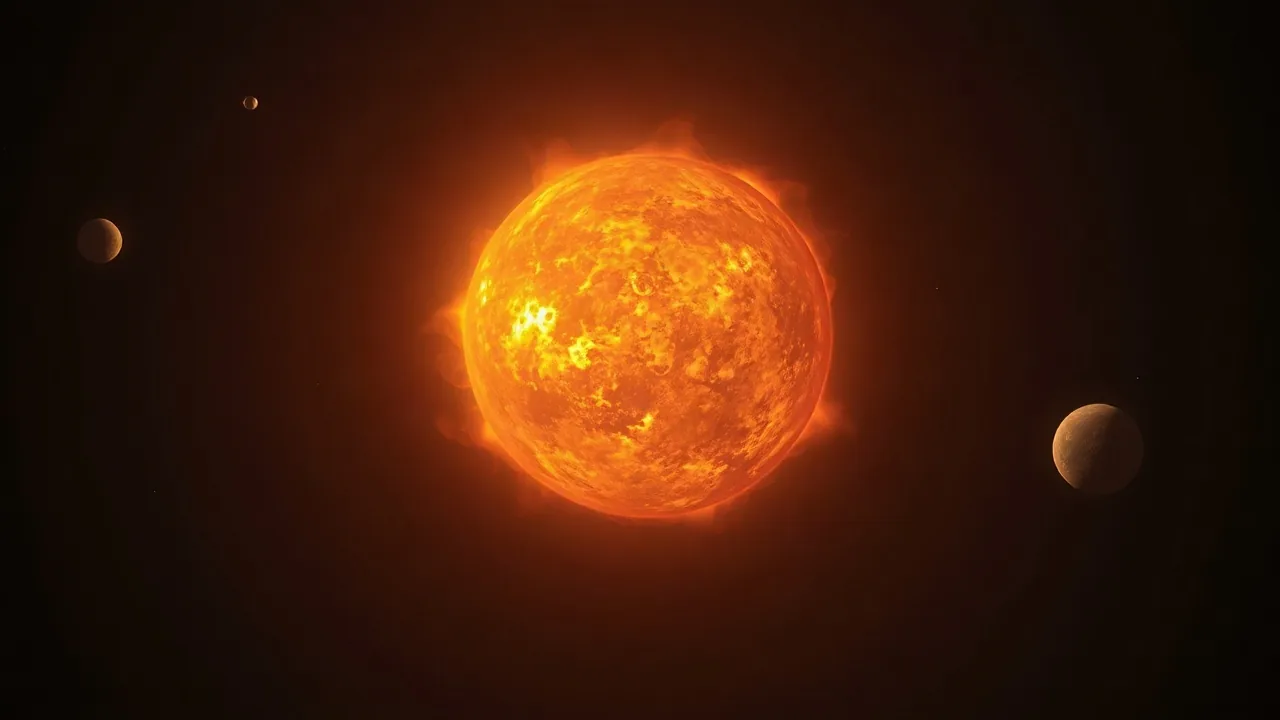
Our solar system's final moments might arrive significantly faster than scientists have long predicted, according to new research. The eventual loss of mass from our Sun as it enters its death throes could destabilize the orbits of planets, including Earth, at a rate potentially 100 times greater than previous models indicated.
This accelerated timeline stems from a complex analysis of how the Sun's diminishing gravitational pull will affect the delicate balance of planetary motion. As stars like our Sun age, they expand into red giants before eventually shedding their outer layers, leaving behind a white dwarf. This process involves a substantial loss of the star's mass.
A team of astrophysicists led by Dr. Dimitri Veras of the University of Warwick explored the long-term evolution of planetary systems around Sun-like stars. Their simulations considered the impact of this mass loss on the stability of planetary orbits. The findings suggest that the gravitational dance that has kept the planets in their paths for billions of years could be disrupted far more abruptly than earlier theories proposed. This instability could lead to planets being ejected from the solar system or colliding with each other.
Planetary Orbits at Risk
Previous estimates placed the timeframe for significant orbital destabilization over billions of years. However, this latest modeling, incorporating more nuanced physics of stellar evolution and gravitational interactions, points to a much swifter cosmic reckoning. The study, which appears in the journal Nature Astronomy, utilized advanced computational methods to simulate the gravitational perturbations exerted by the shrinking Sun on the surrounding planets. The researchers specifically focused on the period following the Sun's red giant phase, when it sheds its mass most rapidly.
"The Sun will eventually lose 30 percent of its mass over the next 7 to 10 billion years," explained a spokesperson for the research team. "This mass loss will affect the orbits of all planets, moons, and asteroids. Our models suggest that the outer planets, in particular, are vulnerable to significant orbital changes." This dramatic reduction in the Sun's gravitational influence means that the planets, no longer tethered as strongly, could begin to drift into less stable paths.
The implications of this research extend beyond our own solar system. Billions of Sun-like stars populate the Milky Way galaxy, and understanding their eventual fate and the impact on their planetary companions is crucial for comprehending the prevalence of stable planetary systems throughout the cosmos. The stability of a planetary system is a key factor in the potential for life to arise and persist. If orbits become too erratic, the conditions necessary for habitability, such as stable temperatures and the presence of liquid water, would likely be impossible to maintain.
The accelerated destabilization could mean that planets within other solar systems might face chaotic orbital dynamics much sooner than astronomers had thought. This has significant ramifications for the search for exoplanets and the assessment of their potential habitability. The study highlights the dynamic and often violent nature of stellar evolution and its profound consequences for the celestial bodies that orbit them. The long-term fate of our solar system remains a profound area of astronomical study.
The Sun is currently in its main sequence phase, a stable period that is expected to last for another 5 billion years. However, as it approaches the end of its life cycle, it will expand dramatically, engulfing Mercury, Venus, and possibly Earth. Following this phase, it will shed its outer layers, forming a planetary nebula, and its core will collapse into a white dwarf. It is during the mass-loss phase that the gravitational balance is most severely threatened. This new understanding underscores the dynamic and potentially short-lived nature of orbital stability in planetary systems, even those around seemingly stable stars like our Sun.