
Distant Fast Radio Burst Detected Near Universe's Dawn
Astronomers have detected the most distant Fast Radio Burst (FRB) ever observed, originating from a galaxy when the universe was just 3 billion years old. The galaxy's surprisingly low metallicity has puzzled scientists.

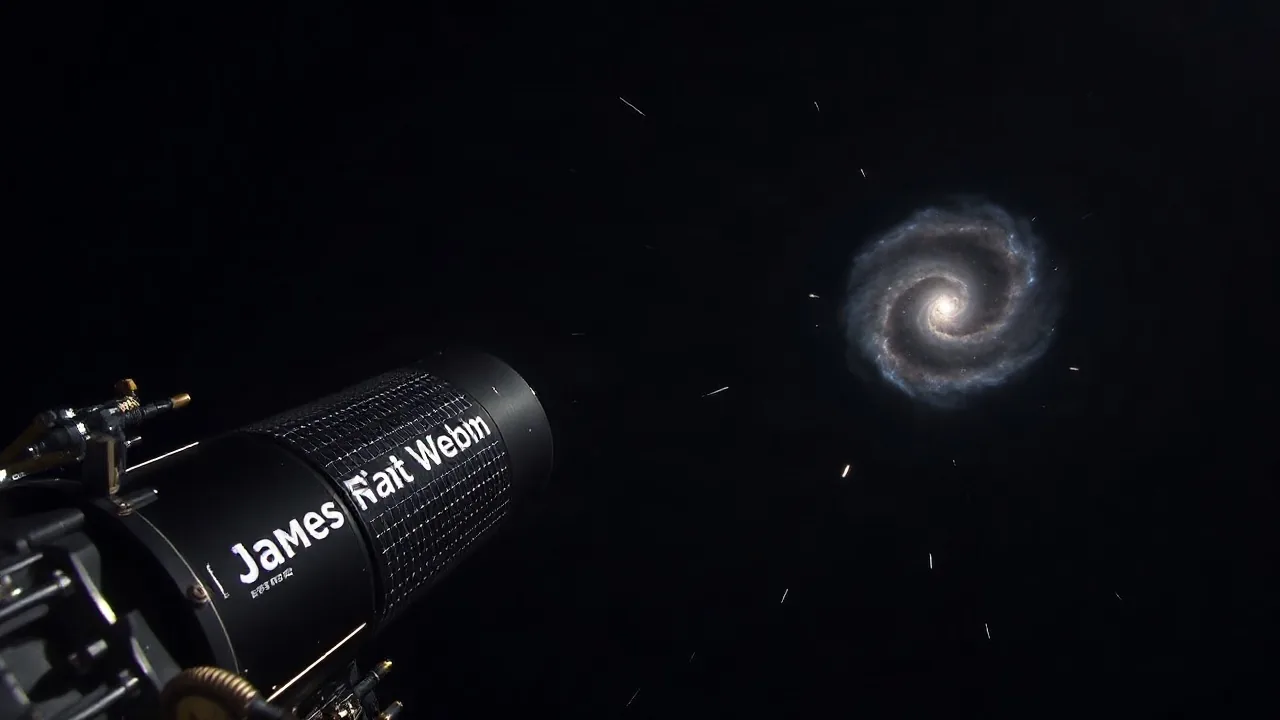
Astronomers using the James Webb Space Telescope (JWST) have identified the most distant Fast Radio Burst (FRB) ever detected, a powerful, millisecond-long radio wave emission originating from a galaxy in the early universe, approximately 3 billion years after the Big Bang. This groundbreaking discovery, published in the journal Nature, pushes the boundaries of our understanding of cosmic phenomena and the evolution of galaxies.
The FRB, designated FRB 20220610A, was traced back to a galaxy incredibly far from Earth, making it the most distant FRB observed to date. Fast Radio Bursts are intense flashes of radio waves that last only a few milliseconds, and their origins remain one of astrophysics' most compelling mysteries. While many FRBs are known to repeat, others appear as single, enigmatic events.
What has particularly surprised researchers is the nature of the host galaxy of FRB 20220610A. Despite its immense distance, placing it in a cosmic epoch when galaxies were still forming and were expected to be chemically primitive, the galaxy exhibited a surprisingly high metallicity. Metallicity, in astronomical terms, refers to the abundance of elements heavier than hydrogen and helium. Early galaxies are typically thought to be composed primarily of these primordial elements.
"The host galaxy has a metallicity that is higher than expected for a galaxy at that cosmic time," said Dr. Dan Smith, lead author of the study and an astrophysicist at the University of Amsterdam. "This suggests that galaxy formation and chemical enrichment processes might have been more advanced or efficient in the early universe than previously modeled."
The ability of the JWST to capture such detailed information about the host galaxy was crucial. Its advanced infrared capabilities allow it to observe light that has been stretched over cosmic distances, providing a glimpse into the universe's infancy. This detection not only sets a new record for the most distant FRB but also provides a unique opportunity to study the chemical composition of galaxies from a period when the cosmos was just beginning to take shape.
Unraveling the mysteries of early galaxies
The implications of this finding extend beyond the study of FRBs. The unexpected metallicity of the host galaxy challenges existing cosmological models. Scientists have long theorized that the early universe was dominated by Population III stars – the first generation of stars, composed almost entirely of hydrogen and helium. These stars would have then fused heavier elements, which were subsequently dispersed into the cosmos through supernovae, leading to the formation of later generations of stars and galaxies with higher metallicities.
The detection of a relatively metal-rich galaxy at such an early cosmic stage suggests that this process may have occurred much faster than anticipated. This could mean that star formation was more vigorous, or that supernovae were more effective at seeding the universe with heavy elements earlier than current theories allow. The team plans to conduct further observations of FRB 20220610A's host galaxy and other distant FRB sources to build a more comprehensive picture.
Understanding the precise origins of FRBs remains a significant challenge. Leading theories propose magnetars – highly magnetized neutron stars – as potential sources, but the exact mechanisms are still under investigation. The extreme distances and energies involved in these bursts offer a unique probe of the intergalactic medium, the diffuse gas and plasma that fills the space between galaxies.
This discovery, enabled by the unparalleled capabilities of the James Webb Space Telescope, opens new avenues for research. By identifying and studying FRBs from the universe's formative years, astronomers can gain invaluable insights into the conditions of the early cosmos, the evolution of galaxies, and the fundamental processes that shaped the universe we see today. The quest to understand these fleeting cosmic signals continues, promising further revelations about our universe's history.