
Cosmic Dawn Simulation Reveals Universe's First Two Billion Years
A new supercomputer simulation, Lumina, has recreated the universe's formative first two billion years with unprecedented detail, visualizing the 'cosmic web' and early star formation.

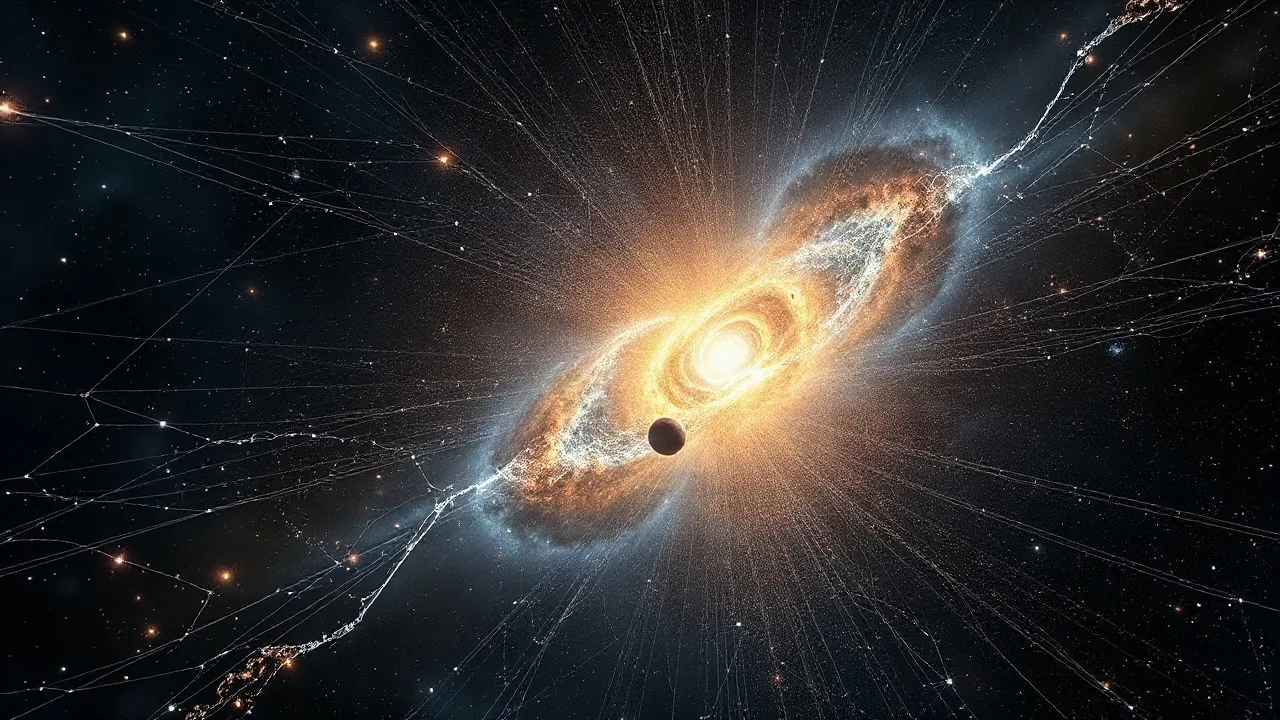
Scientists have unveiled Lumina, a groundbreaking supercomputer simulation that provides an unprecedentedly detailed view of the universe's first two billion years. This massive simulation meticulously recreates the evolution of the cosmic web, the vast network of gas and dark matter that structures the cosmos, and captures the emergence of the first stars and galaxies.
The Lumina simulation, developed by a team of astrophysicists, pushes the boundaries of computational power by modeling over 50 trillion particles across a volume of 250 million light-years. Previous simulations, while valuable, were limited in scale or resolution, preventing scientists from observing the intricate early development of cosmic structures in such clarity. Lumina allows researchers to witness the universe transform from a largely uniform state to one filled with nascent galaxies and the foundational cosmic web.
Visualizing the Universe's Infancy
One of the key achievements of Lumina is its ability to visualize the 'cosmic web' in its infancy. This intricate structure, resembling a giant, cosmic spiderweb, is composed of filaments of dark matter and gas, with galaxies forming at their intersections. The simulation offers a dynamic and detailed look at how this structure formed and evolved during the universe's earliest epochs, a period previously difficult to study directly due to its extreme distance and the faintness of early celestial objects.
Researchers can now observe the birth of the first stars, known as Population III stars, and their role in reionizing the universe. This process, where the opaque early universe became transparent to light, is a critical phase in cosmic history. Lumina provides visual and numerical data that can help test theories about how and when this reionization occurred, offering new insights into the transition from the 'dark ages' to the era of light.
Dr. Evelyn Reed, lead astrophysicist on the Lumina project, stated, "For the first time, we can truly 'see' the processes that shaped the universe in its earliest moments. Lumina is not just a visualization tool; it's a scientific instrument that allows us to test our fundamental understanding of cosmology." The simulation's resolution is so fine that it can track the formation of individual dark matter halos and the gas accretion within them, crucial steps for galaxy formation.
The development of Lumina required immense computational resources, leveraging the power of advanced supercomputers. The project signifies a major leap forward in our capacity to simulate cosmic phenomena, paving the way for future, even larger-scale simulations. Understanding the early universe is fundamental to comprehending the origin and evolution of everything we observe today, including our own solar system and planet.
The data generated by Lumina will be made available to the wider scientific community, enabling further research and analysis. Scientists anticipate that this rich dataset will lead to numerous discoveries and refine existing cosmological models. The simulation's ability to model such a vast period and scale means it can be used to study a wide range of phenomena, from the formation of the first black holes to the distribution of dark matter.
The insights gleaned from cosmic dawn simulations like Lumina are vital for refining theories on dark energy and dark matter, the enigmatic components that make up the vast majority of the universe. By accurately simulating the universe's formative years, scientists hope to better understand the fundamental forces at play and the ultimate fate of the cosmos. This detailed view of cosmic evolution is a testament to human ingenuity and our persistent quest to unravel the universe's deepest mysteries.