
China's Tianwen-2 Captures First Image of Asteroid Kamoʻoalewa
China's Tianwen-2 mission has released the first-ever photograph of asteroid Kamoʻoalewa, a celestial body sometimes referred to as Earth's 'quasi-moon.' The probe is now beginning its scientific exploration of the asteroid.

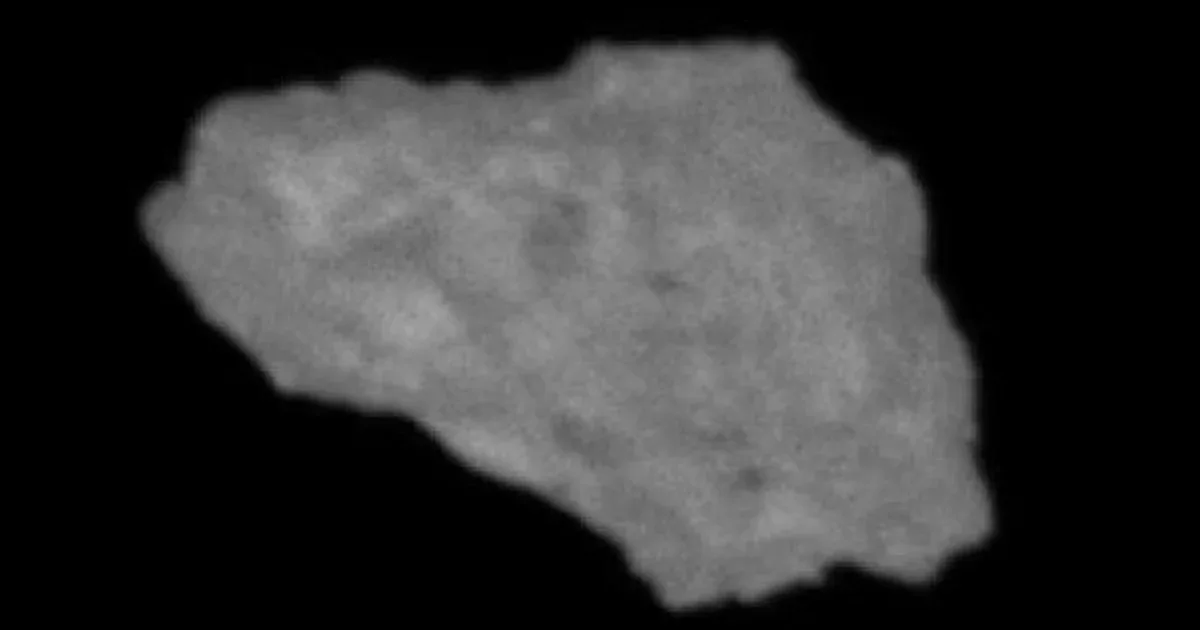
China's Tianwen-2 spacecraft has transmitted the first-ever image of asteroid Kamoʻoalewa, a unique near-Earth object that has captured the attention of scientists due to its peculiar orbit and potential status as a 'quasi-moon' to Earth. The National Space Administration of China (CNSA) released the striking photograph on July 5, 2026, showing the asteroid's surface in unprecedented detail. The Tianwen-2 probe, which launched in 2025, has now successfully reached its target and commenced its intensive scientific survey mission.
Kamoʻoalewa, discovered in 2016, orbits the Sun but its trajectory keeps it in close proximity to Earth, exhibiting a complex gravitational dance that has led some astronomers to classify it as a quasi-satellite. This makes it an exceptionally valuable target for study, offering a potentially accessible window into the early solar system. The images released by CNSA reveal a rocky, irregular surface, providing initial data for analyzing the asteroid's composition and geological history.
Scientific Objectives and Future Exploration
The primary goal of the Tianwen-2 mission is to conduct a comprehensive scientific investigation of Kamoʻoalewa, including its physical characteristics, mineralogical makeup, and origin. Scientists hope that studying this asteroid will provide crucial insights into the formation and evolution of both Earth and its neighboring celestial bodies. Following its orbital observation phase, the Tianwen-2 probe is expected to attempt a landing to collect samples. These samples, if successfully retrieved, would be returned to Earth for detailed laboratory analysis in a future mission phase.
The mission represents a significant step forward in China's ambitious space exploration program. Building on the success of the Tianwen-1 Mars mission, Tianwen-2 underscores China's growing capabilities in deep space exploration and asteroid rendezvous operations. The data gathered from Kamoʻoalewa could also inform future asteroid deflection strategies and resource utilization efforts, should humanity ever need to protect Earth from potential impacts or harness extraterrestrial resources.
Dr. Jian Li, a lead scientist on the Tianwen-2 project, stated in a press briefing, "The successful arrival at Kamoʻoalewa and the transmission of these initial images are a testament to the ingenuity and dedication of our engineering and science teams. We are on the cusp of unlocking secrets held within this unique quasi-moon, potentially rewriting our understanding of early planetary dynamics." The mission highlights the international scientific community's interest in near-Earth asteroids and their potential to serve as archives of the solar system's history.
The mission's technical challenges are considerable, involving precise navigation and maneuvering to maintain a stable orbit around a relatively small and irregularly shaped body. The probe must contend with Kamoʻoalewa's weak gravity and dynamic movement. The success of the sample collection and return phase will be a critical benchmark for future space missions targeting similar small bodies. The collected data will be shared internationally, fostering collaboration in planetary science.