
Blue Origin Advances Reusable Rocket Technology for Space Tourism
Blue Origin is accelerating development of reusable rocket systems and the New Glenn orbital vehicle, positioning itself as a major player in commercial space tourism and satellite deployment.

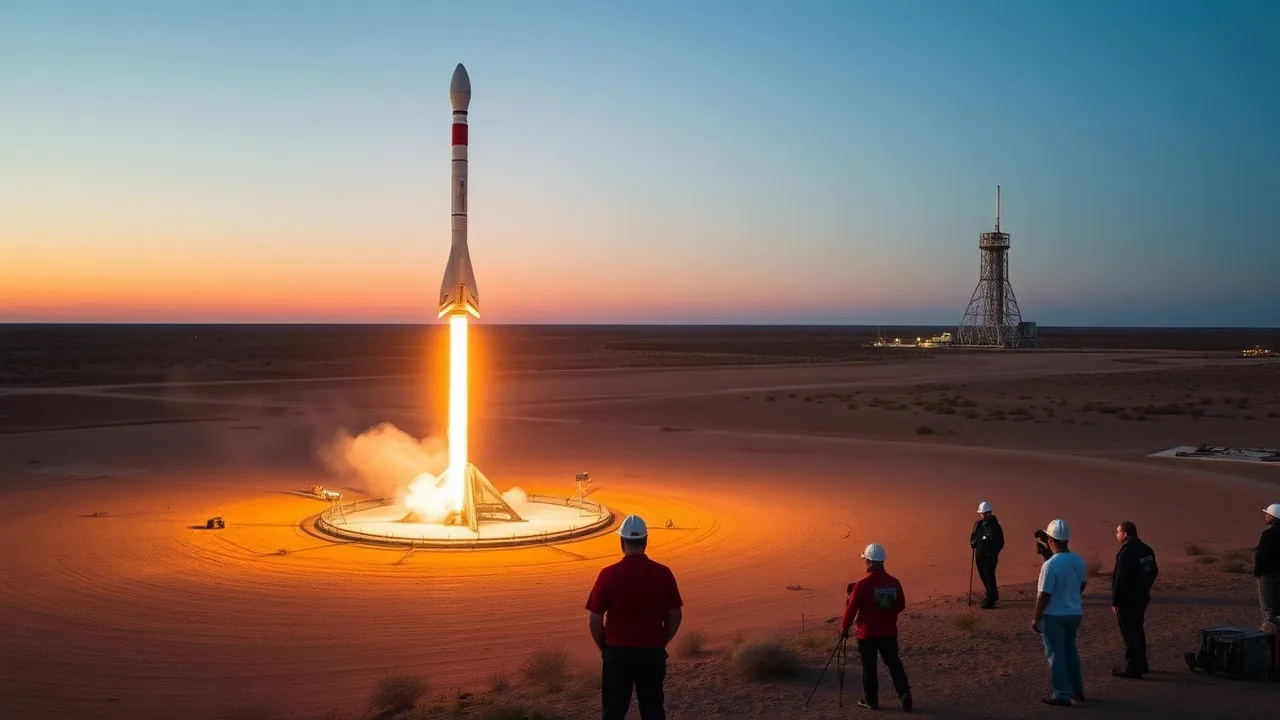
Jeff Bezos's Blue Origin fired a successful test of its New Shepard suborbital vehicle in West Texas this month, marking another stride toward frequent commercial spaceflight operations. The unmanned flight demonstrated improvements to the company's capsule abort systems and landing procedures, validating engineering refinements made over the past 18 months.
Blue Origin has become one of the most scrutinized private spaceflight operators in the United States, rivaling SpaceX and emerging competitors as the commercial space sector grows at an estimated 9.2 percent annually through 2030, according to the Federal Aviation Administration. The company operates from facilities in Van Horn, Texas, and Cape Canaveral, Florida, serving both tourism and research missions.
"We're focused on making space accessible to everyone," said a company spokesperson in a recent statement to aerospace media. "Every test flight brings us closer to routine, safe operations that will open space to researchers, tourists, and commercial payloads alike."
New Glenn and Orbital Ambitions
Beyond suborbital tourism, Blue Origin is constructing the New Glenn, a heavy-lift orbital launch vehicle designed to compete with SpaceX's Falcon Heavy and upcoming Starship variants. New Glenn will stand 322 feet tall and carry up to 100,000 pounds of payload to low Earth orbit, with the first crewed test flight targeted for 2026 or 2027.
The company has secured contracts with major satellite operators including Amazon's Project Kuiper, United Launch Alliance, and the U.S. Space Force. These commitments provide revenue certainty as Blue Origin scales manufacturing and testing.
- New Glenn's dual-core design uses BE-4 engines developed in-house
- First stage is engineered for 10+ reflights before refurbishment
- Second stage operates in vacuum and supports orbital refueling experiments
- Payload fairings are recovered and reused, reducing launch costs
Reusable reusable rockets have become the industry standard because they dramatically lower per-flight costs. A single New Glenn first stage could theoretically reduce launch expenses to $100 million or less per flight after the first dozen flights, compared to $300 million for expendable vehicles.
The Space Tourism Footprint
Blue Origin's New Shepard has completed 21 crewed flights to date, carrying 96 private citizens, scientists, and celebrities past the Karman Line at 62 miles altitude. Each 11-minute mission generates about $250,000 in revenue per passenger, establishing a profitable niche in space tourism.
The company paused New Shepard operations for nine months in 2022 after an uncrewed flight anomaly, then resumed with enhanced safety protocols. Since September 2023, it has maintained a clean operational record across all commercial missions.
Tourism flights appeal to affluent travelers and corporate clients seeking a brief weightlessness experience and suborbital views of Earth's curvature. Blue Origin markets the experience as a life-changing event rather than pure adventure, targeting executives, researchers, and professionals curious about space environments.
Competitors in this narrow segment include Virgin Galactic, which uses a spaceplane rather than rockets, and upcoming operators from Japan and the UAE. However, Blue Origin's proven reusable vehicle architecture and established operational cadence have positioned it as the market leader.
Broader Aerospace Innovation Strategy
Blue Origin is investing heavily in aerospace innovation beyond crewed missions. The company acquired Orbital Reef, a concept for an orbital commercial station, and has partnered with Boeing, Sierra Space, and others to develop independent space infrastructure by 2027 or 2028.
The BE-4 engine, produced by Blue Origin and powering United Launch Alliance's Atlas V and Vulcan rockets, has become the most flown rocket engine in the world. More than 145 BE-4s have powered orbital launches since 2015, generating steady manufacturing revenue and technical expertise.
Blue Origin also operates Blue Moon, a lunar lander program, and is developing advanced life support systems, power generation equipment, and cargo vehicles for deep space missions. These space technology initiatives position the company to participate in NASA's Artemis program and commercial lunar operations.
The company has invested over $10 billion of Bezos's personal wealth into these programs since founding in 2000. Recent fundraising and potential public offering discussions suggest investor confidence in the commercial space sector's trajectory and Blue Origin's technical achievements.
Regulatory oversight remains a key factor. The FAA oversees all commercial spaceflight licenses, issuing experimental permits for test flights and commercial licenses for routine operations. Blue Origin holds licenses for both New Shepard and emerging orbital vehicles, demonstrating compliance with federal safety and range safety standards.
As competition intensifies and launch costs decline, New Glenn represents Blue Origin's bid to dominate the heavy-lift market. Success depends on manufacturing discipline, on-time delivery, and sustained customer contracts. The next 24 months will prove whether the company can transition from development to production-scale operations.