
BepiColombo Nears Mercury Orbit After 8-Year European Space Journey
Europe's BepiColombo mission is entering its final phase after an eight-year voyage to Mercury. The spacecraft recently shed its propulsion module and is set to enter orbit in November 2026.

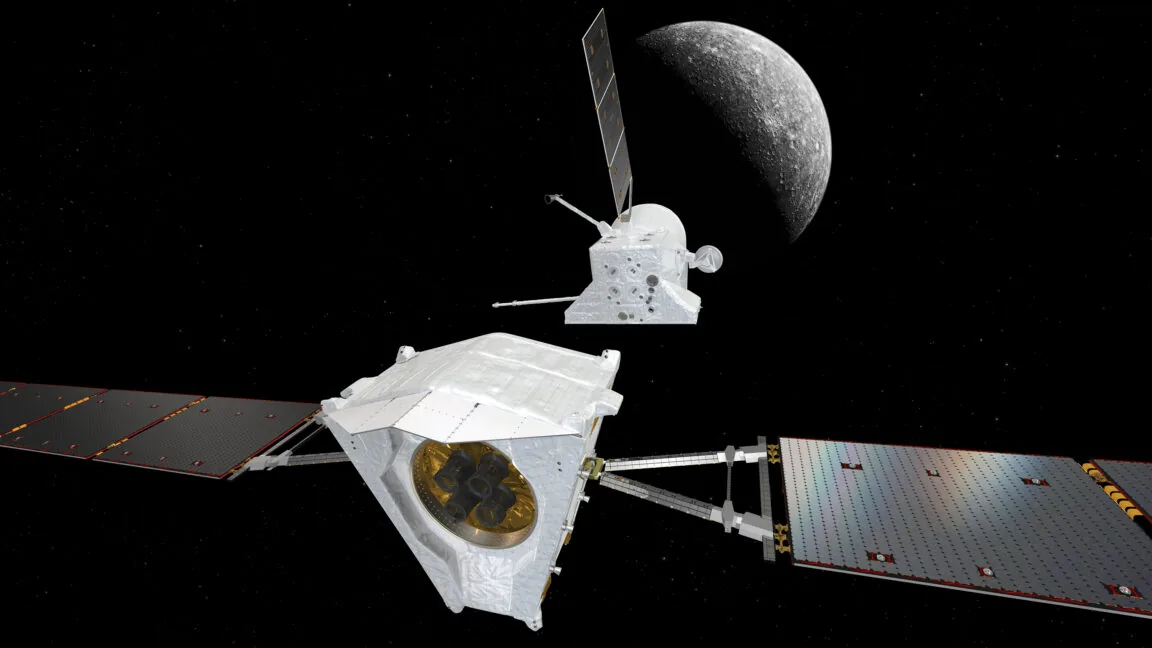
After an eight-year journey across the solar system, Europe's ambitious BepiColombo mission is on the cusp of entering orbit around Mercury. The complex robotic spacecraft, a joint endeavor between the European Space Agency (ESA) and Japan, successfully jettisoned its Mercury Transfer Module this week, a critical step as it navigates the final months of its interplanetary voyage. This maneuver marks a significant milestone in the nearly $2 billion mission's quest to unravel the mysteries of the solar system's innermost planet.
Launched in 2018, BepiColombo has employed a sophisticated combination of plasma propulsion and a series of nine gravity-assist flybys of Earth, Venus, and Mercury itself. These maneuvers have meticulously altered the spacecraft's velocity, guiding it toward its ultimate destination. The goal is to reach Mercury with precisely the right speed for the planet's gravity to capture it into a stable orbit. This intricate orbital dance requires far more energy than reaching a planet like Pluto, underscoring the challenge of approaching the Sun.
A Punishing Environment Pushed Technologies to the Limit
The separation of the Mercury Transfer Module occurred approximately 39 million miles (63 million kilometers) from the Sun, a region characterized by extreme temperatures and intense solar radiation. According to Ignacio Tanco, head of inner Solar System mission operations at ESA, this phase presented a challenge "equivalent to launching a new spacecraft," carrying "considerable risk" of technical failures. The transfer module, built by ESA, provided power and propulsion throughout the eight-year cruise. Now that it's no longer needed, the remaining European Mercury Planetary Orbiter and the Japanese Mercury Magnetospheric Orbiter (Mio) must independently manage power generation, propulsion, pointing, and thermal control – a crucial concern so close to the Sun.
"This is something that we will only see after separation if it has worked, and we will be using several new sensors and mechanisms as part of the attitude control system," Tanco stated. The separation also frees up the spacecraft's instruments, including its primary cameras, which were previously obscured by the transfer module during the journey. "It will be only upon release of the transfer module that these instruments will see first light," Tanco added.
Early telemetry data confirms the successful separation. The Mercury Planetary Orbiter's solar arrays are now generating power, providing vital energy after being shielded from direct sunlight during the cruise phase. "We have confirmation that the power margins on the spacecraft are positive, that the solar arrays are recharging the batteries that were discharged during the separation. This is all excellent news," reported Elsa Montagnon, BepiColombo's spacecraft operations manager at ESA.
The path to Mercury hasn't been without its hurdles. In 2024, BepiColombo's ion thrusters experienced partial power loss, prompting engineers to extend the mission's cruise phase by a year to compensate for the reduced thrust. Despite these challenges, the mission has traveled over 6 billion miles (10 billion kilometers) from Earth and is now scheduled to enter orbit around Mercury on November 21, 2026.
"Mercury is a challenging destination. It’s very difficult to reach. It’s very difficult to operate at because of the extreme environment so close to the Sun," explained Santa Martinez, ESA's mission manager for BepiColombo. "But what makes this mission really unique is that for the first time in space exploration, we are bringing two spacecraft to the vicinity of the planet, and we are going to put them in orbit around this mysterious body. This is going to bring to humanity and to the scientific community unprecedented views of the Mercury planet, and it’s going to open a new chapter in our understanding of the Solar System."
BepiColombo is named in honor of Italian mathematician Giuseppe "Bepi" Colombo, who was instrumental in designing gravity-assist trajectories for early solar system missions. Unlike NASA's MESSENGER spacecraft, which orbited Mercury from 2011 to 2015, BepiColombo comprises two distinct orbiters: the European Mercury Planetary Orbiter and the Japanese Mercury Magnetospheric Orbiter. These two spacecraft will eventually separate from each other in December, after achieving their initial orbit. Routine scientific observations are slated to commence in April 2027. "Having two spacecraft there is groundbreaking," said Geraint Jones, ESA's project scientist for BepiColombo. "It makes an enormous difference in understanding the effects that the solar wind has on planets like Mercury, so, fundamentally, we want to learn about the origins of this planet and how it came to be like it is." Scientists hope to map the planet in high resolution and investigate questions about its composition, particularly regarding potential water ice in shadowed polar craters, and its magnetic field.