
Vertu Alphafold AI Phone: High Price, Mixed Performance for Executives
Luxury phone maker Vertu is targeting executives with its $6,880 Alphafold foldable, featuring an AI agent designed for business tasks. Early tests show mixed results, highlighting the AI's potential and limitations.

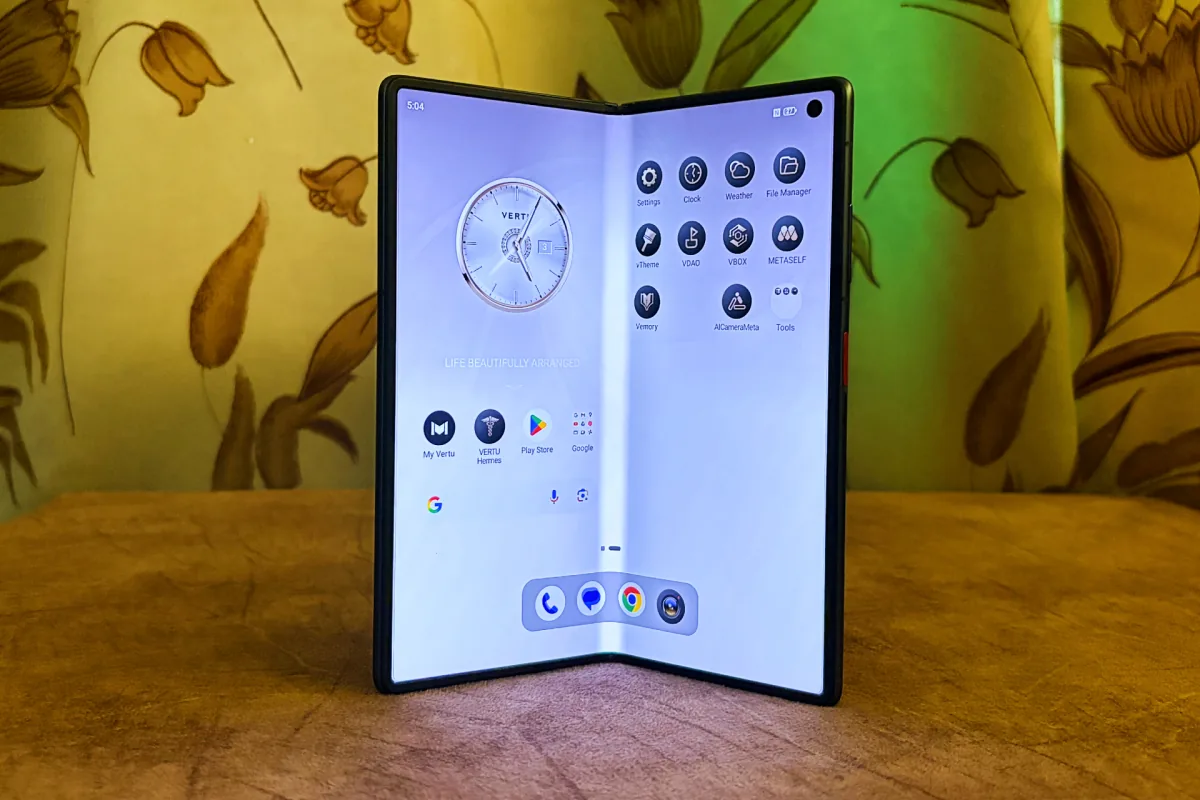
Vertu, the UK-founded luxury phone manufacturer, has launched its latest device, the Alphafold, a foldable smartphone priced at $6,880 and aimed squarely at affluent executives. Unlike mainstream smartphone manufacturers focusing on consumer-grade AI features, Vertu is betting on its Hermes Agent, an AI designed to automate complex business tasks and serve as a high-end digital assistant for its target demographic. The company claims the agent can analyze files, manage workflows across applications, and recall previous conversations, with an option to escalate requests to a human concierge.
The Alphafold itself presents a strong luxury appeal, with the review unit featuring genuine calfskin leather and titanium accents, setting it apart from the glass and synthetic finishes common in the market. While its design is intended to convey status, its 264-gram weight is notably heavier than competitors like the Samsung Galaxy Z Fold 7. Vertu acknowledges that the Alphafold leverages a hardware platform from ZTE/Nubia, a common practice for the company, while asserting its own contributions lie in the premium materials, software experience, quality control, and customer service. This partnership is not new, with previous Vertu models also noted to be based on ZTE hardware.
Performance of the Hermes AI Agent
The core of Vertu's pitch for the Alphafold lies not in its foldable hardware, but in the capabilities of its proprietary Hermes Agent. In testing, the AI was tasked with sophisticated executive functions, moving beyond simple prompt-response interactions. Scenarios included analyzing spreadsheets and contracts, planning business trips, and automating multi-step tasks. The performance was evaluated against Google's Gemini on a Samsung Galaxy Z Fold 7.
Initial software builds presented issues with file uploads and connecting to the concierge service. However, following feedback from testers, Vertu implemented server-side fixes that restored functionality. The Hermes Agent demonstrated strengths in analyzing local files and spreadsheets, an area where Gemini required manual uploads. It also showed a greater willingness to automate actions across multiple applications, completing multi-step workflows more autonomously than its competitor. This autonomy, however, sometimes led to less accurate outcomes, raising questions about the ideal balance between AI independence and user confirmation.
In one test simulating an executive en route to the airport, the Hermes Agent successfully sent a message about a delay, enabled Do Not Disturb mode, and opened navigation. However, it failed to initiate navigation automatically and set an incorrect time for a reminder. In contrast, Gemini on the Samsung device proactively asked clarifying questions about the destination and reminder preferences, ultimately yielding a more precise result despite completing fewer immediate actions.
When planning a business trip from Mumbai to Pune, the Hermes Agent reported an inability to find direct morning flights and offered to escalate the request to the concierge. It also created a calendar entry for the incorrect dates. Gemini, while also noting the lack of direct morning flights, proceeded to suggest alternative travel options, demonstrating a more proactive approach to completing the task.
Analysis of business documents yielded mixed results. The Hermes Agent could summarize quarterly financial spreadsheet data and identify specific figures. However, it struggled with recall, later failing to recognize a previously uploaded document within the same conversation. This inconsistency highlights the evolving nature of AI capabilities and the challenges in ensuring reliable performance for critical business functions.
The Alphafold's high price point is heavily justified by its luxury materials and the promise of an AI agent that can streamline an executive's day. While the Hermes Agent shows potential in automating tasks and analyzing data locally, its performance inconsistencies and occasional lack of precision in critical workflows suggest that it may not yet fully replace the nuanced judgment of a human assistant. The device represents a significant investment, and potential buyers will need to weigh the allure of luxury and cutting-edge AI against the current practical limitations of the technology.