
Male Fruit Fly Brain Mapped With All 166,000 Neurons, Aids Sex Difference Study
Scientists have completed a comprehensive map of the male fruit fly's central nervous system, detailing all 166,000 neurons. This breakthrough allows direct comparison with the female fly brain map, potentially explaining behavioral differences.

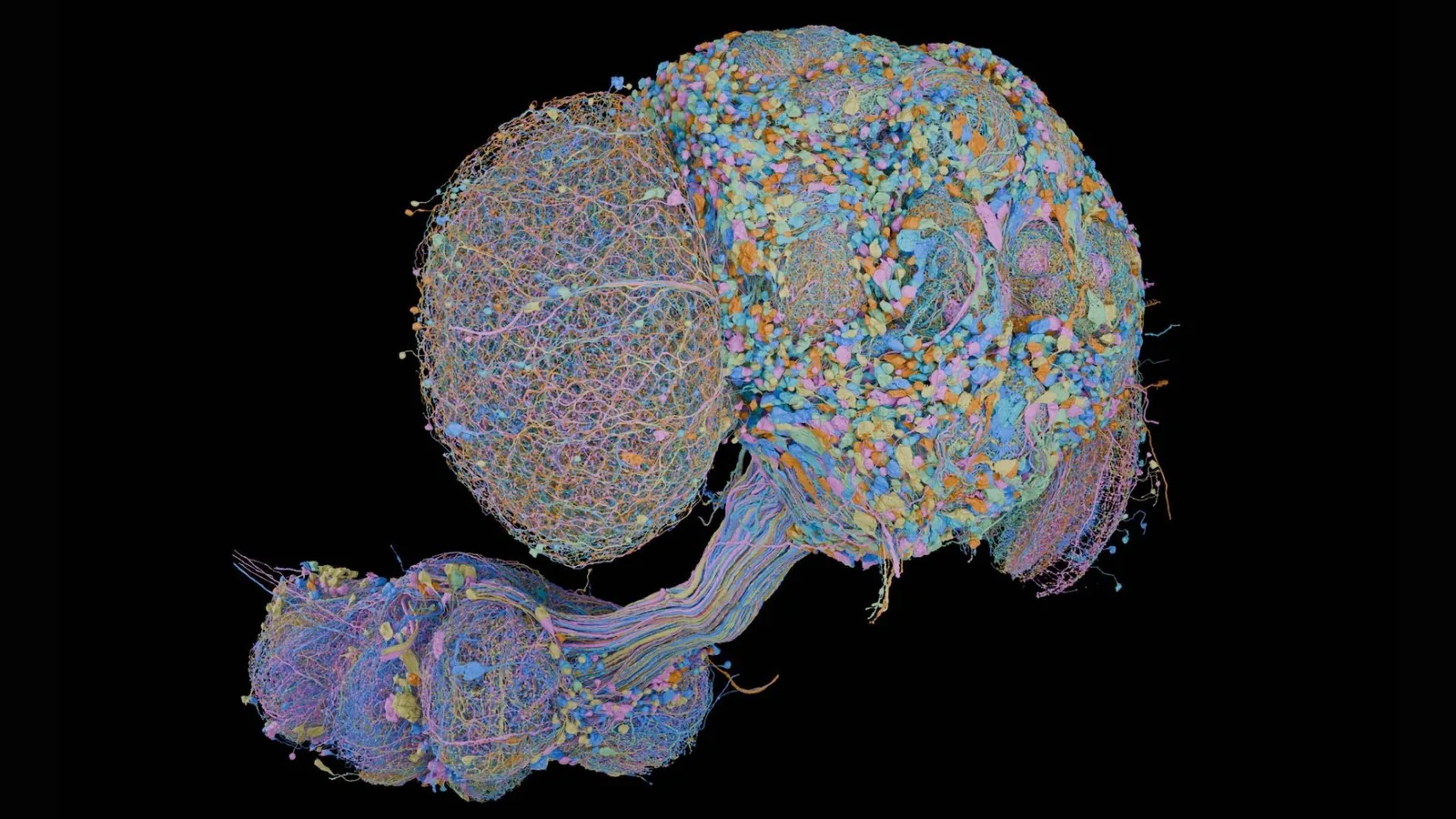
Researchers have unveiled an unprecedentedly detailed map of the male fruit fly's central nervous system, charting every one of its 166,000 neurons and the intricate connections within. This groundbreaking neuroscientific achievement, published in the journals Cell and Current Biology, offers a complete wiring diagram comparable to a similar map of the female fruit fly brain released in 2024, which detailed approximately 140,000 neurons. The availability of both maps provides scientists with the first opportunity to directly compare the neural architecture of males and females in a species exhibiting complex social behaviors, potentially unlocking the secrets behind sex-specific actions like mating rituals and aggressive encounters.
“It is the first time we can compare both sexes of an animal with complex social behavior,” said Gerry Rubin, a study co-author and head of biology at the Howard Hughes Medical Institute's Janelia Research Campus. “Male and female flies have a lot of differences in their behavior, and neuroscientists want to understand how the brain controls those behaviors. This now allows us to easily home in on the neurons that are causing those differences.” The new map, initially released as a preprint, is expected to accelerate research into the fundamental principles of neural computation and circuit design.
Mapping Complex Behaviors and Future Applications
The fruit fly, despite its minuscule brain roughly the size of a poppy seed, performs remarkably sophisticated computations with limited neuronal resources. This efficiency has long intrigued scientists, with some suggesting its architecture could inform the design of more efficient artificial intelligence systems. “The fly nervous system performs remarkably sophisticated computations with relatively few neurons and little energy, and its architecture could suggest principles for designing more efficient artificial systems,” explained Carlos Ribeiro, a principal investigator at the Champalimaud Foundation in Lisbon, Portugal, whose team contributed significantly to the brain map and led one of the associated research studies. Ribeiro also highlighted the map's role as a technical blueprint for future, more ambitious connectomics projects, including those targeting the brains of mammals like mice and eventually humans.
Beyond fundamental neuroscience, the research has immediate practical applications. The Champalimaud Foundation team, for instance, utilized the new data to investigate the neural circuits governing the fruit fly's sense of taste. Fruit flies possess taste receptors across various body parts, including their legs and mouthparts. By tracing these sensory inputs back to the brain and analyzing their connections with motor control circuits, researchers identified how these pathways influence decisions related to eating, such as determining if a food source is safe or desirable.
“This diagram of taste processing is a hypothesis-generation tool,” stated Inês de Haan Vicente, a research technician in Ribeiro's lab and co-author of the taste-related study. “Suppose you are interested in how taste controls locomotion. Now you can go to the map and ask: which sensory neurons are connected to the neurons controlling locomotion? Which intermediate neurons should I manipulate? It gives you a place to start.” This approach exemplifies how detailed neural maps can serve as powerful investigative platforms.
The new map is accompanied by three other studies exploring distinct facets of fruit fly neurobiology. One delves into visual processing, revealing that over half of the identified neuron types participate in interpreting visual information. Another study specifically examines sex-based differences, pinpointing a neural network unique to the male brain that appears to orchestrate behaviors such as courtship and aggression—for example, males tend to lunge, while females may headbutt. While some circuits are sex-specific, the research indicates that fundamental sensation and movement circuits are largely shared, though signal routing within these shared pathways can differ between sexes. Future investigations will focus on deciphering the functional consequences of these sex-specific routing differences, aiming to deepen our understanding of the biological underpinnings of behavior in both flies and, by extension, other species.