
Great Apes Use Touch to Ease Tension Before Stress, Study Finds
New research reveals that great apes like chimpanzees and bonobos use physical contact, including hugs and kisses, to build trust and de-escalate tension before stressful events, such as competition over food.

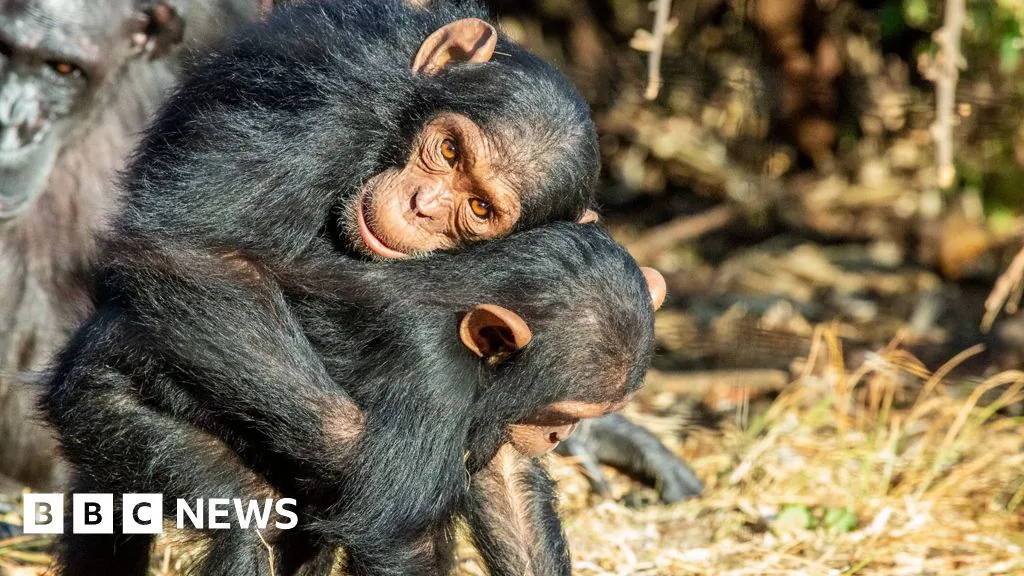
Researchers have discovered that great apes, including chimpanzees and bonobos, engage in physical contact such as touching, embracing, and kissing as a way to foster trust and alleviate stress before potentially conflict-ridden situations. The study, conducted by scientists at Durham University, observed the behavior of these primates in sanctuaries within the Democratic Republic of Congo and Zambia.
The findings suggest that these displays of affection are not random but serve as a deliberate strategy to prepare for and manage tension. Specifically, the apes were monitored in the crucial five minutes leading up to the distribution of food, a time known to incite competition. Individuals who participated in pre-conflict touching and hugging were more inclined to share food access and dine cooperatively.
Professor Zanna Clay, a lead researcher on the project, described the behavior as a "rallying cry" before stressful moments, drawing a parallel to a sports team huddling before a significant game. "Before stressful events, they come together, they reassure each other, they touch each other, they hug each other," Professor Clay stated. She further elaborated that this collective action signifies a "we" mentality over an "I" perspective, emphasizing group cohesion.
Evolutionary Roots of Social Affection
The study also identified instances of "reassurance trains," where multiple apes would embrace each other sequentially, indicating a widespread social mechanism for tension management. Comparing the behaviors of bonobos and chimpanzees, the two species most closely related to humans, offers significant insights into the evolutionary underpinnings of social interaction. "Comparing bonobos and chimpanzees - our two closest relatives - offers fascinating insight into the evolutionary roots of social behaviour and how they, and we, manage tension, competition and cooperation," explained Dr. Jake Brooker, another researcher on the team. He highlighted that social touch is among the most ancient forms of communication, potentially predating verbal language.
The research posits that the use of touch to build trust and encourage cooperation might extend back at least seven million years. This timeline predates the evolutionary split of humans, chimpanzees, and bonobos from a common ancestor. This evolutionary link suggests that familiar human social gestures, like a football huddle, a comforting embrace for a teammate, or a supportive pat on the shoulder before a challenging event, could be rooted in a primal social toolkit developed millions of years ago by our distant ape relatives.
The implications of this study extend beyond primate behavior, offering a new perspective on human social dynamics and the fundamental role of physical contact in mitigating conflict and fostering solidarity. Understanding these ancient mechanisms can provide valuable insights into contemporary human social strategies for managing stress and promoting community cohesion in an increasingly complex world.