
AI Tools Transform White House Litigation Strategy
Federal courts and executive legal teams are deploying artificial intelligence to manage complex White House East Wing litigation, raising questions about transparency and the role of automated systems in government lawsuits.

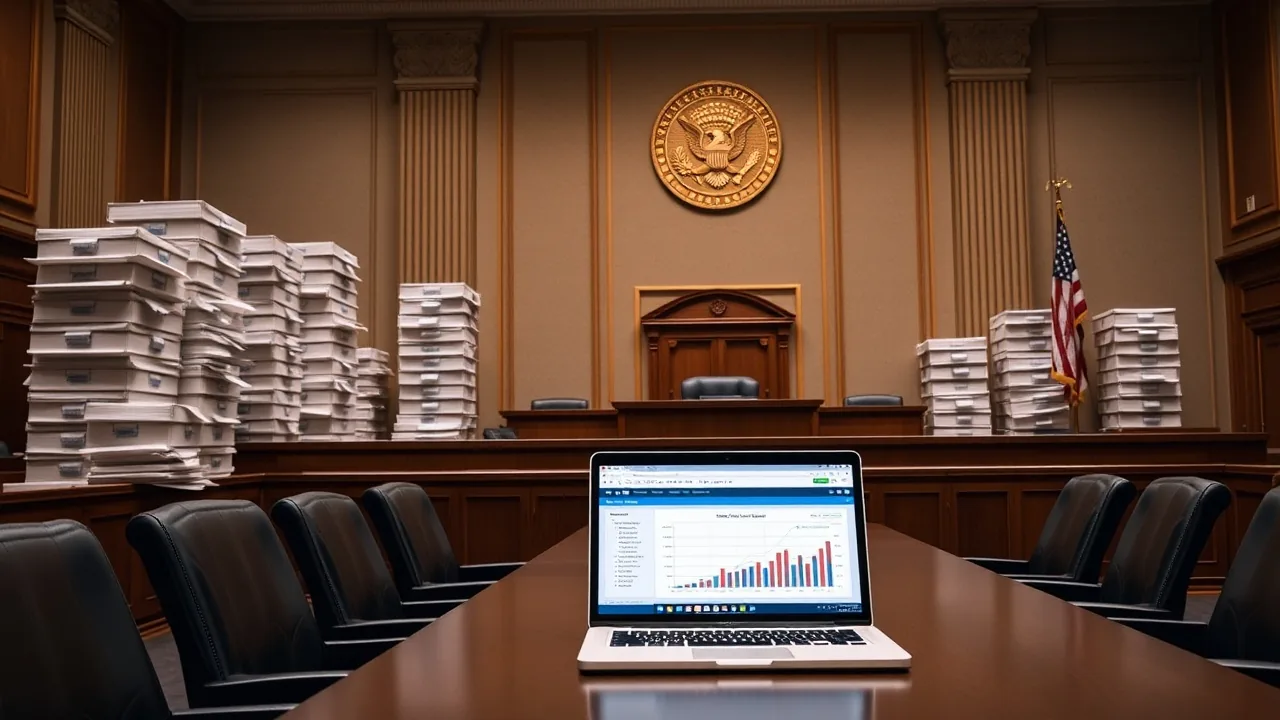
The White House Counsel's Office deployed machine learning document review tools in March 2026 to manage discovery obligations in three concurrent litigation matters tied to East Wing personnel and policy decisions, according to sources familiar with the filings. The move marks an accelerating trend in how federal government agencies handle high-stakes litigation involving sensitive executive branch records.
The cases involve requests for internal communications, policy memos, and personnel files spanning 2024 through early 2026. Traditional manual review of such volumes would require months of work by paralegal teams. Instead, the Counsel's Office contracted with a legal technology vendor to use natural language processing algorithms trained on federal discovery standards and attorney-review protocols.
How AI Is Reshaping Government Legal Processes
Government legal tech adoption has accelerated since 2024, but deployment in White House litigation remained rare until this year. The tools being used serve two primary functions: identifying potentially privileged documents and flagging materials relevant to specific legal questions without human review of every page.
"Machine learning systems can process 100,000 documents in days, catching patterns human reviewers might miss under time pressure," said Dr. Patricia Chen, director of the Government Accountability Institute at Georgetown Law Center. "But when the litigation involves White House operations, questions about who validated the algorithm and what assumptions it encoded become paramount."
Federal judges have begun asking harder questions about artificial intelligence use in discovery. In a May 2026 order in a separate Department of Defense case, Judge Sandra Morales of the U.S. District Court for the Eastern District of Virginia required the government to produce detailed technical documentation about the AI system's training data, error rates, and validation testing before accepting its output as legally sufficient.
The East Wing cases have not yet reached similar judicial scrutiny, but discovery disputes are expected in the coming months. Opposing counsel for the plaintiffs have already demanded transparency reports on the AI systems in use.
Transparency and Legal Precedent Under Pressure
The intersection of government transparency and automated decision-making is forcing federal courts to confront novel procedural questions. Discovery rules assume human judgment at key decision points; data analysis tools compress or eliminate those judgment moments entirely.
A core tension exists: governments want efficiency, but litigation opponents and judges want assurance that no documents are hidden by algorithmic error. In the East Wing cases, the White House Counsel's Office has volunteered to produce an audit log showing which documents the algorithm flagged as privileged and why, though legal scholars debate whether that log itself becomes discoverable.
"This is uncharted territory," said Michael Torres, a partner at Covington & Burling and former DOJ Civil Division attorney. "If an AI system incorrectly withholds a document based on its classification model, is that negligence, a discovery violation, or just the cost of using new technology? Courts haven't answered that."
The White House Office of Management and Budget issued non-binding guidance in January 2026 encouraging agencies to use vetted AI tools in discovery while maintaining audit trails. No agency is required to comply, and enforcement mechanisms remain undefined.
Implications for Future Government Litigation
If the East Wing cases resolve without major AI-related discovery sanctions, other agencies are likely to follow the Counsel's Office lead. The Defense Department, State Department, and Department of Justice all maintain large litigation dockets and face similar discovery burdens. Cost savings and speed make AI adoption attractive, particularly in high-volume civil cases.
However, three risks remain unresolved by May 2026. First, algorithmic bias in document classification could systematically favor one party over another, embedding government advantage into the discovery process. Second, opacity around training data and validation testing could allow flawed systems to operate without external scrutiny. Third, judicial acceptance of AI-assisted discovery could undermine meaningful adversarial testing if opposing counsel lack sufficient technical expertise to challenge algorithmic decisions.
Legal technology vendors are developing tools marketed specifically to government clients, including features designed to address judicial skepticism. One firm, LegalMind AI, released a product in April 2026 that generates human-readable explanations for every classification decision, attempting to make algorithmic logic transparent to judges and opposing counsel.
The outcome of the East Wing cases will likely set precedent for how federal courts evaluate AI use in government litigation. If judges accept the tools with minimal scrutiny, adoption will accelerate. If courts impose strict transparency and validation requirements, government agencies may move more slowly, preserving traditional document review practices for sensitive cases.
For now, the White House legal team is betting that demonstrating good-faith effort at transparency and accuracy will satisfy both opposing counsel and eventual judicial review. Whether that bet pays off will define the next chapter of AI in American government litigation.