
Xenon Detector Anomaly Hints at Dark Matter Particle Discovery
An unexplained energy signature detected in a deep underground experiment could be the most compelling evidence yet for a dark matter particle. Researchers are cautious but excited by the anomaly.

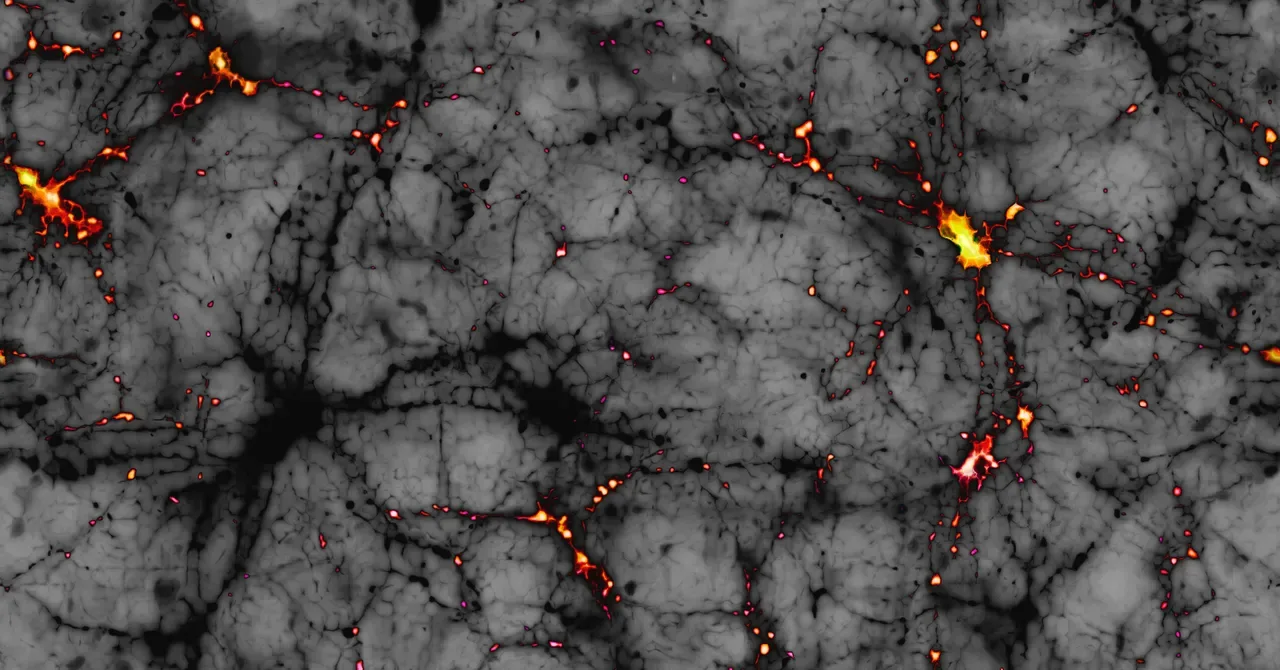
An unusual energy signature detected deep underground in a South Dakota gold mine may represent the most significant physical evidence to date for dark matter, scientists announced. The anomaly occurred in a tank filled with liquid xenon at the Sanford Underground Research Facility (SURF), where a collision seemingly struck the nucleus of an atom, leaving an unexplained recoil. Dark matter, an invisible substance comprising about 85 percent of the universe's matter, has long eluded direct detection, its existence inferred primarily through gravitational effects on visible cosmic structures.
The elusive nature of dark matter poses one of astrophysics' most profound mysteries. Its composition remains unknown, with theories ranging from a single particle type to complex interactions. The leading hypothesis for its constituent particles, known as WIMPs (Weakly Interacting Massive Particles), posits particles with mass that interact minimally with conventional matter. Billions of these hypothetical particles are thought to constantly pass through Earth undetected, but an occasional interaction with an atomic nucleus could produce a detectable signal. This is precisely what researchers with the Xenon Collaboration experiment believe they may have observed.
Unusual Signal Recorded in Deep Underground Detector
During 220 days of observations conducted between 2023 and 2024, the SURF experiment recorded a single instance where a xenon nucleus recoiled after receiving energy. While the event's statistical significance is too low for a definitive discovery, specific theoretical models suggest that such a reaction could be consistent with a WIMP interaction. Rick Gaitskell, a professor at Brown University and a lead researcher on the project, emphasized the preliminary nature of the findings. "With only one event, we don’t want to get ahead of ourselves. We are not claiming to have seen dark matter. But we have seen something interesting that we want to share with the scientific community for their input," Gaitskell stated in a press release.
The team has published their findings as a preprint, awaiting peer review, and presented the results at the 2026 TeV Particle Astrophysics Conference in Japan. This cautious approach mirrors past announcements concerning dark matter. For instance, in November 2025, Japanese astronomers reported potential signs of dark matter in the Milky Way, also advising restraint until further verification. However, even with prudence, the potential implications are significant. If this anomaly is indeed caused by dark matter, it could provide crucial data for characterizing the particle responsible. Initial calculations under WIMP models suggest the particle is roughly 200 times more massive than a proton, offering a pathway to understanding its interaction with ordinary matter.
The search for dark matter particles has driven the construction of specialized observatories in remote locations, including deep mines and beneath Antarctic ice, all designed to detect these faint signals. This latest potential breakthrough highlights the ongoing scientific endeavor to unravel the universe's fundamental components. The SURF facility, situated over a kilometer underground, offers an environment shielded from cosmic rays, minimizing background noise and maximizing sensitivity for detecting rare particle interactions.