
Webb Telescope Spots Clues: 'Little Red Dots' Could Be Black Hole Stars
The James Webb Space Telescope may have identified the nature of elusive 'little red dots' in the early universe. New data suggests these objects are supermassive black holes actively feeding and growing within dense gas clouds.

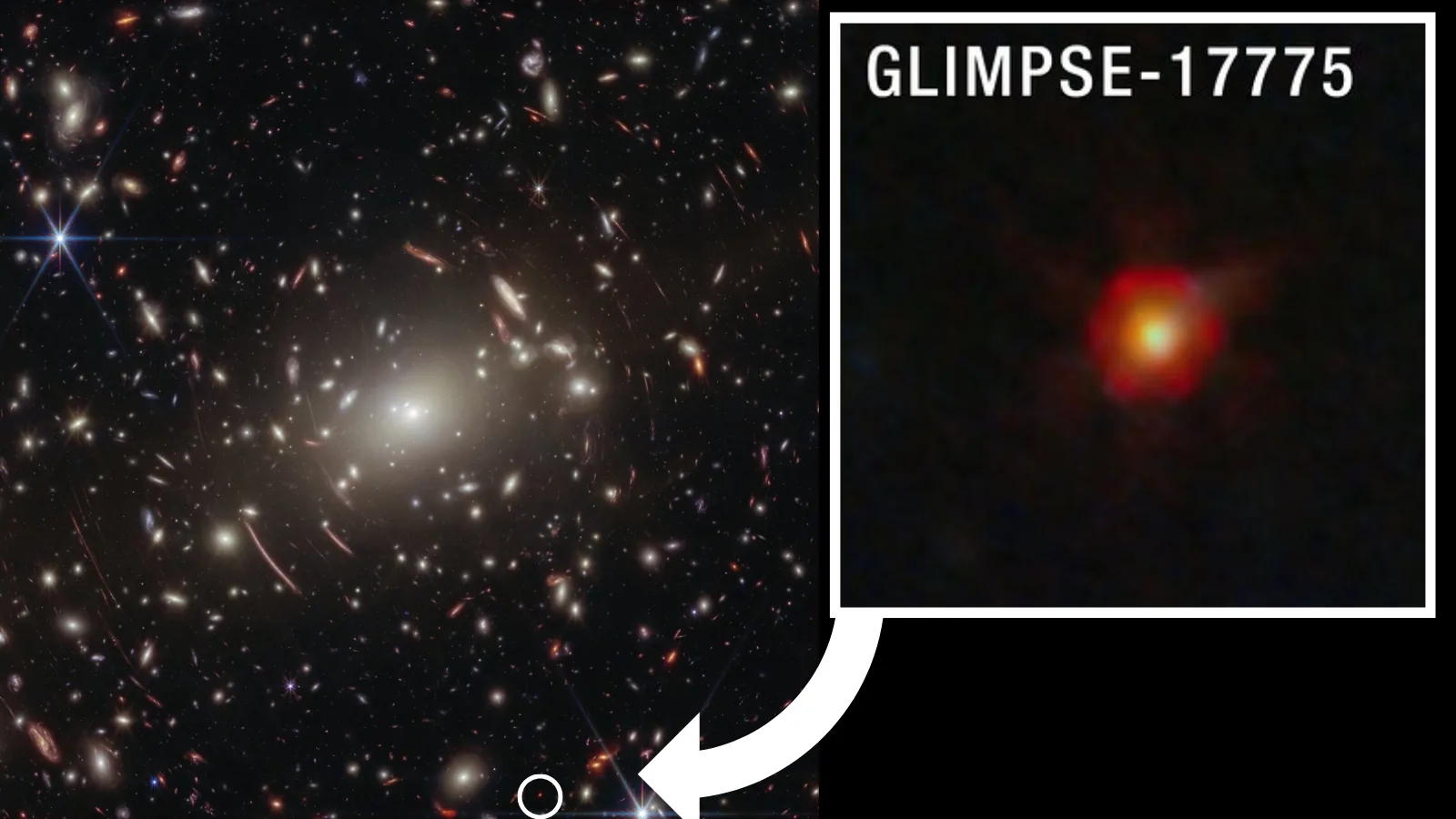
Astronomers using the powerful James Webb Space Telescope (JWST) have potentially solved a cosmic puzzle concerning mysterious objects dubbed "little red dots." These enigmatic entities, observed in the early universe, now show strong evidence of being actively growing supermassive black holes cloaked in dense gas, a phenomenon known as a black hole star. The findings, revealed through deep-sky observations, offer a significant breakthrough in understanding the universe's formative years.
The "little red dots" first came into focus in 2022 as JWST began transmitting unprecedented data from the cosmos. Their presence in large numbers approximately 600 million years after the Big Bang, only to seemingly vanish before the universe reached 2 billion years old, challenged existing cosmological models. Several theories attempted to explain their existence and subsequent disappearance, with the black hole star concept emerging as a leading contender. This theory posits that their intense, brief growth phases lead to them burning out, or that the supermassive black holes at their centers eventually clear away surrounding gas and dust, altering their observable characteristics.
Until recently, direct observational proof for the black hole star hypothesis remained elusive. However, JWST's detailed imaging of an object designated GLIMPSE-17775, observed 1.8 billion years after the Big Bang, provides compelling evidence. This observation was made during a study of the galaxy cluster Abell S1063, which acts as a gravitational lens. The captured spectrum is the deepest ever recorded for a "little red dot," containing multiple indicators that point towards it being a black hole star, according to the research team.
Cosmic Puzzle Pieces Align with Gravitational Lensing
Vasily Kokorev from the University of Texas at Austin, a lead researcher on the project, stated, "I think part of the scientific community is converging on a singular picture — that little red dots can be explained by black hole star models. But none of the previous little red dots have all of the pieces of evidence in the same place." He added, "With GLIMPSE-17775 we can test these models because of how deep and amazing this source's spectrum is."
The JWST's observation of GLIMPSE-17775 occurred while the telescope was searching for the theorized first generation of stars, known as Population III stars, within the galaxies of Abell S1063. This galaxy cluster is a remarkable example of gravitational lensing, a phenomenon predicted by Albert Einstein's theory of general relativity. The immense gravity of Abell S1063 warps the fabric of spacetime, bending light from objects behind it and magnifying their appearance. This lensing effect allowed astronomers to study GLIMPSE-17775 in unprecedented detail, effectively transforming 30 hours of observation into a much richer dataset.
"When we saw the spectrum for the first time, it was like having all the pieces of a puzzle scattered on the floor," Kokorev described. "We picked up each piece of the puzzle, measured the lines, and started combining the different pieces into a mosaic. Maybe a few pieces looked like nothing at first, but then a couple of them came together, and we realized that there was something there."
The analysis of the JWST data revealed several key pieces of evidence. Emission lines from elements within GLIMPSE-17775 did not align with expectations for a simple rotating gas cloud. Instead, they strongly suggested the scattering of electrons, a characteristic signature of radiation sources enveloped by a vast, dense cocoon of gas. Signs of fluorescence and helium-absorbing radiation further supported the presence of such a dense shroud. Additionally, the detection of spectral lines from iron, termed an "iron forest" by the team, is consistent with the high-energy output expected from a rapidly accreting supermassive black hole, the defining feature of a black hole star. This dense gas envelope would also explain why "little red dots" are typically faint in X-rays, as the cocoon would absorb such high-energy radiation.
While the evidence is strong, the team noted a missing feature in GLIMPSE-17775's spectrum: a characteristic dip known as a "Balmer Break," commonly observed in other "little red dots." They hypothesize that this feature might be less pronounced because GLIMPSE-17775 is surrounded by a more substantial host galaxy. The team believes their findings fill a crucial gap in the understanding of these early cosmic objects and their role in the evolving universe.
"Everything fits, nothing is broken, and I think that makes the puzzle that is our universe even better," Kokorev concluded. He expressed eagerness to continue the investigation, stating, "Looking ahead, I’m eager to dive deeper and learn about what is powering the central engines of little red dots. While we think it’s a black hole, there are some other interesting theories being proposed, which is exciting. Maybe in a year or two, we’ll have the final answer to what powers these sources." The ongoing study of these objects promises further insights into the universe's earliest epochs.