
Venus and Jupiter Align: Where to See the Planetary "Kiss" Tonight
Venus and Jupiter will appear incredibly close in the night sky tonight, offering a rare visual treat. Look west shortly after sunset to witness this stunning planetary conjunction.

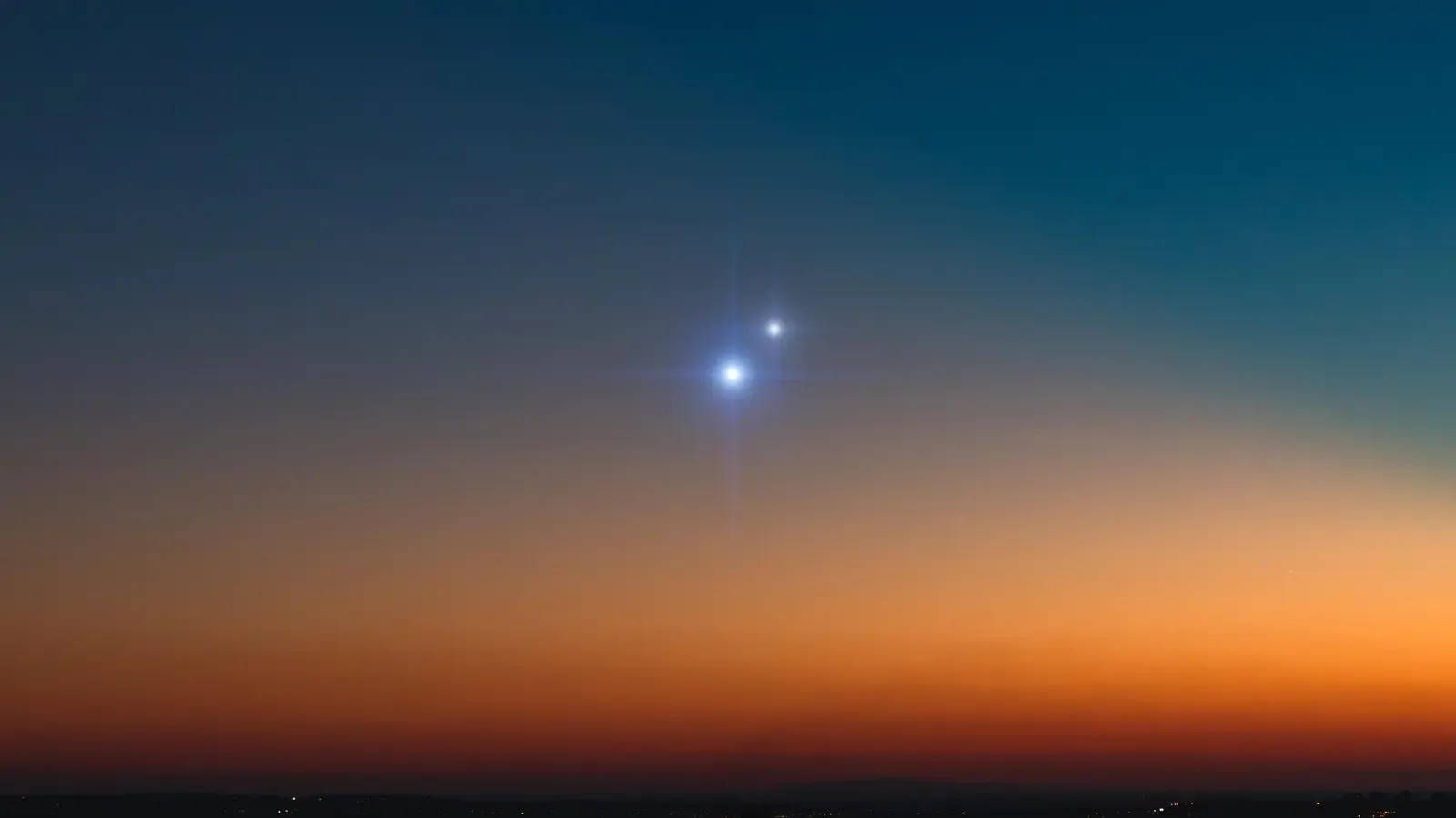
Stargazers have a celestial treat in store tonight as the two brightest planets, Venus and Jupiter, will appear to 'kiss' in the western sky shortly after sunset. This rare planetary conjunction will bring the planets within 1.6 degrees of each other, a separation no wider than a thumb held at arm's length. The spectacle will be visible for a couple of hours after the sun dips below the horizon, offering a prime viewing opportunity for naked-eye observers.
While the celestial bodies will seem intimately close, it's important to remember this is an illusion of perspective. Venus is currently approximately 110 million miles from Earth, while Jupiter is a much more distant 560 million miles away. Their apparent closeness is due to their orbital paths aligning with Earth's line of sight, a phenomenon known as a conjunction. These events occur because planets orbit the sun on roughly the same plane, leading to occasional visual gatherings from our vantage point.
A Glimpse into Future Celestial Events
Beyond tonight's planetary embrace, the astronomical community is buzzing about another significant upcoming event: the eruption of T Coronae Borealis, also known as the "Blaze Star." This recurrent nova, located about 3,000 light-years away, erupts approximately every 80 years. The last observed outbursts were in 1866 and 1946. Scientists have pinpointed June 25, 2026, as a statistically probable date for its next dramatic brightening, although a window in February 2027 remains a possibility. This prediction is based on unusual dimming patterns observed in 2023 and 2024, mirroring pre-eruption behavior seen before the 1946 event.
T Coronae Borealis is a binary star system, comprising a red giant and a white dwarf. The red giant sheds material onto the white dwarf, which builds up until a thermonuclear reaction triggers a nova explosion on the white dwarf's surface. Unlike a supernova, both stars endure this process. When the eruption occurs, the star system is expected to surge in brightness from its usual magnitude 10 to around magnitude +2 or +3, making it clearly visible to the naked eye. While it won't outshine the brightest stars, its sudden appearance in what normally appears as an empty patch of sky promises to be one of the decade's most extraordinary astronomical sights. This upcoming astronomy event serves as a powerful reminder of the dynamic and often surprising nature of the cosmos.
Tonight's alignment of Venus and Jupiter provides an accessible and beautiful introduction to the wonders of the night sky. It’s a chance for anyone, anywhere, to connect with the vastness of space and appreciate the celestial mechanics that govern our universe. While the 'kiss' is fleeting, the memory of witnessing such a planetary dance can be truly captivating. Don't miss this opportunity to look west after sunset and marvel at two of our solar system's most prominent bodies sharing the same patch of sky.