
World's Timekeepers to Vote on Ending Leap Seconds
Global timekeepers are set to vote this week on abolishing the "leap second," a measure used since 1972 to keep Coordinated Universal Time (UTC) in sync with solar time. The proposal aims to simplify timekeeping and prevent future disruptions.

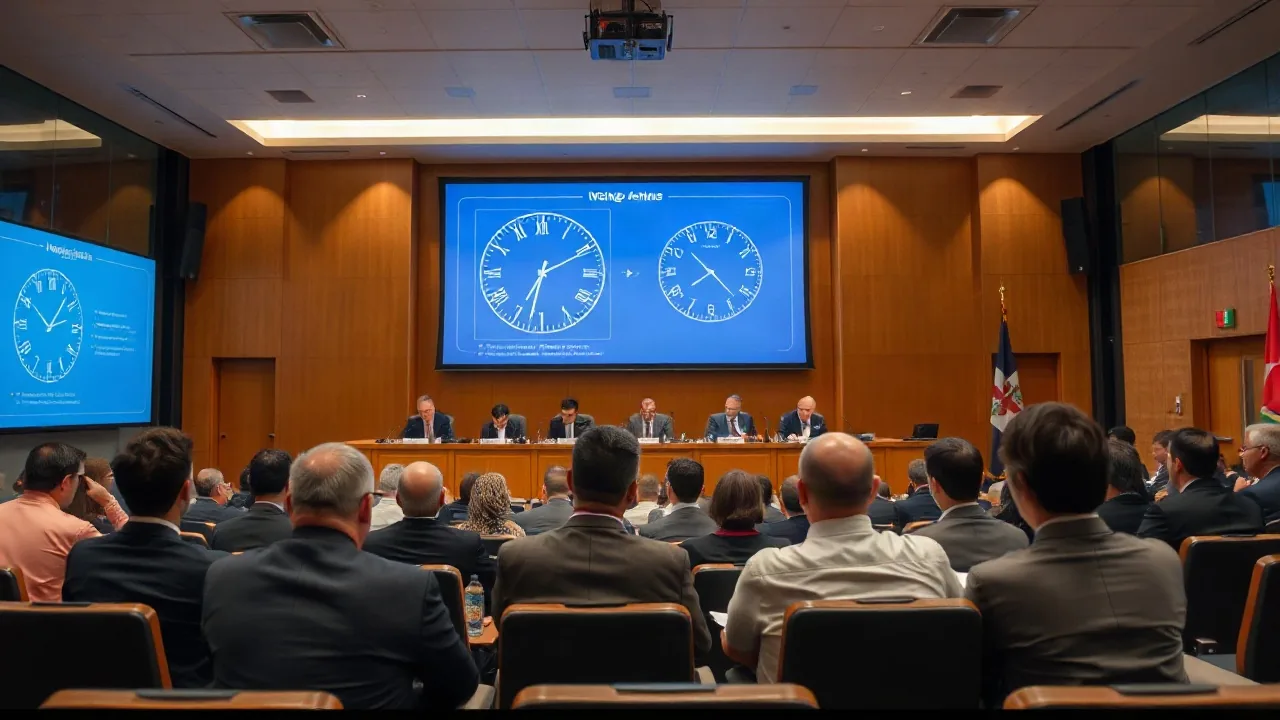
Representatives from over 80 countries are gathering in Paris this week to vote on a proposal that could permanently end the practice of adding "leap seconds" to the world's atomic clocks. The decision, if approved, would eliminate the need for these occasional one-second adjustments, which have been used since 1972 to keep Coordinated Universal Time (UTC) synchronized with solar time, known as UT1. The vote is taking place at the General Conference on Weights and Measures (CGPM), the ultimate authority on international standards for measurement.
The concept of the leap second was introduced to account for the slight slowing of Earth's rotation, which causes solar time to drift away from the more stable atomic time. While seemingly minor, this drift can accumulate, and over decades, the difference between UTC and UT1 has grown. Leap seconds are added, usually on June 30 or December 31, when the difference between UTC and UT1 approaches 0.9 seconds. This mechanism has been employed 27 times since its inception in 1972.
The Case for Abolition
Proponents of ending the leap second argue that the adjustments are becoming increasingly complex and disruptive to modern digital systems. Many computer systems, particularly those involved in navigation, finance, and telecommunications, are not designed to handle these abrupt one-second insertions. Such systems can experience errors, outages, or require expensive recalibrations to accommodate the extra second. This has led to a growing consensus among scientists and engineers that the potential for failure outweighs the benefits of maintaining the precise synchronization with astronomical time.
Dr. Demetrios Matsakis, a scientist at the U.S. Naval Observatory and a long-time advocate for abolishing leap seconds, explained the challenges. "The leap second is a relic of a time when timekeeping was simpler," he stated. "Today, our interconnected digital world relies on precise, uninterrupted time signals. The risk of a leap second causing a significant failure in critical infrastructure is a growing concern." He further noted that the Earth's rotation is actually slowing down and speeding up unpredictably, making the prediction and implementation of leap seconds even more complicated.
The International Telecommunication Union (ITU), the United Nations agency responsible for global telecommunications standards, has also expressed support for discontinuing leap seconds. The ITU's recommendation is to allow UTC to drift from UT1, with the understanding that this drift would be corrected through larger, less frequent adjustments, perhaps on the order of a minute, every few centuries. This would provide a stable time scale for digital systems while ensuring that scientific observations of Earth's rotation can still be made and recorded.
The alternative proposed would involve maintaining UTC based purely on atomic time, with no leap second adjustments. The difference between this atomic time scale and solar time would be allowed to grow. While this would simplify the operation of most modern technologies, some scientists are concerned about the long-term implications for astronomy and geodesy, the study of Earth's shape and gravity field. They argue that losing the direct link between our civil time and the Earth's actual position in space could hinder scientific research.
The CGPM's decision will have far-reaching consequences for how time is measured and managed globally. If the leap second is abolished, the transition would likely take effect around 2035, allowing time for systems to adapt to the change. The vote represents a significant moment in the history of timekeeping, balancing the precision of atomic clocks with the ever-changing rhythms of our planet.