
Supermassive Black Holes Fuel Galactic Star Formation, New Study Shows
New research suggests supermassive black holes, once thought to halt star creation, may actively trigger it by forming rings of gas. This challenges previous understandings of galaxy evolution.

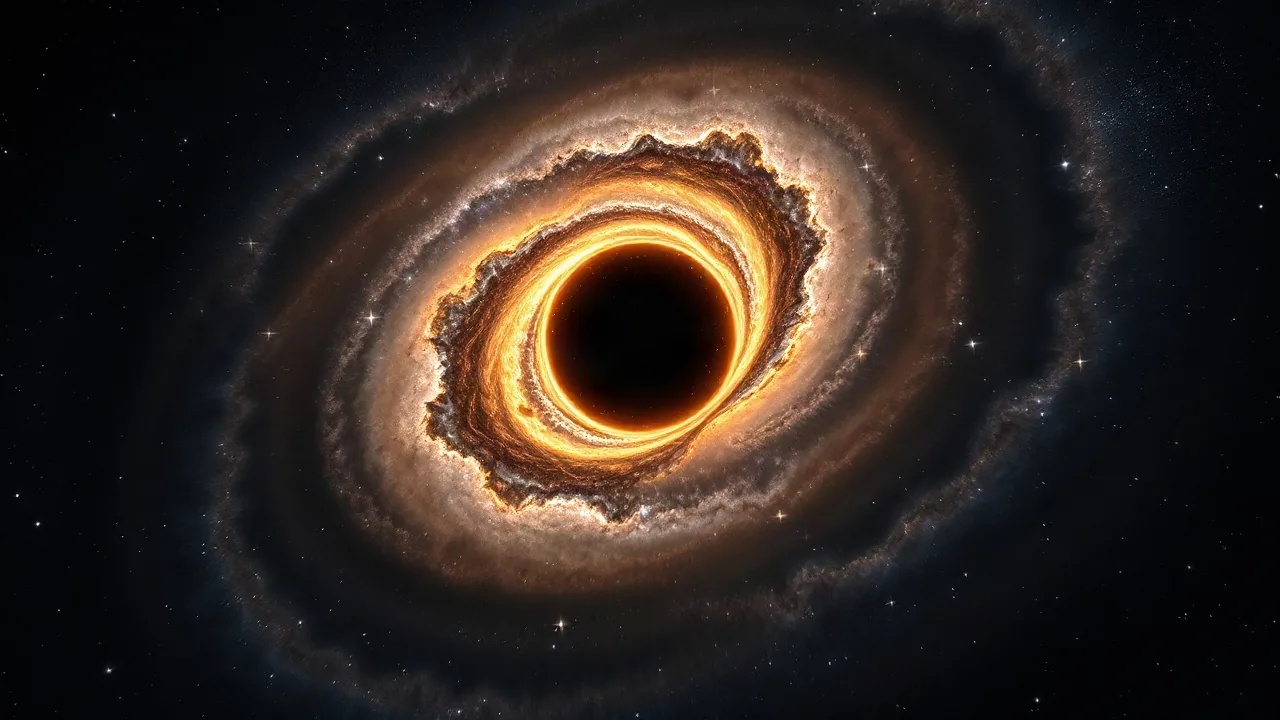
Supermassive black holes residing at the centers of galaxies are playing a more dynamic role in galactic evolution than previously understood, with new findings indicating they can actively fuel star formation. For years, astronomers believed these colossal objects, millions to billions of times the mass of our Sun, primarily acted to inhibit the birth of new stars by expelling gas. However, a recent study published in Nature Astronomy presents evidence that some active supermassive black holes may, in fact, create the very conditions necessary for star creation.
The research focused on observations of galaxies with active black holes, which are currently consuming matter and emitting powerful jets of radiation and particles. Scientists observed distinct rings of cold gas forming around these black holes, a phenomenon that contradicts earlier models. These rings, rich in molecular gas, are identified as ideal nurseries for new stars. This discovery suggests a cyclical relationship where the black hole's activity, rather than solely destroying gas, can concentrate it into structures that promote stellar genesis.
A New Perspective on Galactic Engineering
Previously, the prevailing theory was that the intense radiation and outflows from active galactic nuclei (AGN) would heat or blow away the gas needed to form stars, effectively shutting down star formation in the surrounding galaxy. This process, known as "feedback," was considered a primary mechanism for regulating galaxy growth. The new observations, however, reveal a more nuanced picture. The observed ring structures are thought to be a direct consequence of the black hole's energetic output, channeling gas into dense, cool regions conducive to collapse and subsequent star birth. This phenomenon was observed in multiple distant galaxies, suggesting it is not an isolated incident but potentially a common feature of galactic evolution.
Dr. Elena Rossi, a lead researcher on the study from the European Southern Observatory, stated, "We were surprised to see these prominent gas rings directly associated with the central black hole's activity. It challenges our long-held assumptions and opens up exciting new avenues for understanding how galaxies grow and evolve over cosmic timescales." She further explained that the precise mechanism by which the black hole's jets and winds sculpt these rings is still under investigation, but the observational evidence is compelling.
The implications of this research extend to our understanding of the universe's structure. Galaxies are not static entities but dynamic systems shaped by the interplay between their central black holes and their interstellar gas. This finding could help explain why some galaxies cease forming stars while others continue to do so, even in the presence of a supermassive black hole. The concentration of gas into these rings may be a critical, previously overlooked, step in the process of star formation and, by extension, the development of planetary systems like our own. The team plans to conduct further observations with next-generation telescopes to refine these models and explore more galaxies exhibiting similar phenomena.
Understanding this complex relationship is crucial for cosmological simulations. Current models attempting to replicate the large-scale structure of the universe often struggle to accurately portray the co-evolution of galaxies and their central black holes. If active black holes can indeed trigger star formation through these ring structures, it necessitates a revision of how these simulations account for gas dynamics and star birth rates. This could lead to more accurate predictions about the number and types of galaxies that exist throughout the cosmos, and potentially, the prevalence of habitable planets.