
Sun's Surface Reveals Breaking Waves and Magnetic Mysteries in New Detail
Scientists using the Daniel Inouye Solar Telescope have captured unprecedented images of the Sun's surface, revealing phenomena like breaking waves and magnetic field activity with striking clarity.

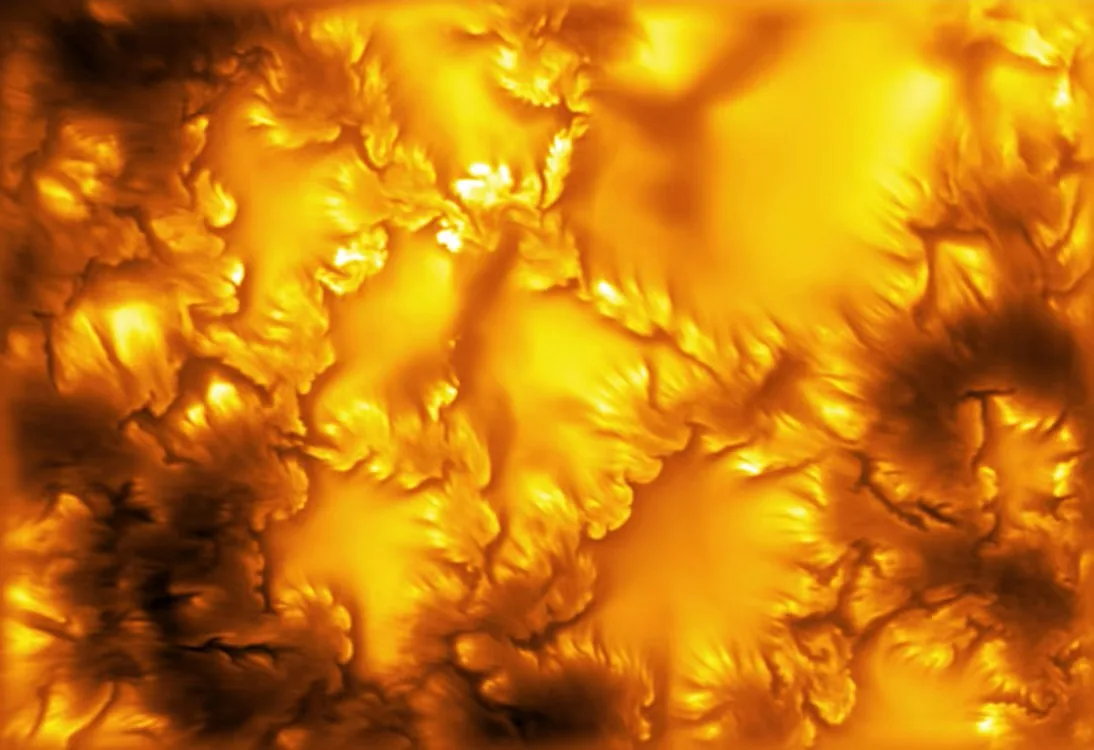
Scientists have captured the most detailed images yet of the Sun's surface, revealing foundational physics that explain the behavior of our star. Using the Daniel Inouye Solar Telescope, situated atop Haleakalā on Maui, researchers observed plasma on the Sun's surface behaving similarly to breaking waves and whirlpools found in Earth's oceans and Jupiter's atmosphere. This groundbreaking discovery, published in the journal Nature, offers significant insights into how magnetic fields are generated and dissipate on the Sun's photosphere.
The observed vortex formation on the Sun has long been a puzzle in solar physics. "For the first time, we have identified both their origin and their driving mechanism," stated lead study author Dr. David Kuridze, an assistant astronomer at the National Solar Observatory in Boulder, Colorado, in an email to CNN. The phenomenon, known as Kelvin-Helmholtz Instability, was theoretically predicted to exist in the photosphere, but seeing these structures widely spread across the surface was a considerable surprise.
This discovery has far-reaching implications for understanding solar flares and coronal mass ejections. These events, when directed towards Earth, can disrupt satellite communications, interfere with power grids, and even damage electrical equipment. The new findings could also help scientists unravel why the Sun's outer atmosphere is significantly hotter than its surface.
Understanding Solar Vortices and Magnetism
Kelvin-Helmholtz Instability arises when two fluids moving at different speeds and in different directions interact, leading to the formation of turbulent vortices. The images from the Inouye telescope provide the first direct visual evidence of this phenomenon occurring on the Sun. Dr. Kuridze explained to CNN that these solar whirlpools act as miniature engines, transferring energy and heat from the Sun's surface to its outer atmosphere. This process is partly driven by flux braiding, where the vortices twist and intertwine magnetic field lines, generating heat when these lines snap and reform.
For their research, the scientists focused the Daniel Inouye Solar Telescope on a magnetically active region adjacent to a large sunspot. The prevailing scientific view is that these small solar whirlpools play a more crucial role in the development of massive solar events than previously understood. The ultimate aim of this research is to develop the ability to interpret the formation and movement of these vortices as predictive signs of future, larger solar events that could potentially impact Earth.
The unprecedented resolution of the imagery allows for a deeper understanding of the dynamic processes occurring on the Sun. By observing these instabilities, scientists can refine models of solar activity and improve space weather forecasting. The Daniel Inouye Solar Telescope, the most powerful solar telescope on Earth, is continuously gathering data that promises to further demystify the Sun's complex magnetic field and its influence on the solar system.
The research team plans to continue monitoring these phenomena, looking for patterns and correlations that could lead to improved prediction models. Understanding the intricate interplay of plasma dynamics and magnetic fields on the Sun is critical for protecting our technological infrastructure and for advancing fundamental knowledge about stellar evolution. The observations mark a significant leap forward in solar physics, offering a clearer window into the star that sustains life on Earth.