
New Star S301 Orbits Milky Way's Black Hole Closer Than Ever
Astronomers have identified a star, dubbed S301, on an exceptionally close and fast orbit around Sagittarius A*, the Milky Way's central supermassive black hole. This discovery offers a new avenue for measuring the black hole's spin.

Astronomers have discovered a star, designated S301, on an unprecedentedly close and fast orbit around Sagittarius A* (Sgr A*), the supermassive black hole at the center of the Milky Way. The finding, published in the journal Nature on August 20, 2026, could provide scientists with their first direct measurements of the black hole's spin, a fundamental property predicted by Einstein's theory of general relativity.
For decades, researchers have studied a population of stars orbiting Sgr A* to infer its mass and properties. These stars act as natural probes, allowing scientists to indirectly study the extreme environment near the black hole. However, understanding finer details like spin has remained elusive due to the immense distances and the slow progression of orbital effects. The spin of Sgr A* influences the orbits of nearby stars, but this effect diminishes rapidly with distance, requiring either extremely long observation periods or stars that venture exceptionally close to the black hole.
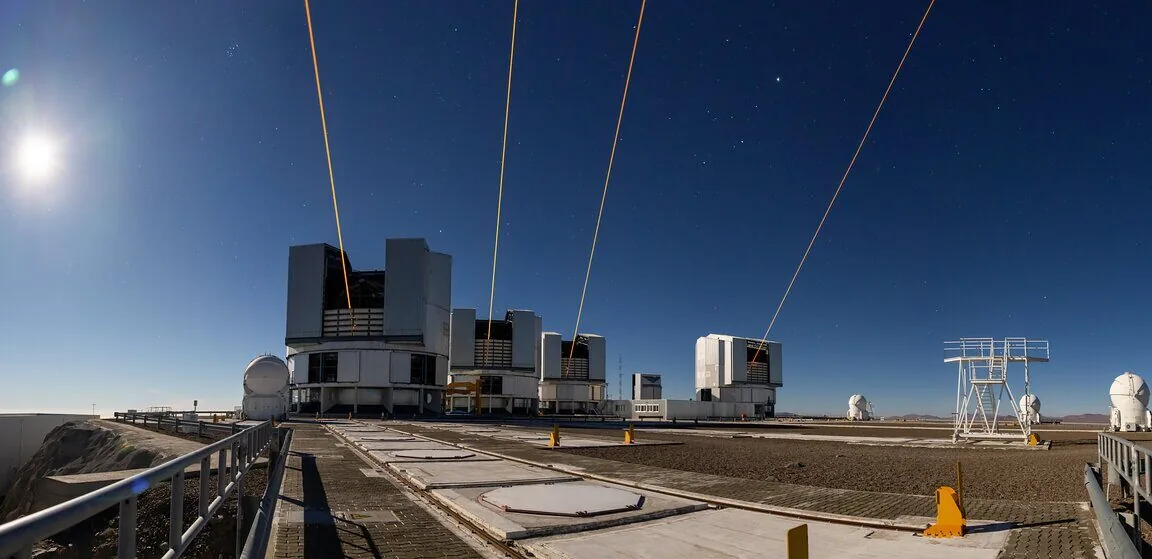
The GRAVITY instrument, an advanced near-infrared adaptive optics instrument on the European Southern Observatory's Very Large Telescope, was instrumental in this discovery. By combining the light from four telescopes, GRAVITY achieves a resolution equivalent to a single 130-meter diameter telescope. Since 2017, a dedicated team has used GRAVITY to meticulously track stars in the immediate vicinity of Sgr A*. This intensive observation campaign led to the identification of S301, initially observed moving away from the black hole in 2023. Subsequent analysis of its orbital path allowed researchers to confirm its identity and predict its earlier position, pinpointing a moment of closest approach to Sgr A* earlier that year.
A Record-Breaking Orbit
S301's orbit is remarkable for its speed and eccentricity. The star completes an orbit in just 8.7 years, significantly faster than other known stars in the region. Its orbit is highly elliptical, with an eccentricity of 0.9832, meaning it traces a severely stretched oval shape. At its closest point, S301 travels at approximately 25,000 kilometers per second, which is over 8% of the speed of light. This close approach brings the star within an estimated 11 Astronomical Units (AU) of Sgr A*, a distance comparable to Saturn's average distance from the Sun. For context, this is roughly ten times closer to the black hole than any previously identified star.
The immense gravitational forces at this proximity could have significant implications. Researchers noted that if S301 were a larger star, its structure would likely be torn apart by Sgr A*'s tidal forces. The star itself is estimated to be about 1.5 times the mass of our Sun. The prevailing theory suggests S301 may have originated as part of a binary system that strayed too close to Sgr A*, with its companion star being ejected.
The discovery of S301 is more than just identifying a unique celestial object; it represents a significant advancement in observational astronomy. The precision with which scientists can now track S301's orbit offers a tangible pathway to measuring Sgr A*'s spin. With about a decade of further data, astronomers anticipate being able to estimate the black hole's spin with considerable accuracy. Future observations with even higher resolution or longer data sets could reveal further details about the black hole, such as deviations from a perfect spherical shape or the existence of properties beyond mass and spin that influence its behavior.
This finding is a testament to advancements in astronomical instrumentation and observational techniques. The GRAVITY instrument and the continued study of stellar dynamics around Sagittarius A* are pushing the boundaries of our understanding of black holes and the fundamental physics that govern them. The close examination of S301's trajectory promises to unlock new secrets of our galaxy's enigmatic center.