
SpaceX Launch Creates 'Jellyfish' Cloud Over Florida Skies
A SpaceX Falcon 9 rocket launch from Cape Canaveral on July 9, 2026, produced a stunning "jellyfish"-like cloud formation due to ice crystals and sunlight.

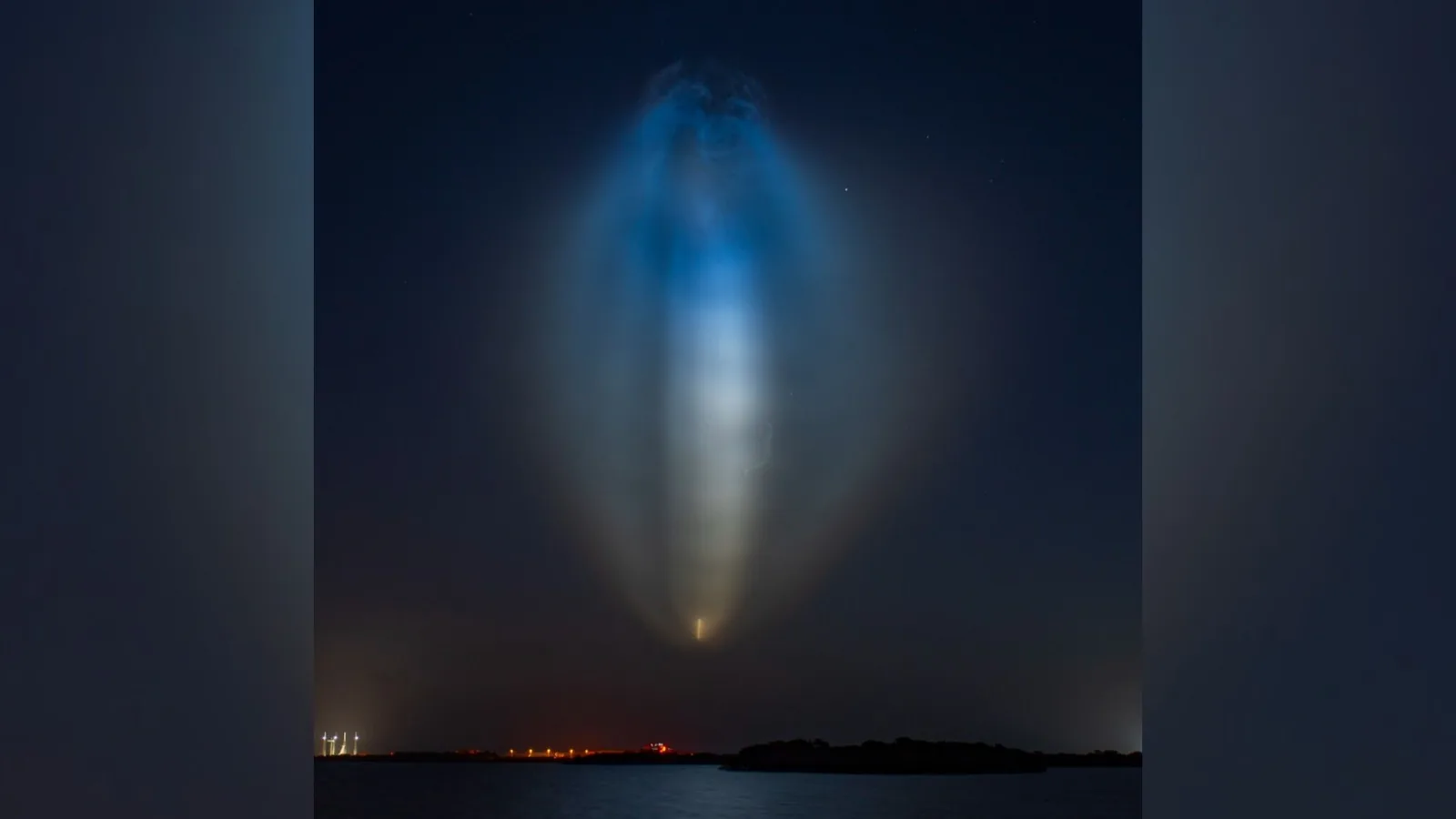
A spectacular celestial display unfolded in the early morning hours of July 9, 2026, as a SpaceX Falcon 9 rocket ascended from Cape Canaveral Space Force Station in Florida. The launch, which carried 29 Starlink broadband satellites into low Earth orbit, created a breathtaking plume resembling a glowing jellyfish in the pre-dawn sky. This was the rocket's 36th flight, setting a new record for the Falcon 9 program. Liftoff occurred precisely at 5:25 a.m. EDT (0925 GMT), painting a surreal image against the darkness.
The ethereal formation, while visually striking and sparking wonder, has a clear scientific explanation rooted in the physics of rocket exhaust and atmospheric conditions. As the Falcon 9's engines propelled the rocket skyward, they expelled a mixture of water vapor and carbon dioxide. Upon reaching higher altitudes, the rapidly dropping temperatures caused the water vapor to freeze. This process formed a trail of ice crystals that expanded into the translucent, cloud-like structure observed shortly after the launch.
The vibrant appearance of the plume was further enhanced by the specific lighting conditions of early morning. The angle and intensity of the rising sun caught the ice crystals, illuminating the trail and creating the colorful, otherworldly effect. While the phenomenon might evoke comparisons to mythical creatures or abstract art, it is a direct result of advanced aerospace engineering interacting with Earth's atmosphere.
Atmospheric Optics and Rocket Science Converge
This particular launch was notable not just for its impressive payload and record-setting flight, but also for the aesthetic spectacle it generated. Such events highlight the intersection of cutting-edge technology and natural phenomena. The visual impact of rocket launches, particularly those occurring during twilight hours, has become a recurring theme in space photography. These images often capture the public's imagination, turning technical achievements into moments of shared awe.
Experts note that the appearance can vary significantly based on factors such as the rocket's trajectory, altitude, atmospheric moisture content, and the precise time of day relative to sunrise or sunset. The unique shape often compared to a jellyfish or, more specifically, a comb jelly, is a result of the exhaust gases expanding and interacting with wind currents at different atmospheric layers. The shimmering effect is caused by sunlight refracting through the myriad of tiny ice crystals.
This latest launch underscores the ongoing expansion of SpaceX's Starlink constellation, which aims to provide global internet coverage. With thousands of satellites now in orbit, the frequency of launches and the potential for similar atmospheric displays are likely to increase. Understanding these visual side effects is becoming an integral part of documenting space missions, blending the worlds of science reporting and visual art.