
SpaceX Launch Marks Progress in Commercial Spaceflight Goals
SpaceX's latest launch demonstrates advances in reusable rocket technology and commercial satellite deployment. The mission underscores the company's role in reshaping space exploration and reducing launch costs.

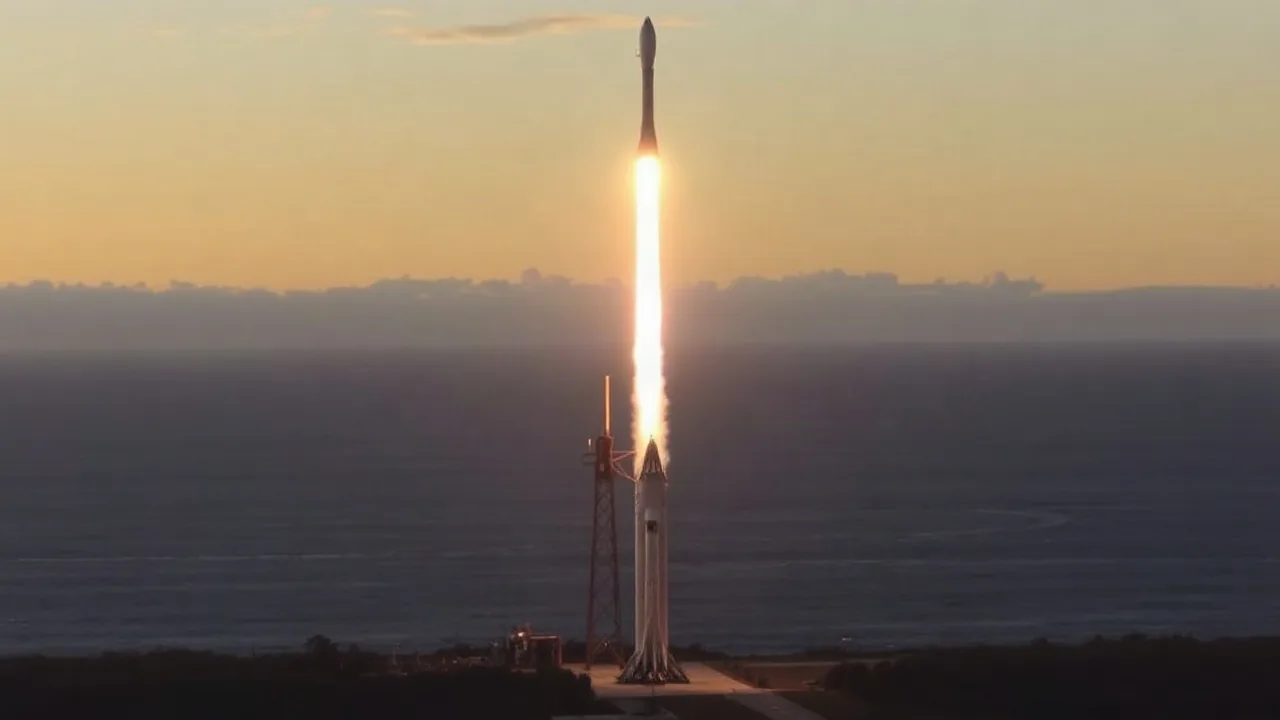
SpaceX completed another orbital mission in early October 2026, continuing its aggressive launch cadence and reinforcing the company's dominance in commercial spaceflight. The Falcon 9 rocket lifted off carrying a mixed payload of commercial and government satellites, marking the company's 82nd successful orbital launch of the year.
The booster completed its 19th flight before landing on a drone ship in the Atlantic Ocean, demonstrating the reliability of SpaceX's reusable rocket strategy. Each successful booster recovery reduces the cost of rocket technology deployment and accelerates the company's timeline for launching Starship, its next-generation heavy-lift vehicle.
"Our focus on rapid reusability and cost reduction is changing how the world accesses space," said Gwynne Shotwell, SpaceX President and CEO, during a post-launch briefing. "This approach enables us to support everything from national security missions to private satellite networks."
Commercial Spaceflight Reaches New Efficiency Metrics
The October 2026 mission carried 50 Starlink internet satellites alongside two experimental government payloads. This mixed-payload approach has become routine for SpaceX, allowing the company to optimize launch scheduling and improve profitability across its operations.
Commercial spaceflight has moved beyond proof-of-concept into mature operations. SpaceX now launches approximately once every two to three days, a pace unimaginable five years ago. Industry analysts estimate the company controls roughly 65 percent of the global commercial launch market as of 2026.
The Starlink constellation continues expanding toward its planned 42,000-satellite network. Deployment of Starlink v2 satellites began in mid-2026, offering improved bandwidth and coverage. The constellation now provides internet service to over 2.5 million subscribers worldwide, generating consistent revenue for the company.
Other commercial operators have attempted to compete in the space exploration launch sector:
- Amazon's Project Kuiper has conducted initial test launches but remains years behind Starlink in deployment.
- Axiom Space continues building commercial modules for orbital stations.
- Relativity Space is testing 3D-printed rocket components at production facilities in California.
- Rocket Lab maintains a niche in small-satellite launch services with its Electron vehicle.
Implications for Space Exploration and National Security
SpaceX's persistent launch capability underpins critical U.S. military and intelligence programs. The Space Force and National Reconnaissance Office relied on SpaceX for 14 national security missions in 2026 alone. The company's fixed pricing model has reduced government spaceflight costs by an estimated 40 percent compared to legacy contractors.
NASA continues relying on SpaceX for cargo resupply to the International Space Station. The company completed 11 Dragon cargo missions through September 2026, maintaining critical supply lines for the orbiting laboratory. Dragon also certified for crewed missions to the station, with two NASA astronauts scheduled for launch in November 2026.
The broader implications extend to lunar exploration. SpaceX is developing the Lunar Starship variant for NASA's Artemis program, designed to land astronauts on the Moon's surface. Though development challenges have delayed timeline expectations, SpaceX demonstrated successful booster catch operations at Starbase in Texas during September 2026, a capability critical for rapid Starship turnaround times.
Dr. Robert Zubrin, aerospace engineer and Mars Society founder, noted that SpaceX's approach fundamentally challenges conventional space industry economics. "They've proven that aggressive iteration and reusability drive cost reduction far more effectively than traditional procurement methods," Zubrin said in an October interview. "This forces the entire sector to innovate or lose relevance."
Technical Achievements in Modern Rocket Engineering
The October 2026 launch incorporated several operational refinements to the Falcon 9 design. Engine performance metrics improved through incremental upgrades to the Merlin engine line, extending booster service life and reducing maintenance intervals. SpaceX reported a 12 percent increase in payload capacity to low-Earth orbit compared to 2025 baselines.
Booster recycling now operates on a 10-day turnaround cycle for flight-proven hardware in optimal conditions. This rapid reusability model depends on sophisticated avionics, structural monitoring systems, and ground infrastructure at launch facilities in Florida and California. SpaceX invested heavily in these capabilities throughout 2025 and 2026.
The company continues testing environmental mitigation measures at launch sites, addressing water treatment and noise suppression. Federal environmental reviews completed in August 2026 approved expanded launch frequency at the Starbase facility in South Texas, clearing obstacles to higher operational tempo.
Looking forward, mission analysis indicates SpaceX will maintain launch frequencies above 100 missions annually through 2027. Starship development remains the company's singular focus for next-generation capability, with orbital test flights planned for late 2026 or early 2027. Success with Starship would position SpaceX to support deep-space missions and establish sustainable cislunar infrastructure within five years.
The October 2026 launch represents incremental progress in execution excellence rather than dramatic technological breakthrough. Yet that steady drumbeat of successful missions defines the current era of commercial spaceflight: reliable, routine, and rapidly reshaping how humanity accesses and uses orbital space.