
Nutcracker Man: Kenyan Footprints Reveal Taller, Social Hominin
New analysis of fossil footprints in Kenya suggests 'Nutcracker Man' (Paranthropus boisei) was larger and more socially complex than previously believed. The findings reshape our understanding of early human relatives.

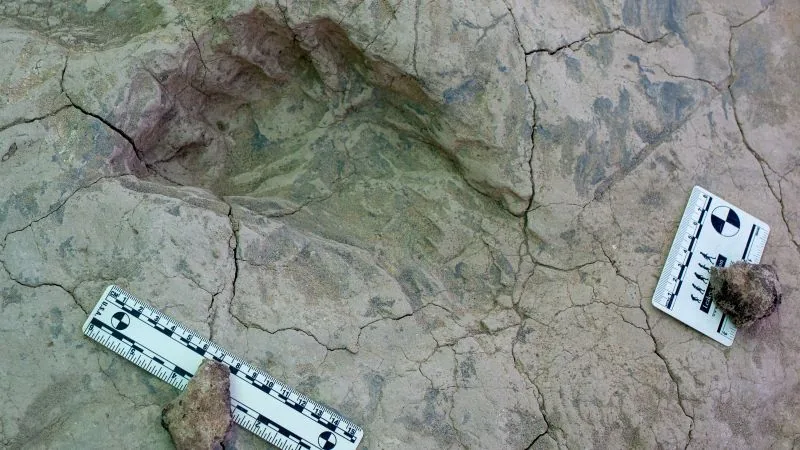
Scientists have gained new insights into the life of an ancient human relative known as "Nutcracker Man" thanks to a fresh analysis of fossil footprints discovered in Kenya. The species, scientifically identified as Paranthropus boisei, lived in eastern Africa between approximately 2.3 million and 1.2 million years ago. This latest evidence indicates that P. boisei may have been taller and heavier, with more intricate social interactions, than earlier fossil discoveries had suggested.
Previous estimations, based on limited P. boisei fossil remains, proposed an average height of about 4.2 feet (131 centimeters) and a weight of roughly 108 pounds (49 kilograms) for males. However, updated calculations derived from the dimensions of 21 newly identified P. boisei footprints point to a more humanlike stature, with individuals reaching up to 6 feet (1.8 meters) tall and weighing as much as 165 pounds (75 kilograms). The arrangement of these preserved tracks also suggests that eight P. boisei individuals traversed the site, located in East Turkana's Koobi Fora Formation, concurrently and as a cohesive group. These remarkable footprints offer a unique glimpse into the sophistication of their social structures within their lakeside environment, according to researchers who published their findings on Monday in the journal PNAS.
"The site captures an amazing snapshot of hominin anatomy, locomotion, behavior, and environments," stated lead study author Kevin Hatala, an associate professor of biology at Chatham University in Pittsburgh and an associate researcher at the Max Planck Institute for Evolutionary Anthropology in Leipzig, Germany. "Each set of footprints like this one provides a window to a moment in time when we can directly observe how hominins were living, and engaging with their environments," Hatala explained via email. "We think that the footprints may capture a group of adult males moving together along the lakeshore," he added, speculating that the presence of dangerous animals like hippos might explain why the group consisted solely of adult males.
Coexisting Cousins and Behavioral Clues
Footprints serve as crucial fossils, offering both anatomical and behavioral data, according to Patricia Kramer, a professor in the department of anthropology at the University of Washington in Seattle and an affiliate curator of archaeology at the Burke Museum. Kramer, who has previously studied these trackways, expressed her enthusiasm for the new research. "I am excited that the authors have provided additional information and analysis about the trackways at Koobi Fora," she commented. The tracks, estimated to be around 1.4 million years old, are well-defined and up to 0.4 inches (12 centimeters) deep, likely pressed into mud in shallow lake water.
The research team, led by senior study author Anna Katherine “Kay” Behrensmeyer, a senior research geologist and curator of vertebrate paleontology at the Smithsonian’s National Museum of Natural History in Washington, DC, uncovered seven tracks during fieldwork in 1978. Subsequent excavations in 2016 and 2023 yielded 14 additional hominin footprints, alongside tracks from animals such as antelope and hippos. The Koobi Fora region was a shared habitat for multiple archaic human relatives. For hundreds of thousands of years, P. boisei lived contemporaneously with Homo erectus. A separate 2024 study, also led by Hatala, reported the discovery of fossil footprints in Kenya’s Turkana Basin made by two distinct hominin species within days of each other, leading researchers to hypothesize they belonged to H. erectus and P. boisei.
"We can’t say how the two different hominins interacted on the mudflats, but we know they were both here at this time," Behrensmeyer noted in a statement. Homo erectus, an earlier relative of Homo sapiens, exhibited body proportions similar to modern humans, indicating adaptation to upright locomotion. In contrast, P. boisei, a more distant evolutionary cousin, possessed physical traits more akin to tree-dwelling primates. While P. boisei footprints share resemblances with those of H. erectus and modern humans, Hatala highlighted key distinguishing features. Previous research on Pleistocene hominin footprints from periods when only P. boisei was present (not H. erectus) revealed flatter arches compared to prints made by H. erectus and modern humans. "While that doesn’t necessarily mean those older hominins had flatter feet, 'it at least tells us they moved their feet against the ground in a different way,'" Hatala explained. He also noted that these older footprints often feature a big toe angled more away from the other toes, characteristics that differ from modern humans and support the hypothesis that these prints were made by P. boisei.
Interpreting footprint variations can be challenging due to differing ground conditions, but the researchers accounted for these variables. "In our experiments we have sampled an extensive range of substrate variation, and we have conducted multiple experiments using a rehydrated version of the same kind of mud in which these Early Pleistocene footprints are preserved," Hatala stated. Kramer cautioned that attributing significance to specific morphology, such as toe angle or arch height, requires careful consideration, as efficient bipedal locomotion can be achieved in various ways. "Nonetheless, we desperately need the kind of in-depth, thorough analyses that this new work exemplifies," she remarked.
The initial discovery of P. boisei fossils occurred in the 1950s. However, estimating the species' size has been difficult due to a scarcity of skeletal remains beyond skulls. Larger bones from that era in the region were typically assigned to H. erectus, while smaller ones were associated with Paranthropus. "But maybe these species were much closer in body size than previously thought," Hatala posited. Unlike skeletal fossils, which represent deceased individuals, fossil footprints offer a direct impression of ancient hominins during their active lives. These preserved moments not only document the past but also underscore the connection between modern humans and our long-extinct relatives, according to Behrensmeyer. "They allow people to relate to these fossils much more easily than an isolated piece of bone or jaw," she observed. This perspective helps illuminate the prehistoric world of our extinct relatives, Kramer added. Though P. boisei and H. erectus may have differed significantly from modern humans, Homo sapiens eventually followed in their path, inhabiting the same African landscapes approximately half a million years later. "It is a story of a world populated by creatures so much like us but so different at the same time," Kramer concluded.