
Quantum Magnetism Linked to Black Hole Dynamics by Physicists
Researchers have discovered a mathematical link between extremely slow quantum magnetism and the rapid processes occurring near black holes. This breakthrough bridges two vastly different areas of physics.

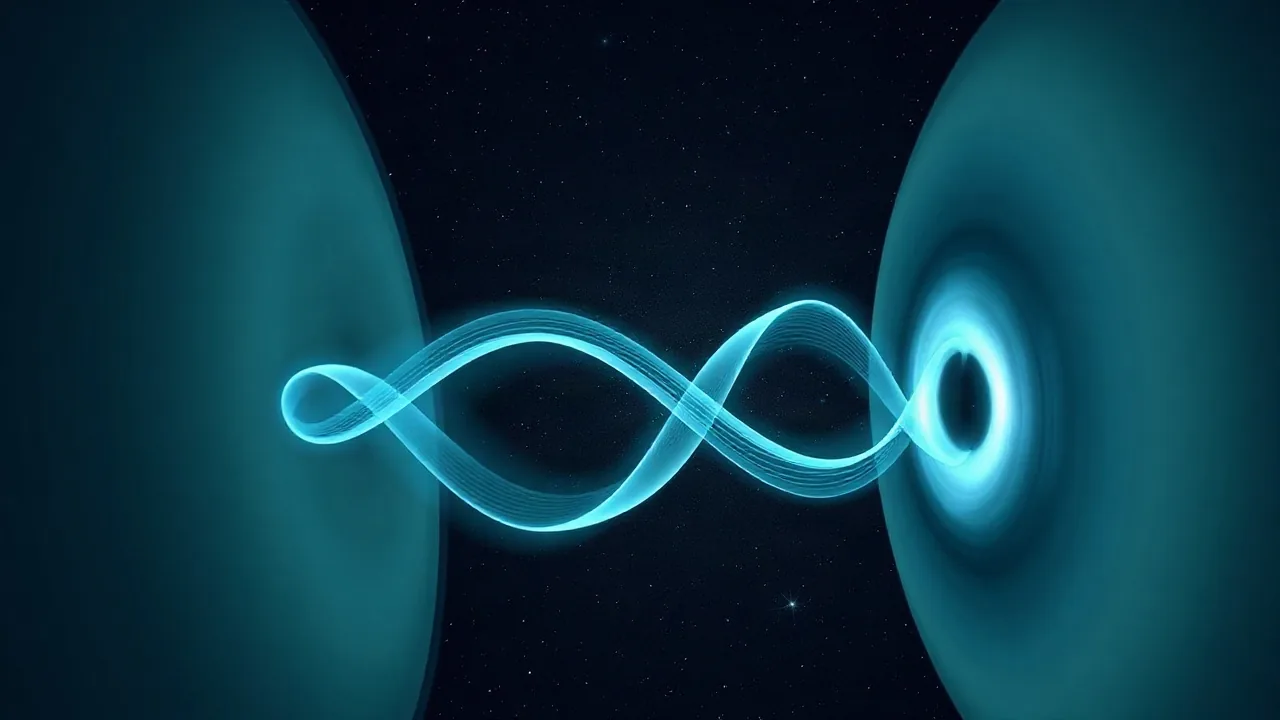
An international team of physicists has unveiled a surprising mathematical connection between the subtle behaviors of quantum magnetism and the extreme dynamics of black holes. This discovery, published in the journal Nature Physics on September 19, 2026, bridges theoretical frameworks that were previously considered disparate, potentially offering new avenues for understanding both phenomena.
The research focused on the way magnetic fields behave at the quantum level, a process that typically unfolds over immense timescales, often described as ultraslow. Simultaneously, the team examined the rapid, energetic processes that occur when matter interacts with black holes, such as accretion disks and the expulsion of jets, which happen on ultrafast timescales. The unexpected finding was a shared mathematical structure governing the behavior of both systems.
"We were astounded to find that the equations describing how quantum spins interact and align in certain magnetic materials bear a striking resemblance to the equations modeling the flow of plasma and energy around a black hole," said Dr. Anya Sharma, a theoretical physicist at the Max Planck Institute for Gravitational Physics and lead author of the study. "It suggests a deeper, underlying unity in how complex systems evolve, regardless of their scale or the speed at which they operate."
Unifying Diverse Physical Regimes
Historically, the study of quantum magnetism has been confined to condensed matter physics, dealing with the collective behavior of electrons in solids. Black hole physics, on the other hand, falls under the domain of general relativity and astrophysics, exploring the most extreme gravitational environments in the universe. The challenge for researchers was to find a common language to describe these vastly different physical scenarios.
The breakthrough came through the application of advanced mathematical techniques, including tensor networks and topological field theories. These tools allowed the researchers to abstract the essential dynamics of both ultraslow quantum magnetic phenomena and ultrafast black hole accretion processes. By stripping away the specific physical details, they were able to identify a core mathematical framework that applies to both.
This finding has significant implications. For quantum magnetism, it could lead to new insights into exotic magnetic states and potentially guide the development of novel quantum computing architectures that rely on precise control of magnetic interactions. For black hole physics, it may offer a simplified model for understanding the complex turbulence and energy transfer mechanisms within accretion disks, which are crucial for feeding black holes and powering relativistic jets.
Dr. Kenji Tanaka, an astrophysicist at Kyoto University and co-author of the paper, elaborated on the implications for astrophysics. "Understanding the energy conversion efficiency in accretion disks is a major challenge. If the mathematical parallels hold true, we might be able to borrow insights from condensed matter physics to model these astrophysical phenomena more accurately, potentially improving our simulations of galaxy evolution and active galactic nuclei."
The research team plans to further explore this connection by investigating other systems exhibiting similar mathematical structures. They are particularly interested in whether this link extends to other areas of physics, such as fluid dynamics or particle physics, where complex emergent behaviors are observed. The discovery underscores the power of abstract mathematical principles to connect seemingly unrelated scientific disciplines.