
Northern Lights Visible Thursday in 9 US States After Solar Flare
A powerful solar flare has increased the chances of seeing the Northern Lights on Thursday night and early Friday across nine U.S. states. Officials warn of potential radio blackouts.

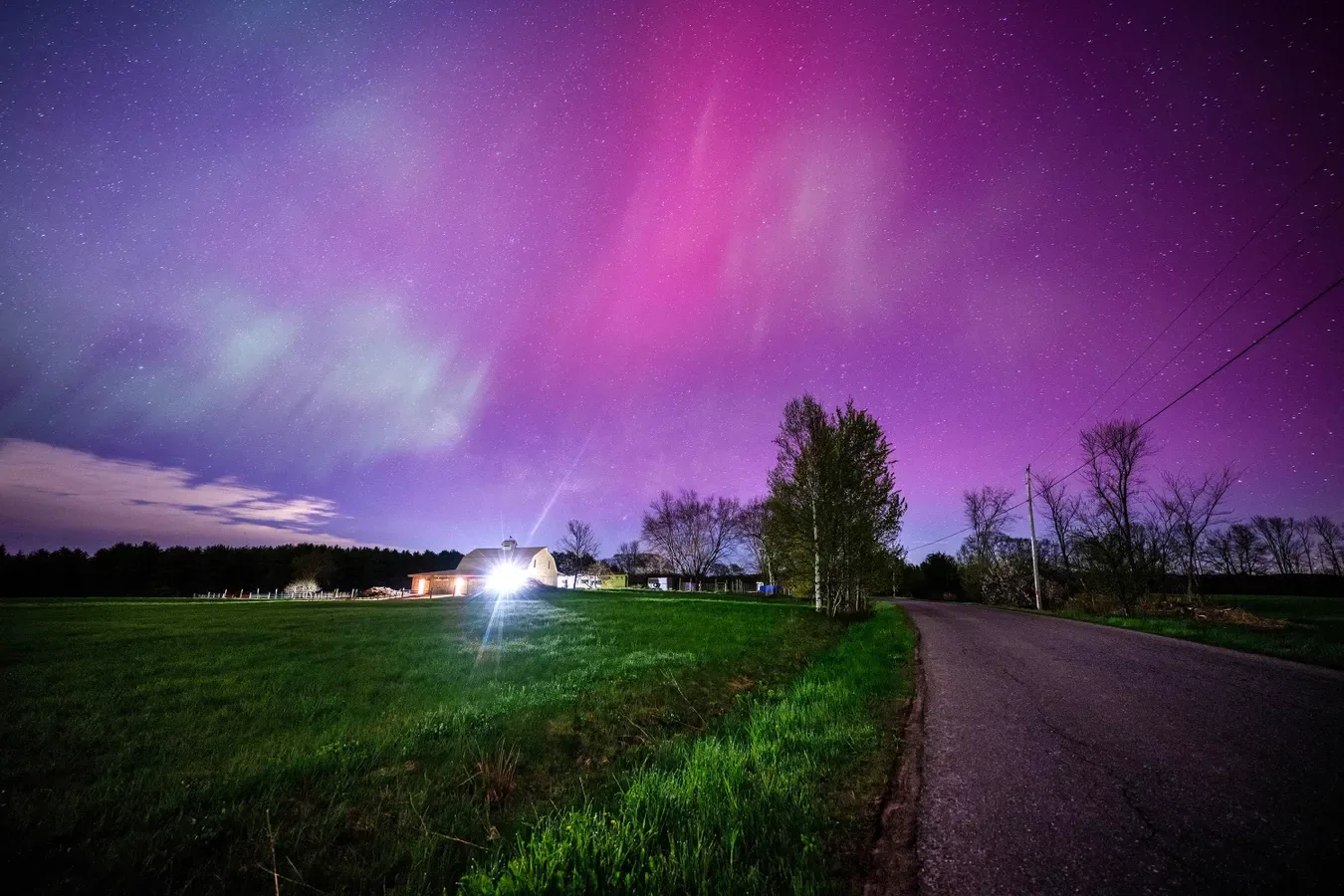
Residents in nine U.S. states may have a chance to witness the aurora borealis, commonly known as the Northern Lights, on Thursday night and into early Friday morning. The enhanced visibility is due to a coronal mass ejection (CME) originating from a powerful X-class solar flare that is now approaching Earth, according to a forecast from the National Oceanic and Atmospheric Administration (NOAA). The geomagnetic activity could also trigger strong high-frequency radio blackouts.
Coronal mass ejections are massive eruptions of solar plasma and magnetic fields from the Sun's atmosphere. When these charged particles travel through space and reach Earth, they can interact with the planet's magnetic field, leading to geomagnetic storms. These storms are responsible for the spectacular light displays of the aurora, typically seen at higher latitudes. The X-class solar flare, observed by forecasters on Tuesday, is among the most intense types of solar eruptions.
Geomagnetic Storms and Aurora Visibility
NOAA's aurora forecast map indicates that areas along the U.S.-Canadian border have a low to moderate likelihood of viewing the aurora. States potentially in the viewing zone include parts of Washington, Idaho, Montana, North Dakota, and South Dakota. Further east, northern Minnesota, Wisconsin, and Michigan's Upper Peninsula might also experience the phenomenon. Alaska is projected to have the highest likelihood of aurora sightings, with most of the state falling within a 'high likelihood' area.
The National Oceanic and Atmospheric Administration also issued a warning about potential disruptions caused by the solar event. Forecasters suspect that the solar flare could lead to strong high-frequency radio blackouts on Thursday. These blackouts can affect radio communications, GPS navigation, and other technologies that rely on radio waves. The event is a stark reminder of the Sun's powerful influence on Earth's technology and environment.
For those hoping to catch a glimpse of the aurora, experts recommend traveling as far north as possible, away from city lights and light pollution. Finding a location with a clear view of the northern sky, ideally from an elevated position like a hill, can significantly improve viewing chances. The aurora is generally most active between the hours of 10 p.m. and 2 a.m., making late-night viewing the most promising time. While photographing the aurora can be challenging, using a tripod and a camera with manual settings for long exposures is key to capturing the ethereal light show.