
Aurora Borealis Forecast: Northern Lights May Appear as Far South as These States Next Week
Enhanced solar activity is predicted to bring the aurora borealis further south than usual. Northern states along the U.S.-Canadian border and Alaska have the best chances to witness the celestial display next week.

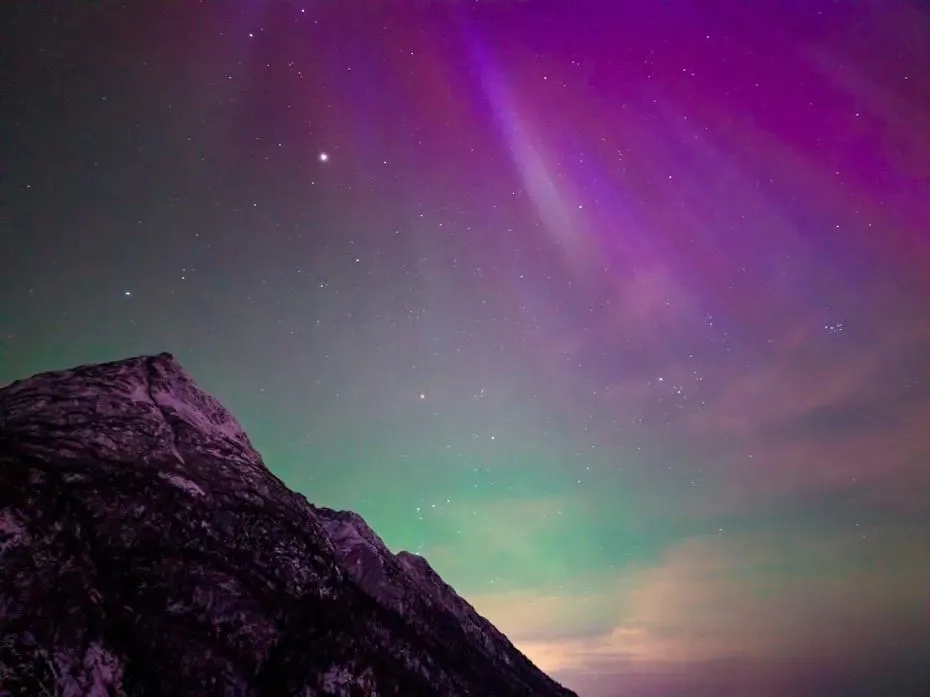
The aurora borealis, commonly known as the Northern Lights, may be visible across a wider swath of the United States next week due to an incoming solar event. The National Oceanic and Atmospheric Administration (NOAA) has forecast increased chances for visibility beginning Monday night, June 30, 2026, as a coronal mass ejection (CME) from the sun is expected to reach Earth.
Coronal mass ejections are significant expulsions of plasma and magnetic fields from the sun's outer atmosphere, known as the corona. These events are more powerful than standard solar winds and can trigger geomagnetic storms when they interact with Earth's magnetosphere. While NOAA is currently predicting only minor geomagnetic storms, classified as G1 on a scale of one to five, even these less intense events can push the visible range of the aurora further towards the equator.
According to NOAA's current predictions, areas along the U.S.-Canadian border hold a "low" likelihood of aurora visibility on Monday night. This includes states such as northern Washington, Idaho, Montana, and both North and South Dakota. In the Midwest, residents in northern Minnesota, Wisconsin, and Michigan's Upper Peninsula may also have a slight chance to observe the phenomenon. Alaska, however, is expected to have the highest likelihood of aurora sightings, with much of the state falling within the "high" visibility zone for Monday night.
Viewing and Photographing the Aurora
For those hoping to catch a glimpse of the aurora borealis, experts at NOAA recommend seeking locations as far north as possible. A clear view of the northern horizon is essential, and it is advisable to move away from urban areas to minimize light pollution. The most active periods for the aurora typically occur in the hours surrounding midnight, generally between 10 p.m. and 2 a.m. local time. When planning to photograph the celestial event, experts suggest using a camera with manual settings capable of long exposures, a sturdy tripod to prevent blurring, and a wide-angle lens to capture the expansive display.
The upcoming solar event is a reminder of the dynamic relationship between Earth and its star. While CMEs can sometimes cause disruptions to satellite communications and power grids, they also provide spectacular natural light shows. The forecast offers a chance for many Americans to witness a phenomenon usually reserved for higher latitudes, turning a scientific prediction into a memorable visual experience.