
NJ Meteorite Uncovers Life's Building Blocks After Crashing Into Home
A rare meteorite that struck a New Jersey home in July 2024 contains essential building blocks for life, scientists announced. The analysis offers new insights into early solar system chemistry.

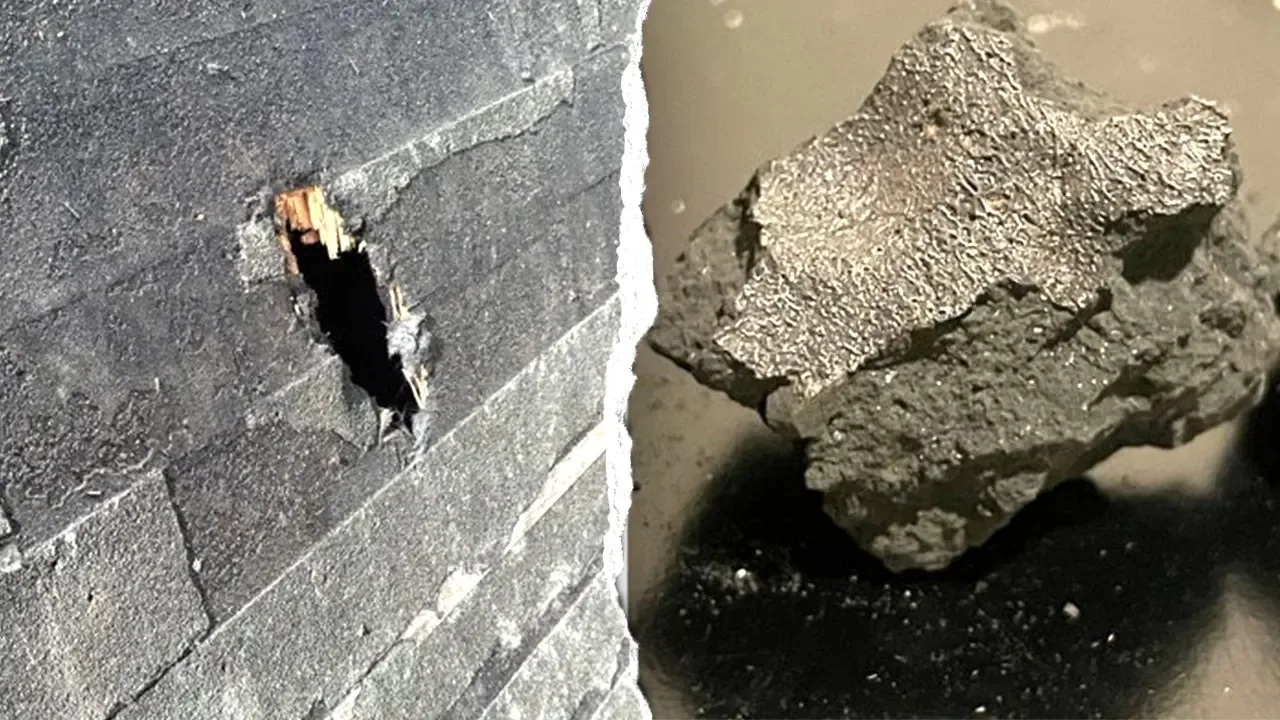
A rare meteorite that smashed through the roof of a New Jersey home on July 16, 2024, has been found to contain vital molecular components considered essential for life, according to a recent study published in Science Advances. The discovery, made just two years after the celestial object landed in Hillsborough, New Jersey, offers a unique glimpse into the ancient chemistry of the solar system.
The homeowner at the time reported hearing a "loud crash" and discovered a significant hole in their ceiling, with fragments and dust scattered across the room. A distinct sulfur-like odor was also noted. Fortunately, no one was injured during the incident, though the property sustained damage. The meteorite fractured into numerous pieces upon impact.
Scientists have classified the space rock as an intermediate CM1/2 carbonaceous chondrite, a type of meteorite exceedingly rare, with only two witnessed falls of this specific subtype recorded to date. This classification highlights its significance for astronomical research.
Unraveling Solar System Origins
Tracking the meteorite's descent involved collaboration across multiple observation points. Cameras in Northford, Connecticut, and Douglassville, Pennsylvania, along with a doorbell camera in Wayne, New Jersey, captured the meteor's fiery passage. Analysts from the American Meteor Society, using this data, were able to trace its trajectory back to the outer regions of the asteroid belt. Mike Hankey, operations manager for the society, stated in a release from the SETI Institute that the meteor's path indicated a source low in the asteroid belt.
NASA researchers noted that the meteorite contains some of the solar system's oldest known materials, preserving a record of chemical processes that occurred over 4.5 billion years ago. The swift actions of an amateur astronomer, who identified the freshly fallen object and meticulously collected the fragments using gloves and appropriate storage containers like aluminum foil and glass, proved crucial for the scientific study. This careful preservation allowed for detailed analysis.
The Hillsborough meteorite, as it has been dubbed, is proving instrumental in helping scientists explore clues about ancient water, the chemical evolution of primitive asteroids, and the fundamental ingredients that may have contributed to the emergence of life across the early solar system. Understanding its origins required interdisciplinary expertise from various scientific fields.
Dr. Danny Glavin, a senior scientist at NASA's Goddard Space Flight Center and a co-author of the study, expressed surprise at the intricate complexity of the amino acids and organic compounds found within the meteorite. Amino acids are the fundamental units that build proteins, while organic compounds are carbon-based molecules vital for life as we understand it.
"It's just more proof that the chemical building blocks of life could have been delivered — and are still being delivered — to Earth today by these carbonaceous asteroid fragments," Glavin stated in a press release. This finding reinforces the hypothesis that extraterrestrial material has played a role in seeding Earth with the precursors to life.
Peter Jenniskens, a meteor astronomer affiliated with NASA's Ames Research Center and also a co-author of the study, explained that the team's comprehensive analysis, encompassing the meteorite's trajectory, mineral composition, and organic chemistry, is providing a clearer understanding of primitive asteroids. "When we have both a documented fireball and a quick recovery of its meteorite, we can learn not only what the rock is made of, but where it came from in the asteroid belt," Jenniskens added. This research allows scientists to construct one of the most detailed depictions to date of how celestial bodies like the asteroid Erigone have evolved chemically over billions of years.