
Giant 3-Foot Scorpion Fossil Unearthed: 'Largest Ever' Creature Found
A colossal scorpion fossil, measuring over three feet long, has been identified as the largest of its kind ever discovered. Unearthed in the UK, the creature roamed Earth approximately 415 million years ago.

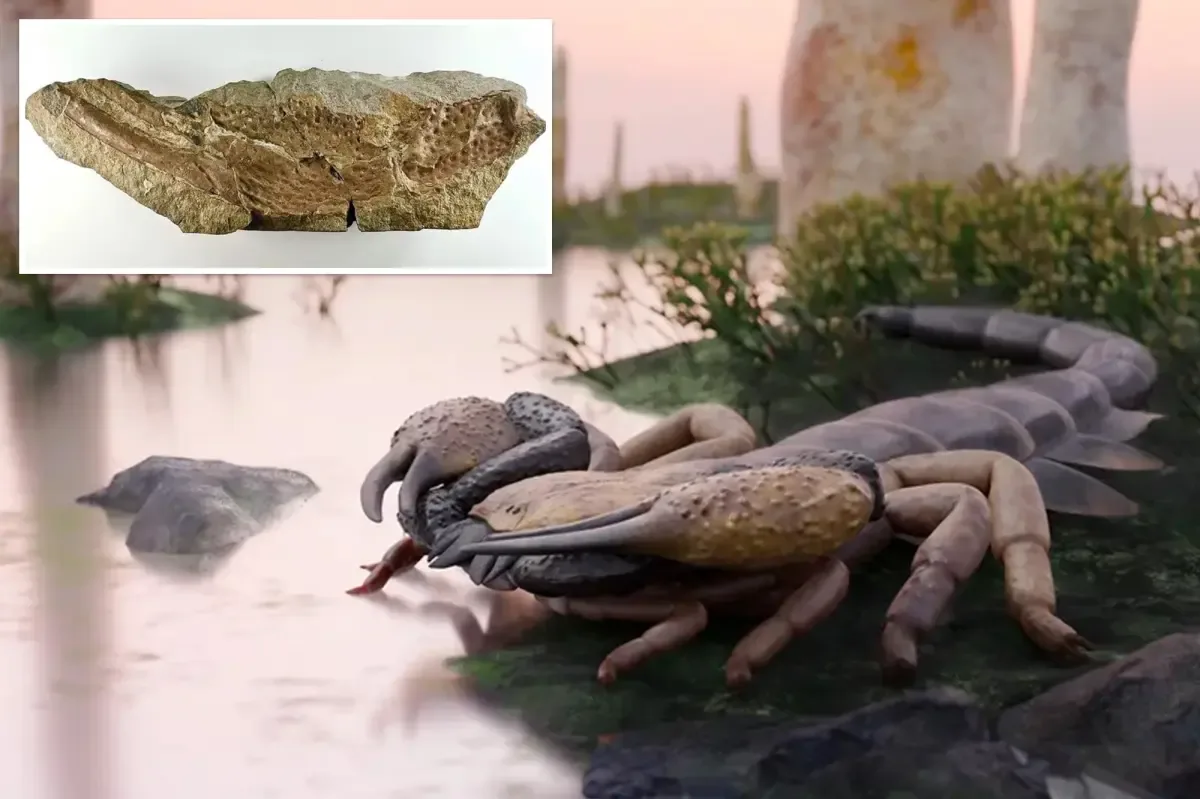
Paleontologists have identified what is believed to be the largest scorpion to have ever existed, a monstrous arthropod that measured over three feet long and featured six-inch pinchers. The creature, named Praearcturus, scuttled across what is now England and Wales during the Devonian period, approximately 415 million years ago. Its immense size, particularly its formidable pincers, far surpasses that of any scorpion known from the fossil record or living today.
The fossils were initially discovered in Herefordshire, UK, in the 1870s. However, due to a lack of a tail and other definitive features, they were mistakenly identified as a type of giant crustacean for over 150 years. It was only through the application of modern scientific techniques, including CT scans and 3D modeling, that researchers were able to correctly identify the specimen as a scorpion and understand its true scale.
Dr. Richard Howard of the Natural History Museum in London, the lead author of the study published in the journal Paleontology, stated, "So we can safely say it’s extremely large and there’s no other scorpion in the fossil record that has claws anywhere near that size." He added that the creature’s appendages were as long as the bodies of the largest living scorpion species.
A Glimpse into Early Arthropod Evolution
The discovery of Praearcturus fundamentally alters our understanding of how and when early arthropods achieved such extraordinary sizes. This giant scorpion predates the well-known large invertebrates of the Carboniferous period, such as giant millipedes and dragonfly-like insects, by roughly 50 million years. The Devonian period, when Praearcturus lived, was a crucial time for the colonization of land by various life forms.
One theory suggests that the scorpion's massive size was an adaptation to an environment with less competition. This allowed it to dominate its ecosystem. Another intriguing possibility, supported by fossil evidence, is that Praearcturus may have been semi-aquatic. Some fossils exhibit flap-like structures called epimera, similar to those found on crustaceans like lobsters and crabs. If true, its semiaquatic lifestyle could have facilitated its enormous growth, as water provides buoyancy and supports larger bodies.
Dr. Greg Edgecombe, a Merit Researcher at the Natural History Museum in London and co-author of the study, commented, "Praearcturus gives us a fascinating glimpse into how early animals adapted to these changing environments." He also proposed that this lineage might have even returned to the water after its ancestors had already begun living on land, highlighting the complex evolutionary paths taken by early life.
The research team, including paleontologist Dr. Russell Garwood from The University of Manchester, emphasized the collaborative effort and technological advancements that made this identification possible. "By bringing together material from several collections and using cutting edge imaging techniques, we’ve been able to build a clearer picture of the animal than was previously possible, which is really exciting," Dr. Garwood explained. This finding not only sheds light on prehistoric arthropod evolution but also underscores the importance of re-examining historical fossil finds with new technologies.