
Jupiter-Venus Conjunction: Watch Celestial Dance Online June 9
Jupiter and Venus will appear less than two degrees apart in the evening sky on June 9. A livestream from the Virtual Telescope Project will offer views of the dazzling celestial event.

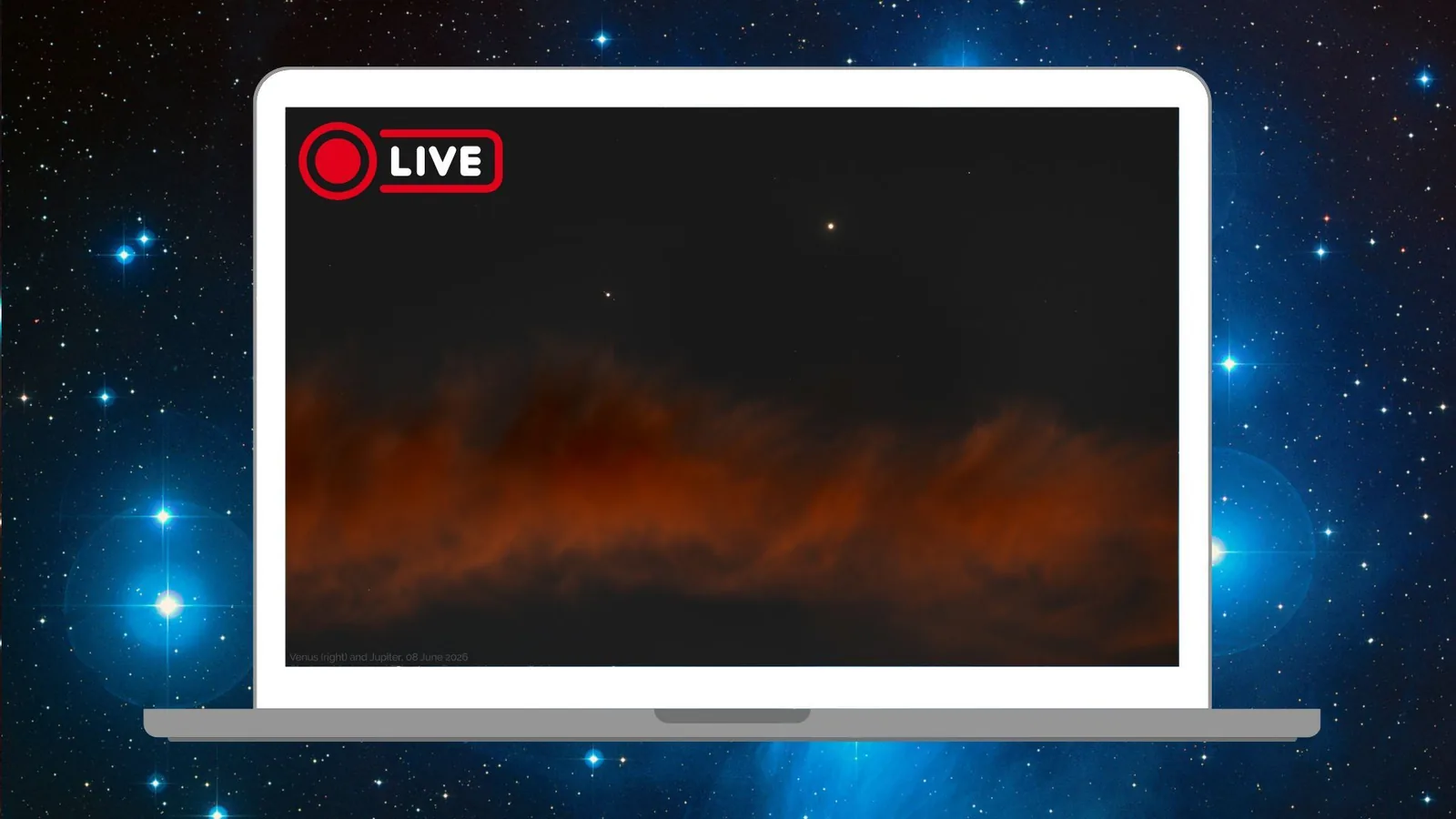
Jupiter and Venus are set to put on a spectacular celestial show on June 9, appearing less than two degrees apart in the sunset sky. Skygazers unable to witness the event in person can tune into a livestream provided by the Virtual Telescope Project. The online broadcast is scheduled to begin at 3:30 p.m. EDT (1930 GMT) on Tuesday, June 9, featuring live telescope views of the two planets from the project's robotic observatories in Manciano, Italy, provided weather conditions permit.
Gianluca Masi, founder of the Virtual Telescope Project, shared a striking image on June 6 of the planets already appearing close together, offering a preview of the upcoming conjunction. The photo depicted Venus shining to the right, enveloped in a soft haze from sunlight reflecting off its surface. To the left, Jupiter, the largest planet in our solar system, emanated a warm glow, accompanied by its four prominent Galilean moons appearing as bright star-like points.
Celestial Alignment Details
By June 9, Venus will be positioned slightly above and to the right of Jupiter, a separation roughly equivalent to the width of two fingers held at arm's length. For observers in the Western Hemisphere, this alignment will be visible shortly after sunset. Near the planetary pair, the planet Mercury will also be faintly visible to the lower right, though its light may be challenging to discern due to the proximity of the setting sun. This close alignment offers a rare opportunity to observe these prominent solar system bodies in close proximity.
Celestial conjunctions, like the one between Jupiter and Venus, occur when two or more astronomical bodies appear close together in the sky as seen from Earth. While they are not physically close in space, their apparent proximity creates visually stunning opportunities for observation. Such events have been documented throughout history and have often inspired awe and scientific inquiry. The upcoming conjunction is particularly noteworthy due to the brightness of both planets, which are among the most easily visible celestial objects after the Sun and Moon.
The Virtual Telescope Project has a history of providing public access to astronomical events through its online platform. Utilizing advanced robotic telescopes, the project aims to make the wonders of the universe accessible to a global audience. Their livestreams often include commentary from astronomers and stunning visual displays, turning remote observations into engaging educational experiences. This event provides a chance for the public to connect with astronomy without requiring specialized equipment or dark sky locations.