
Hubble Detects 'Impossible' Early Galaxy Light
NASA's Hubble telescope has detected energetic light from a galaxy in the early universe, a feat previously considered impossible. This finding offers new insights into cosmic reionization.

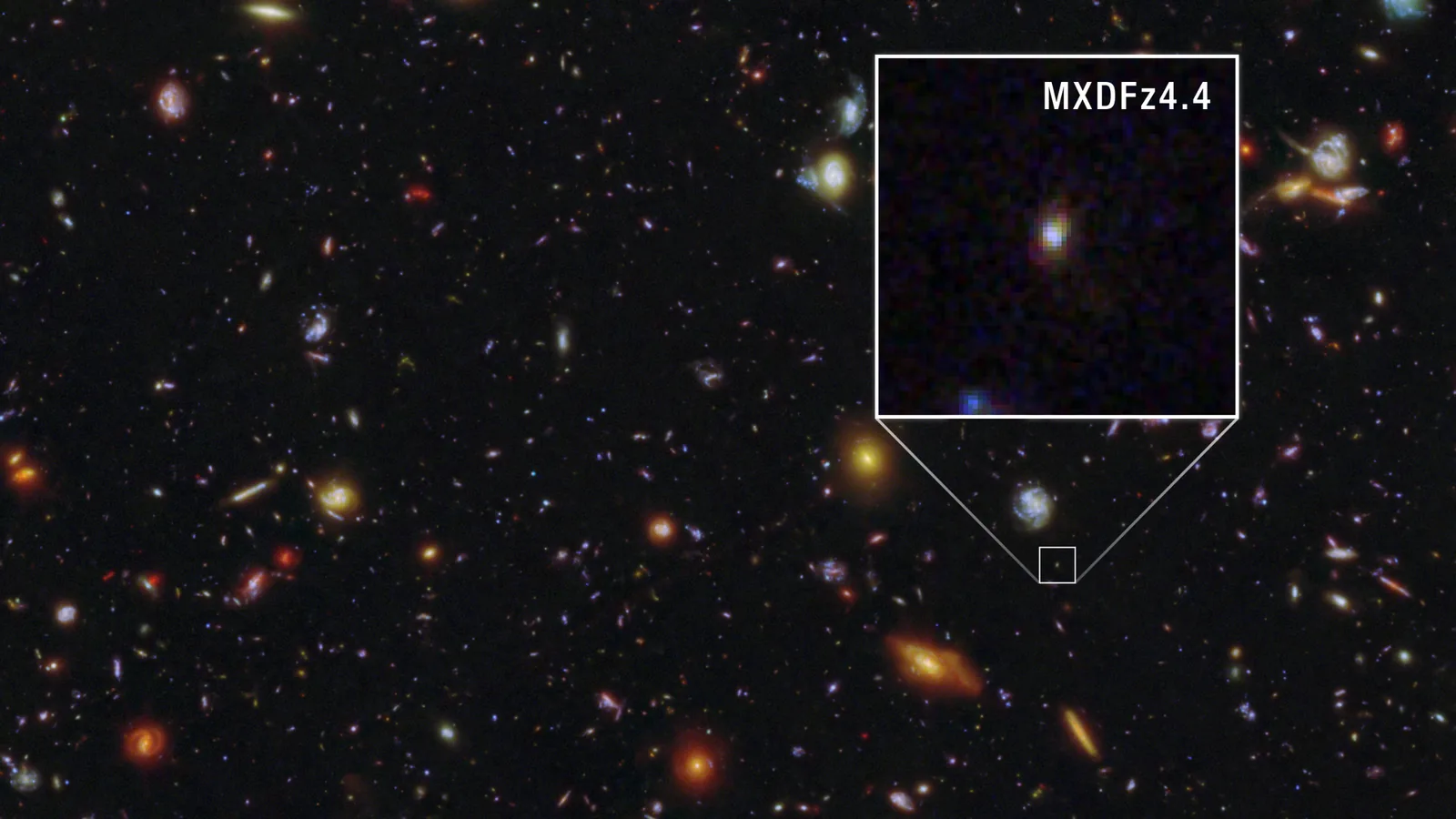
Astronomers have detected energetic ultraviolet photons, capable of stripping electrons from hydrogen atoms, emanating from a galaxy in the early universe that was previously thought to be hidden. The galaxy, designated MXDFz4.4, is shining through the cosmic fog just 250 million years after the Big Bang, marking the earliest detection of such "ionizing" light on record. This discovery, made possible by NASA's Hubble Space Telescope combined with data from the James Webb Space Telescope (JWST) and the European Southern Observatory's Very Large Telescope (VLT), challenges previous understandings of the universe's Epoch of Reionization.
For hundreds of millions of years following the Big Bang, the universe was filled with neutral hydrogen gas, which effectively blocked energetic light. The process of reionization, driven by radiation from the first stars and galaxies, gradually cleared this cosmic fog, allowing light to travel freely. "This was thought to be impossible," stated Ilias Goovaerts, a postdoctoral fellow at the Space Telescope Science Institute (STScI) in Baltimore and lead author of the study published in The Astrophysical Journal. "What’s really special about this galaxy is that it’s getting through so much of the intergalactic medium. It’s the furthest away so it has the most intergalactic medium to get through."
Galactic Composition and Light Escape
The unusual nature of MXDFz4.4 stems from its compact size and high star-formation rate. While its area is approximately 100 times smaller than the Milky Way, it forms stars at a rate about 10 times faster. This intense stellar activity packs a significant number of massive young stars into a confined space. According to Goovaerts, this dense stellar environment helps the galaxy create clear pathways through its surrounding gas, enabling ionizing light to escape not only the galaxy itself but also the dense intergalactic medium.
The research team estimates that between 50% and 100% of the galaxy's ionizing light is successfully escaping. This significant discovery occurred serendipitously in October 2025. While preparing an unrelated funding proposal with a tight deadline, Goovaerts examined a deep Hubble image, searching for prior observations of this specific light signal. Within a couple of hours, a promising indication emerged. "It was very, very quick from us having the idea to me going, okay, there’s something here and this is exciting," Goovaerts recalled. "We were excited from day one, but then it took months for it to mature and to extract all the properties about the galaxy."
The confirmation of MXDFz4.4's distance and characteristics relied on an exceptionally comprehensive dataset. This included an ultra-deep Hubble image, the result of 40 hours of observation. JWST provided imaging across multiple wavelengths, crucial for understanding the galaxy's stellar populations and star-formation history. Furthermore, a six-day VLT observation campaign using its Multi-Unit Spectroscopic Explorer instrument yielded one of the deepest spectra ever captured of a single sky region. This spectrum analyzed the galaxy's Lyman-alpha emission line, which acts as a "hydrogen fingerprint," a glow emitted by excited hydrogen gas that astronomers use to determine cosmic distance and age. This specific spectral signature confirmed the galaxy's extreme distance and its place in the early universe.
No other galaxy from this early cosmic era had previously exhibited detectable ionizing light, positioning MXDFz4.4 as a unique find so far. Marc Rafelski, deputy mission head for the Hubble Space Telescope at STScI and a co-author of the study, highlighted this uniqueness in a statement. The findings suggest that intense bursts of star formation, similar to that observed in MXDFz4.4, may have played a crucial role in clearing the early universe's pervasive hydrogen fog. Researchers anticipate that more such galaxies, previously obscured by the cosmic veil, are likely waiting to be discovered by advanced telescopes like the James Webb Space Telescope, offering deeper insights into the universe's formative years and the fundamental processes that shaped it.