
Physicists Debunk Feynman's Sprinkler Theory After Decades
Researchers have revisited a perplexing physics question posed by Nobel laureate Richard Feynman in the 1940s concerning the spin direction of a reverse sprinkler. New experiments with "silly" sprinkler designs have challenged long-held theories.

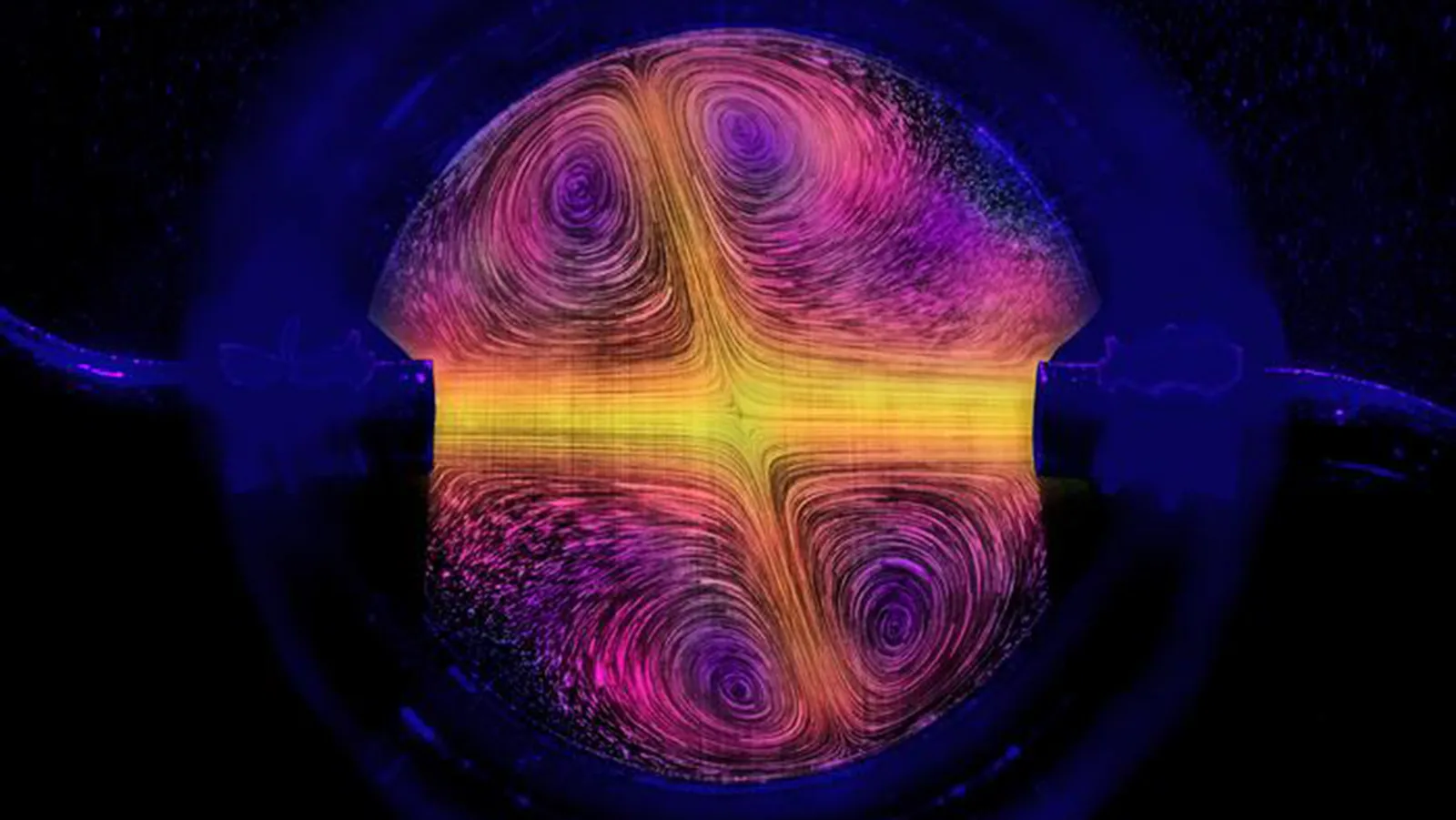
Physicists at New York University have experimentally disproven a decades-old theory proposed by Nobel laureate Richard Feynman regarding the behavior of a reversed lawn sprinkler. The enduring question, which has puzzled scientists since the 1940s, concerns the rotational direction of a sprinkler when it sucks water in instead of spraying it out. The recent study, published on July 13 in the journal PNAS, utilized uniquely designed "silly" sprinklers to settle the debate.
Richard Feynman, renowned for his ability to tackle complex problems with both rigor and curiosity, first pondered this question as a graduate student at Princeton. He reportedly attempted to experimentally verify the sprinkler's behavior, but his apparatus shattered, leaving the answer elusive. Since then, various experiments have yielded conflicting results, with sprinklers spinning in either direction, remaining stationary, or oscillating.
In 2024, a team led by applied mathematician and experimental physicist Leif Ristroph at NYU initially found that a reverse sprinkler rotates in the opposite direction to a standard one. However, this finding was based on conventional S-shaped sprinklers and did not directly confront two prominent theoretical explanations: the Ernst Mach theory, which posits that the sprinkler's spin is dictated by the total angular momentum of the expelled water, and Feynman's own hypothesis, which focused on pressure and suction dynamics at the nozzles.
Challenging Established Theories
To definitively test these competing theories, Ristroph's team designed and constructed seven "silly" sprinklers with unconventional arm geometries. These included a spiral-armed sprinkler engineered to maximize angular momentum, as suggested by Mach's theory, and a sprinkler with a reversed nozzle bend, intended to probe Feynman's hypothesis. The results, however, undermined both prevailing explanations.
The spiral-armed sprinkler, despite its design to exhibit a significant rotational effect based on Mach's theory, showed minimal difference in its spin compared to simpler designs. "We were forced to say, 'Feynman and followers, you guys are off,'" Ristroph stated in an interview. Similarly, reversing the nozzle bend did not produce the direction flip predicted by Feynman's theory.
Instead, the experiments pointed to a different mechanism occurring at the sprinkler's central hub. Here, incoming water collides and swirls, creating an internal angular momentum flux that the solid structure of the sprinkler resists, causing it to rotate. This finding suggests that the reverse sprinkler operates on similar physical principles to a forward-spraying sprinkler, but with the forces acting in reverse at the arm extremities.
Key contributors to this breakthrough include Jesse Smith, who recently completed his physics doctorate at NYU, Ristroph's students, and long-time collaborator Brennan Sprinkle, a computational fluid dynamics expert at the Colorado School of Mines. The team is now developing computer simulations to further explore the momentum-flux model and hopes to derive it from fundamental fluid dynamics principles. Understanding how curved channels convert fluid flow into rotational force could have significant real-world applications, potentially informing the design of more efficient turbines and devices for harvesting energy from wind and water currents. "If we can do something that would help with engineers designing devices to better make use of all the huge amounts of wind and water energy we have all around us," Ristroph said, "that would be, of course, a fantastic thing."