
Astronauts Return to Earth After 8 Months Aboard Space Station
Four astronauts have successfully returned to Earth after an extended eight-month mission aboard the International Space Station. The SpaceX Crew Dragon capsule splashed down safely off the coast of Los Angeles, concluding their orbital research.

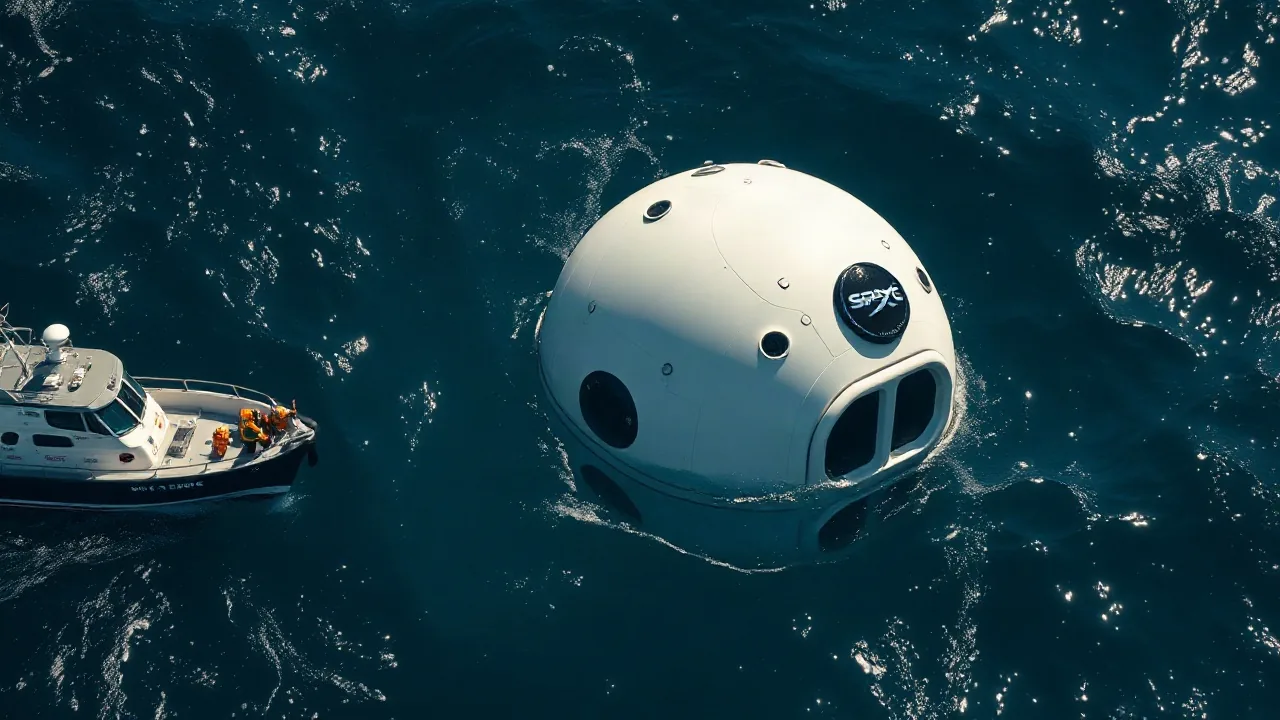
Four international astronauts concluded their eight-month mission aboard the International Space Station on October 10, 2026, splashing down safely in the Pacific Ocean. The SpaceX Crew Dragon spacecraft, named 'Endurance,' carried NASA astronauts Commander Michael Barratt and Pilot Jeanette Epps, along with Japan Aerospace Exploration Agency (JAXA) astronaut Takuya Onishi and European Space Agency (ESA) astronaut Sophie Adenot, back to Earth.
The capsule successfully separated from the ISS and executed its deorbit burn before reentry. Mission Control closely monitored the descent, which culminated in a splashdown approximately 100 miles southwest of Los Angeles, California. Recovery crews were on standby to retrieve the astronauts and the capsule shortly after touchdown. This mission marked a significant duration for the crew, pushing the boundaries of extended human presence in low Earth orbit.
Mission Accomplishments and Future Endeavors
During their 247 days in space, the Crew-12 astronauts conducted a wide array of scientific experiments and critical maintenance tasks aboard the orbiting laboratory. Their research spanned fields such as human physiology in microgravity, advanced materials science, and Earth observation. One notable experiment involved studying the long-term effects of space travel on bone density, data crucial for future deep-space missions. The crew also contributed to the station's upkeep, performing spacewalks to upgrade equipment and ensure the smooth operation of vital systems.
The successful return of the Crew-12 mission underscores the reliability of the SpaceX Crew Dragon spacecraft and its role in maintaining continuous human presence on the ISS. NASA and its international partners rely on these commercial crewed flights to facilitate scientific research and astronaut training. The agency highlighted that these long-duration missions provide invaluable insights into the challenges and adaptations required for humans to live and work in space for extended periods, a key stepping stone for ambitions such as returning humans to the Moon and eventually traveling to Mars.
Speaking after the mission, astronaut Jeanette Epps stated, "It's an incredible feeling to be back home. The work we did up there was vital, but returning to family and feeling gravity again is a profound experience." Commander Michael Barratt added, "This mission has been a testament to international cooperation and scientific dedication. We learned so much, and I am proud of what this team accomplished." The astronauts will now undergo medical evaluations and debriefings to share their experiences and data.
The International Space Station continues to serve as a unique platform for scientific discovery and technological advancement. The seamless transition between crews is vital for the uninterrupted operation of the station and its ongoing research. The safe return of Crew-12 paves the way for the next expedition, which is set to launch in the coming weeks, ensuring that the vital work aboard the International Space Station continues uninterrupted.