
Antarctic Titanosaur Fossil Found After Decades in Drawer
A rare titanosaur dinosaur fossil, discovered in Antarctica in 1985 but unidentified for decades, has finally been recognized by scientists. The bone was found tucked away in a drawer at the British Antarctic Survey.

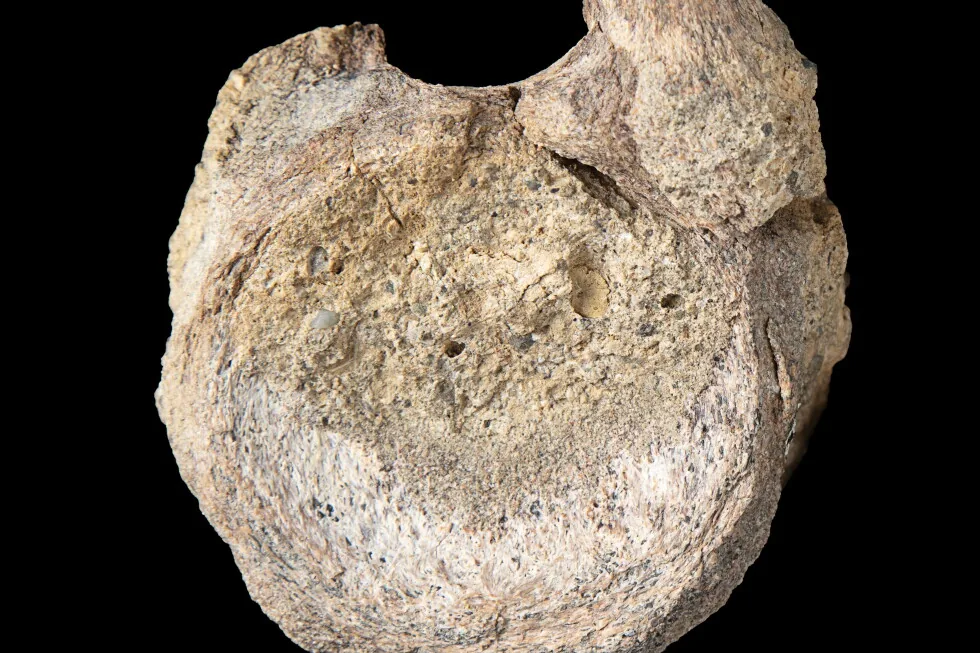
Scientists have identified a rare dinosaur fossil from Antarctica, a significant find that had been stored unnoticed for decades. The bone belongs to the tail of a titanosaur, a large, long-necked, plant-eating dinosaur. While its exact species remains unidentified, the discovery offers a rare glimpse into the prehistoric life of the continent.
The fossil was originally collected in 1985 by geologist Mike Thomson during an expedition to Antarctica’s James Ross Island. Thomson, who was working with the British Antarctic Survey at the time, was mapping rock layers and gathering marine reptile fossils to aid in dating efforts. He logged the specimen as a large reptile, unaware of its true prehistoric significance.
Decades later, paleontologist Mark Evans, a co-author of the study, encountered the bone in the British Antarctic Survey's extensive collections. Intrigued by its potential, he and his research team undertook a detailed analysis. By examining the bone's unique shape and comparing it with known dinosaur remains, they confirmed it was indeed a dinosaur fossil. The findings were officially published this week in the journal Acta Palaeontologica Polonica.
A Prehistoric Landscape Transformed
Fossils are notoriously scarce in Antarctica due to its harsh, icy environment. However, millions of years ago, when this titanosaur roamed, the region presented a vastly different picture. "The region was populated by lush forests — a rather different and much more hospitable place than we think of today," explained study co-author Paul Barrett of the Natural History Museum in London. This contrast highlights the dramatic geological and climatic shifts the continent has undergone.
The dinosaur itself was relatively small for a titanosaur, measuring approximately 23 feet (7 meters) in length. Researchers speculate it may have been a young individual. While the circumstances of its death remain unknown, scientists hypothesize its carcass may have floated offshore and sunk to the seabed, where it became preserved in marine sediment. The advancement of scientific technology since the bone's initial collection has allowed for more sophisticated analysis, including peering inside the bone structure to glean further details about the ancient creature.
Mike Thomson, the geologist who first collected the specimen, passed away in 2020 before the fossil could be identified as a dinosaur. "If he were still with us, he would be delighted to know what this was," Evans stated, reflecting on the serendipitous nature of the discovery and the posthumous recognition of Thomson's initial find.