
4.1 Billion-Year-Old Martian Meteorite Unearthed in Sahara
A meteorite discovered in the Sahara Desert, dated to 4.1 billion years old, offers unprecedented insights into Mars' ancient history and its potential for water.

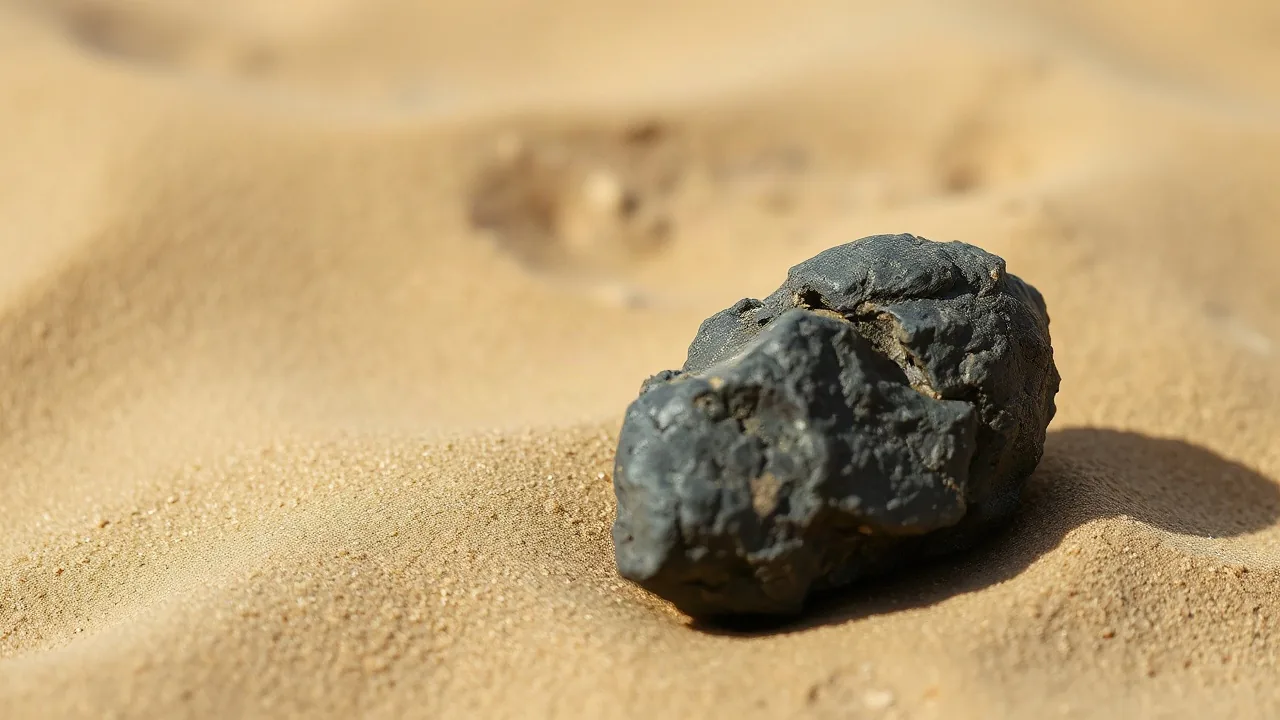
A remarkable Martian meteorite, unearthed in the vast expanse of the Sahara Desert, has been dated to an astonishing 4.1 billion years old, making it one of the oldest known rocks from the Red Planet. The discovery, detailed in a NASA-funded study, provides scientists with a unique opportunity to understand Mars' early geological history and the conditions that might have supported life billions of years ago.
The meteorite, identified as Teghaza 001, was discovered in the Sahara and has undergone extensive analysis to determine its age and origin. Researchers utilized advanced dating techniques to establish its ancient timeline, revealing it solidified just a few hundred million years after the formation of the solar system. This makes it a crucial artifact for understanding the primordial stages of planetary evolution.
Scientists are particularly interested in the meteorite's potential to reveal clues about the presence of water on early Mars. The geological features and mineral composition of Teghaza 001 are being scrutinized for evidence of past liquid water, a key ingredient for life as we know it. This ancient Martian rock is being hailed as a potential 'Rosetta Stone' for deciphering the planet's watery past.
Early Martian Environment Reconstructed
The significance of this 4.1-billion-year-old meteorite lies in its ability to offer a direct glimpse into an era of Mars' history that is otherwise difficult to study. While surface features on Mars provide some information, their age and geological context can be obscured by billions of years of erosion and volcanic activity. Rocks like Teghaza 001, having traveled through space, offer a preserved snapshot of conditions on Mars when the planet was young and potentially more habitable.
Dr. Anya Sharma, lead geochemist on the NASA-funded study, stated, "This meteorite is an invaluable window into a formative period of Martian history. Its composition suggests a different early Mars than we often imagine, one with complex geological processes underway very early on." The research team is employing isotopic analysis to trace the origin of elements within the meteorite, hoping to link it to specific regions on Mars that might have hosted ancient lakes or oceans.
The implications of finding evidence for water on early Mars are profound. If liquid water was present for extended periods, it significantly increases the possibility that microbial life could have emerged. This ancient Martian rock, therefore, is not just a geological specimen but a potential key to answering fundamental questions about life's origins beyond Earth. Further analysis is expected to refine our understanding of the geological evolution of Mars and its potential habitability throughout its history.
The scientific community is eagerly awaiting further publications detailing the specific mineralogical and chemical findings from Teghaza 001. The study’s findings are expected to influence future Mars exploration missions, guiding the selection of landing sites and research priorities in the ongoing search for signs of past or present life on the Red Planet. The Sahara Desert, a known treasure trove for meteorites due to its stable environment and sparse vegetation, has once again yielded a significant scientific prize.