
Payam Method Revolutionizes Piano Education, Students Dominate Competitions
The "Payam Method" is transforming piano education by making lessons fun and engaging. Students using this approach are achieving remarkable success in national competitions.

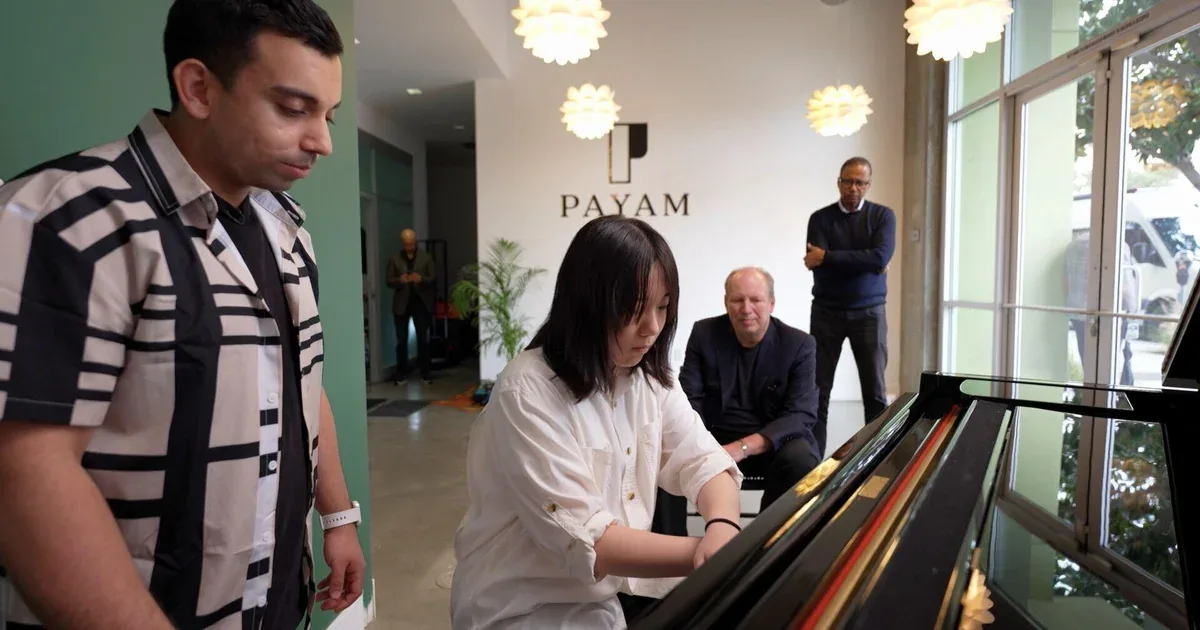
In a significant shift from traditional piano instruction, the "Payam Method," developed by 32-year-old Payam Khastkhodaei, is enabling students of all ages to not only enjoy learning but also achieve unprecedented success in national music competitions. Khastkhodaei, son of Iranian immigrants, has created a system that prioritizes student engagement and joy, leading to a dramatic increase in students reaching advanced levels and winning accolades.
Traditional piano education often involves strict adherence to sheet music and demanding practice, which can lead to frustration and high dropout rates. Khastkhodaei, however, challenges this paradigm, stating, "Piano's not supposed to be fun. It's supposed to be strict, it's supposed to be stressful, it's supposed to be, like, this very intense instrument you're learning. And we're like, 'Why? Like, why can't it be fun? Why can't we actually enjoy the songs we're learning?' Our students don't just learn piano, they love piano. And that's one of the biggest keys to it." This philosophy is implemented in his converted home studio in Bothell, Washington, where he and his former students, now teachers, guide learners from preschool beginners to high school talents, with lessons costing between $75 and $100.
The success rate of the Payam Method is striking. Khastkhodaei reports that while traditionally only 1% to 2% of students reach a "diploma" level, often referred to as the "black belt of the musical world," in his program, 96% achieve this milestone in approximately four years, compared to the usual 12.
From ABCs to Accomplishments
The core innovation of the Payam Method lies in its initial approach. Instead of starting with complex sheet music, students begin with fundamental building blocks like ABCs and 123s, and even by writing numbers directly on piano keys. This gamified introduction uses familiar tools to teach the language of music. "This is a song I would teach my three-year-old student that would come into class one day. And we understand this is one, this is five. They're not reading notes. They're not even sometimes looking at sheet music. We're playing a game," Khastkhodaei explained. This method builds coordination and understanding by mapping known concepts—letters and numbers—to a new system.
This playful, unconventional style has resonated with prominent figures. Oscar-winning composer Hans Zimmer, known for his film scores like "The Lion King," lauded the method, stating, "The operative word in music is, after all, play. So be playful." Zimmer, who himself had a challenging traditional music education, expressed that Khastkhodaei's approach is precisely what he wishes he had experienced earlier in his career.
The curriculum progresses through 18 levels, with students transitioning to sheet music. A student typically moves from the introductory stages to a level 13 proficiency within about a year and a half to two years, all while learning enjoyable songs. Beyond performance, students are also encouraged to compose their own music from an early age. For instance, 12-year-old Delara Rahmatian has already written several original compositions.
The competitive success of Payam's students is a testament to the method's efficacy. In the 2024 PTA Reflections competition, which garners hundreds of thousands of entries nationwide, Khastkhodaei's students achieved remarkable results. Out of 41 students submitted, they secured 13 out of 15 district winner titles and five Washington State first-place awards. Four of these students went on to win national medals, a significant accomplishment given the vast number of participants.
Hadi Partovi, co-founder and CEO of Code.org, recognized the potential of the Payam Method and has joined as CEO of Payam Music, aiming to expand the program nationally. Partovi sees strong parallels between teaching coding and teaching music with this method, noting, "We don't teach coding with ones and zeros or, you know, angle brackets and semicolons. We teach it with blocks and dragging and dropping to make it easier. Similarly, Payam Music teaches music starting with ABCs and 123s before you learn the code of how music is written." Partovi's involvement signals a strategic push to scale the Payam Method from its current few hundred students to a national presence, making engaging music education accessible on a much larger scale.