
Nvidia PAIR Leverages Home PCs to Boost AI Agent Performance
Nvidia has launched PAIR, an open-source system that allows users to offload AI agent tasks to other computers on their home network, speeding up processing and freeing up primary systems.

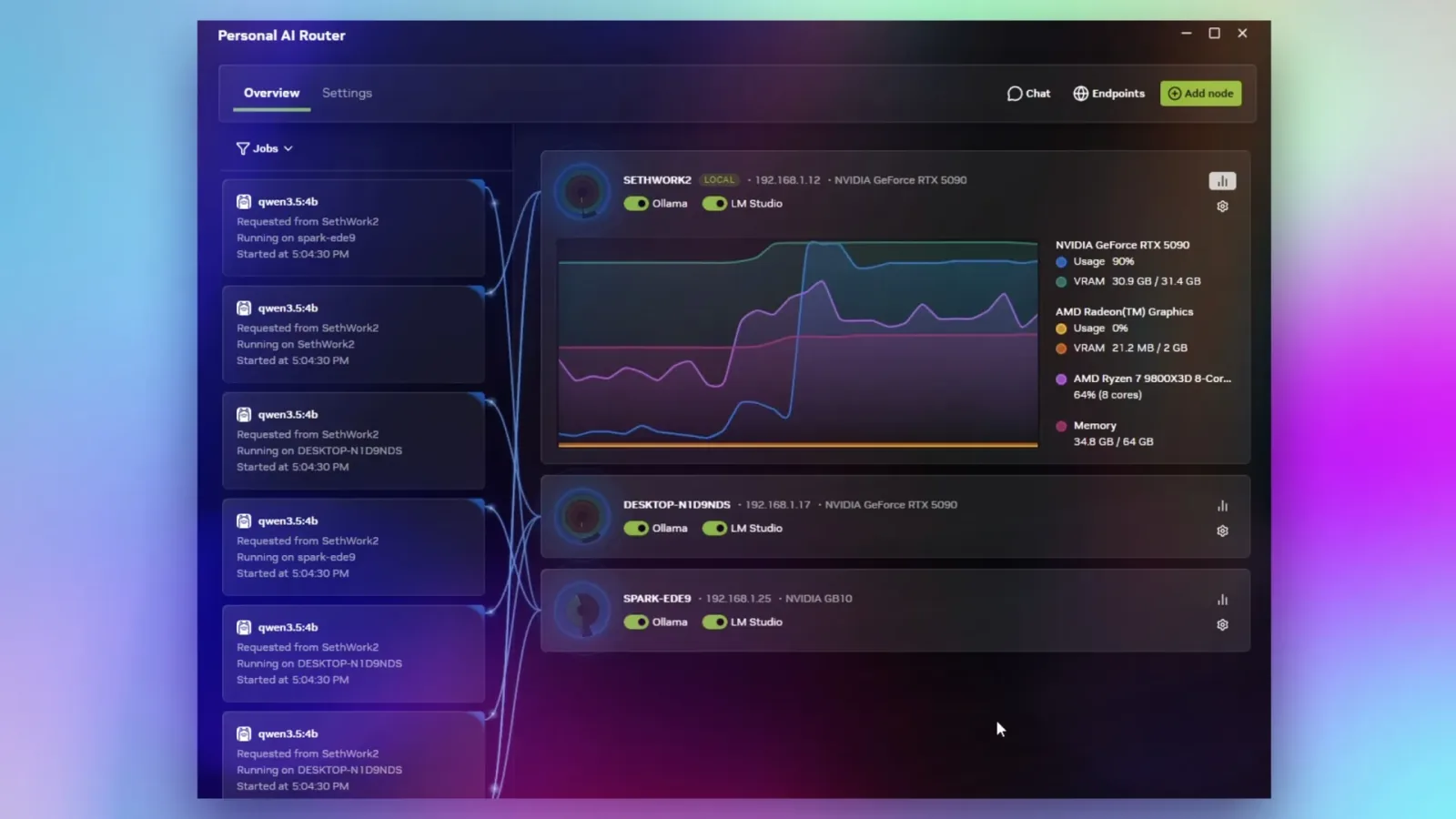
Nvidia unveiled its Personal AI Router, or PAIR, system, an innovative solution designed to accelerate the performance of artificial intelligence agents by distributing tasks across multiple devices on a local network. This new system is particularly beneficial for users who frequently require the processing power for complex or GPU-intensive AI agents within a home environment. PAIR enables the division of AI agent tasks into smaller, parallel subagents that can operate independently, thereby enhancing overall speed or alleviating the load on the main computing system.
The theoretical application allows a user to run PAIR on their primary desktop PC while delegating demanding tasks, such as analyzing vast photo libraries or managing smart devices, to other networked computers like MacBooks. These distributed tasks remain entirely within the local network, ensuring data privacy and security. PAIR is open-source, with its beta version accessible on GitHub starting today. It is built upon established network standards, including mDNS for device discovery and MTLS for robust security.
Decentralizing AI Workloads Locally
The PAIR system is compatible with Windows, macOS, and Linux operating systems. The primary system managing the AI agents requires an NVIDIA RTX-class GPU. While specific system requirements for Windows and Linux are not detailed by Nvidia, Macs need to be equipped with an M4-generation processor or a later model. For the remote systems to execute AI models, they must have the necessary compatible engines installed. Currently, PAIR supports the Ollama and LM Studio inference engines, with ongoing development expected to include further integrations.
Once the PAIR software is installed on all connected systems, users can initiate an AI agent, such as Hermes Desktop or OpenClaw, on the main computer. The primary agent then orchestrates the workflow, identifying subagents that can be executed in parallel and forwarding them to PAIR. PAIR acts as a proxy, assigning these subagents to available networked computers and collecting their results to feed back to the orchestrating agent. This ensures that the main agent focuses on task determination while PAIR manages the execution and communication across the network.
Nvidia is developing PAIR to allocate subagents based on several factors: the availability of a system to accept assignments, the presence of the required inference engine and AI model, the current processing load on the system, and its available GPU bandwidth. The software includes a dashboard for real-time monitoring of these operations. However, PAIR does not overcome fundamental limitations like insufficient processing power or memory on individual devices. It does not pool GPU resources or memory, meaning it cannot run models that exceed the native capacity of any single machine. Instead, each subagent is assigned to a single system, and tasks do not distribute across multiple machines simultaneously.
To optimize PAIR's performance, users may need to keep multiple networked devices powered on. It also remains to be seen how the system will handle potential conflicts, such as a user initiating a gaming session on a machine that is already running a critical AI subagent. Despite these considerations, Nvidia's PAIR represents a significant step towards making powerful AI accessible and efficient within personal computing environments by leveraging existing hardware resources.