
Atlantic Cold Blob and Gulf Stream Slowdown Threaten US East Coast
Scientists tracking a massive cold water anomaly in the Atlantic Ocean warn that a weakening Gulf Stream could expose the US East Coast to extreme weather and rising sea levels. The phenomenon signals potential climate tipping points.

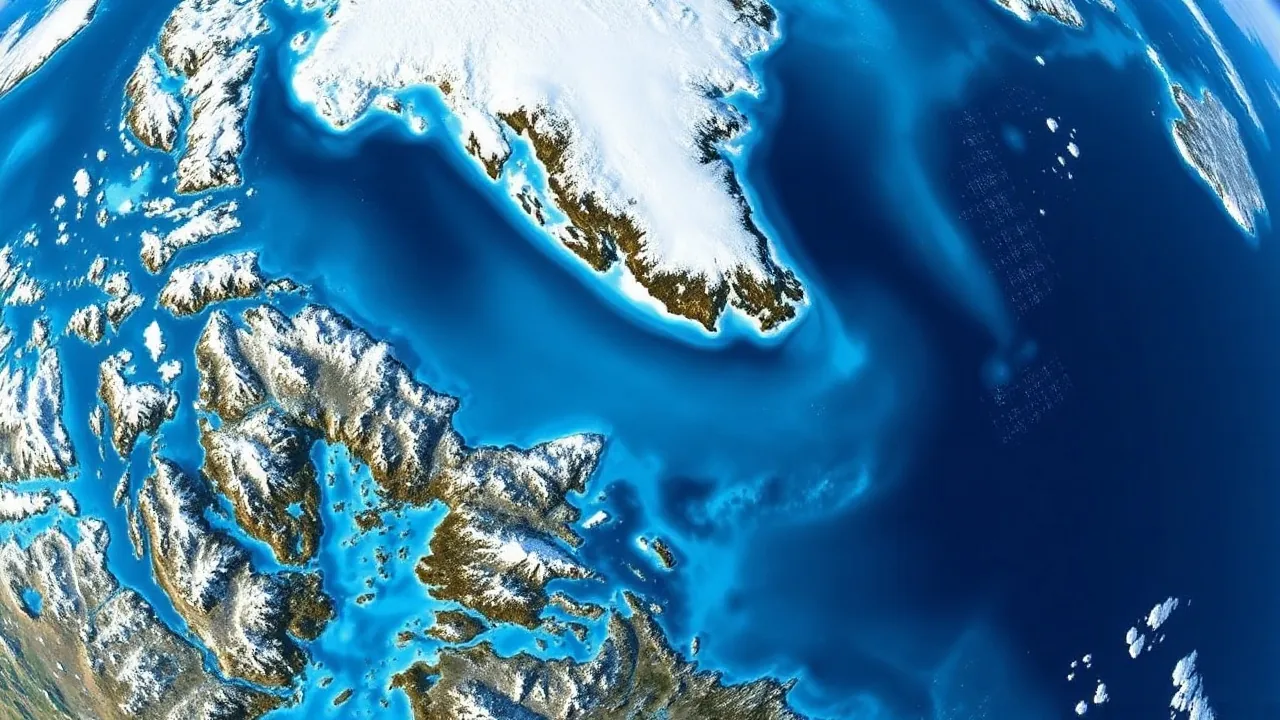
Oceanographers monitoring the North Atlantic have documented an unusual expanse of frigid water south of Greenland, colloquially termed the "Cold Blob," that is intensifying concerns about the stability of one of Earth's most critical ocean currents. The anomaly, visible in satellite data through August 2026, coincides with documented slowdowns in the Atlantic Meridional Overturning Circulation (AMOC), which includes the Gulf Stream. This circulation system regulates heat transport across the hemisphere and has maintained North American climate patterns for millennia.
The Cold Blob itself spans tens of thousands of square miles and represents water temperatures 1 to 3 degrees Celsius below historical norms for mid-summer. "What we are seeing is not typical variability," said Dr. Michael Weisman, senior climate scientist at the National Center for Atmospheric Research, in an interview conducted in July 2026. "The persistence and spatial extent of this cold water, combined with our observations of AMOC slowing, raises the question of whether we are approaching a transition point in the Atlantic system."
Gulf Stream Decline and Ocean Circulation
The Gulf Stream, a warm ocean current that originates in the tropics and flows northeastward along the US East Coast before crossing the Atlantic, has slowed by approximately 15 percent since 1990, according to peer-reviewed studies published in Nature Climate Change. This deceleration is driven largely by freshwater input from melting Greenland ice sheets and changes in surface salinity that disrupt the density gradients necessary to propel the current.
The slowdown cascades into measurable regional effects. When the Gulf Stream weakens, it transports less warm water northward, and simultaneously less cold water returns southward through deeper ocean layers. The Cold Blob emerges as a visible symptom of this imbalance. Scientists link the phenomenon to what they term climate tipping points, thresholds beyond which the Atlantic system could shift into a fundamentally different operating mode.
Historical records trapped in sediment cores and ice sheets show that the AMOC has undergone abrupt shutdowns or dramatic slowdowns several times in the past 100,000 years, events that reshaped precipitation patterns, temperature gradients, and sea level across the North Atlantic basin. A complete collapse would be irreversible on human timescales.
Immediate Impacts on the US East Coast
The weakening of the Atlantic cold blob circulation system poses direct threats to the densely populated US East Coast. One consequence is "compound sea level rise," in which reduced northward heat transport causes water to pool along the continental margin. Tide gauges from Massachusetts to Florida have measured relative sea-level rise of 4 to 5 millimeters annually over the past two decades, double the global average.
Researchers also warn of intensified extreme weather patterns. A sluggish Gulf Stream permits stronger temperature contrasts between warm tropical air masses and cold northern water masses, creating conditions favorable for rapid storm intensification. The 2024 and 2025 hurricane seasons demonstrated this dynamic, with several storms exhibiting unusual rapid-intensification rates within 24 hours of ocean passage.
Beyond storms and surge, the slowdown threatens fish populations and marine ecosystems upon which commercial fisheries depend. Cod, lobster, and other species are already migrating northward and to deeper waters as bottom and surface temperatures shift. This year, New England groundfish landings have declined 8 percent compared to 2025, attributed partly to thermal habitat squeeze.
Climate Change and Anthropogenic Drivers
Climate change is the primary driver of the changes now observable in the Atlantic. Rising global temperatures accelerate Greenland ice sheet melting, injecting freshwater into the ocean at rates not seen in at least 600 years. Between 2010 and 2020, Greenland lost approximately 280 billion metric tons of ice annually. By 2026, that rate has accelerated further, contributing an estimated 0.7 millimeters per year to global sea level rise in its own right.
The freshwater influx reduces the density of seawater at the ocean surface, weakening the gravitational pull that normally draws surface water downward in the Labrador Sea and Nordic Seas. This downwelling motion, called "convection," acts as a pump for the entire AMOC system. Without it, the current stalls.
Atmospheric warming also suppresses the temperature difference between tropical and polar regions, reducing wind forcing that otherwise sustains ocean currents. These mechanisms reinforce one another in a self-amplifying feedback loop.
Policy responses remain inadequate to prevent further deterioration. Global carbon emissions hit 37.5 gigatons in 2025 and are projected to remain above 37 gigatons in 2026, far exceeding the emission reductions needed to stabilize atmospheric CO2 concentrations at sustainable levels. Continued emissions trajectory virtually guarantees further AMOC weakening through the remainder of this decade.
Monitoring and Future Outlook
International research consortia, including the Rapid Climate Change program (RAPID) and the Atlantic Meridional Overturning Circulation and Heatflux Array (AMOHC), maintain moored instruments across the Atlantic to track current velocity, water mass properties, and heat flux in real time. These observations, updated monthly, confirm that the Cold Blob is not an isolated event but part of a broader, multi-decadal trend toward a weaker, colder Atlantic.
Projections from the Intergovernmental Panel on Climate Change (IPCC) Sixth Assessment Report, released in 2023 and updated with 2024 and 2025 data, indicate a 34 to 60 percent likelihood of substantial AMOC weakening by 2100 under current emission scenarios. The Cold Blob phenomenon, visible now in 2026, serves as an early warning signal.
For coastal communities, businesses, and policymakers, the convergence of scientific evidence demands urgent mitigation and adaptation planning. Energy infrastructure, real estate, insurance markets, and transportation networks along the US East Coast were designed for a stable 20th-century climate. The ocean, however, is signaling that those assumptions no longer hold.