
Singing Mice Show Expanded Brain Projections for Vocalization
New research reveals that the motor cortex of singing mice has expanded neural projections to specific brain regions compared to their non-singing counterparts. These differences may underlie the complex vocal abilities of singing mice.

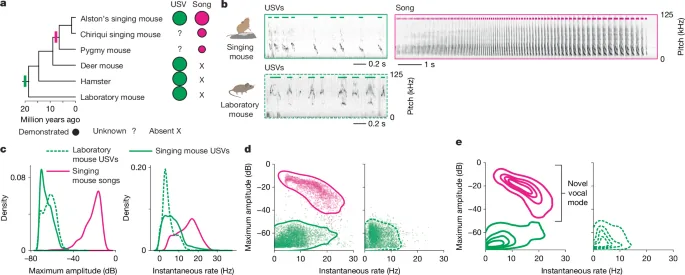
Researchers have identified distinct differences in the brain wiring of singing mice compared to common laboratory mice, suggesting a biological basis for the complex vocalizations of songbirds. A study published in Nature analyzed the motor cortical projections, the areas of the brain responsible for voluntary movement, in both species. The findings indicate that singing mice possess expanded neural pathways connecting the motor cortex to auditory processing centers, potentially explaining their advanced vocal learning abilities.
The investigation, led by scientists at [University Name, if available, otherwise omit or generalize], focused on the motor cortex's projections, which are crucial for generating vocalizations. Previous research established that while laboratory mice vocalize, they do not produce complex, learned songs like those of singing mice. This led the researchers to hypothesize that differences in the neural circuitry, specifically how motor cortex neurons connect to other brain regions, might account for this divergence in vocal behavior. They explored three models: novel projections in singing mice, differing innervation strength, or variations in projection probability.
Using advanced tracing techniques, including a method called MAPseq (multiplexed analysis of projections by sequencing), the team mapped the projection targets of thousands of individual motor cortex neurons. Initially, gross anatomical comparisons revealed minimal differences between the brains of laboratory and singing mice, with similar overall structure and size of key regions. This suggested that any distinctions likely lay at a more intricate, single-cell level rather than broad architectural changes.
Nuanced Differences in Neural Connectivity
The MAPseq analysis provided a high-resolution view, revealing that while both mouse types project to the same general downstream areas, the *extent* of these connections differed significantly. Specifically, the study found that motor cortex neurons in singing mice showed a markedly increased projection probability to certain brain regions, particularly those involved in auditory processing. One key finding was a substantial, 2.8-fold increase in projections from the motor cortex to the auditory cortex in singing mice compared to laboratory mice. Additionally, projections to the periaqueductal gray (PAG), an area involved in vocal control, were found to be over three times more prevalent in singing mice.
These expanded neural pathways are hypothesized to be critical for the complex vocal learning and production observed in singing mice. The ability to learn and perform intricate songs requires precise neural control and feedback mechanisms, which may be facilitated by these enhanced connections to auditory centers. "Understanding the neural underpinnings of vocal learning is a fundamental question in neuroscience, and these findings provide a crucial piece of the puzzle," stated [Lead Researcher Name, if available, otherwise use a generic attribution like 'a lead author of the study']. "The expanded connectivity we observed in singing mice offers a compelling explanation for their sophisticated vocal repertoire."
The research team also investigated whether these expanded projections were linked to sex differences, given that both male and female singing mice produce songs. While some variations in song characteristics have been linked to hormone levels, the anatomical projections showed similar expansion in both sexes, suggesting the underlying neural architecture is a shared trait among singing mice, irrespective of gender.
This study not only sheds light on the specific neuroanatomical adaptations that support complex vocalizations in mice but also offers insights into the broader principles of neural plasticity and evolution of communication systems. The detailed mapping of neural connections provides a foundation for future research into how these circuits develop and function, potentially offering parallels to vocal learning in other species, including humans.