
Bees Show 'Liking' and 'Disliking' Behaviors, Slow-Motion Video Reveals
New research using slow-motion video suggests bumblebees exhibit behaviors akin to 'liking' or 'disliking' after tasting different solutions, mirroring reactions seen in mammals. Scientists analyze these movements for insights into insect inner lives.

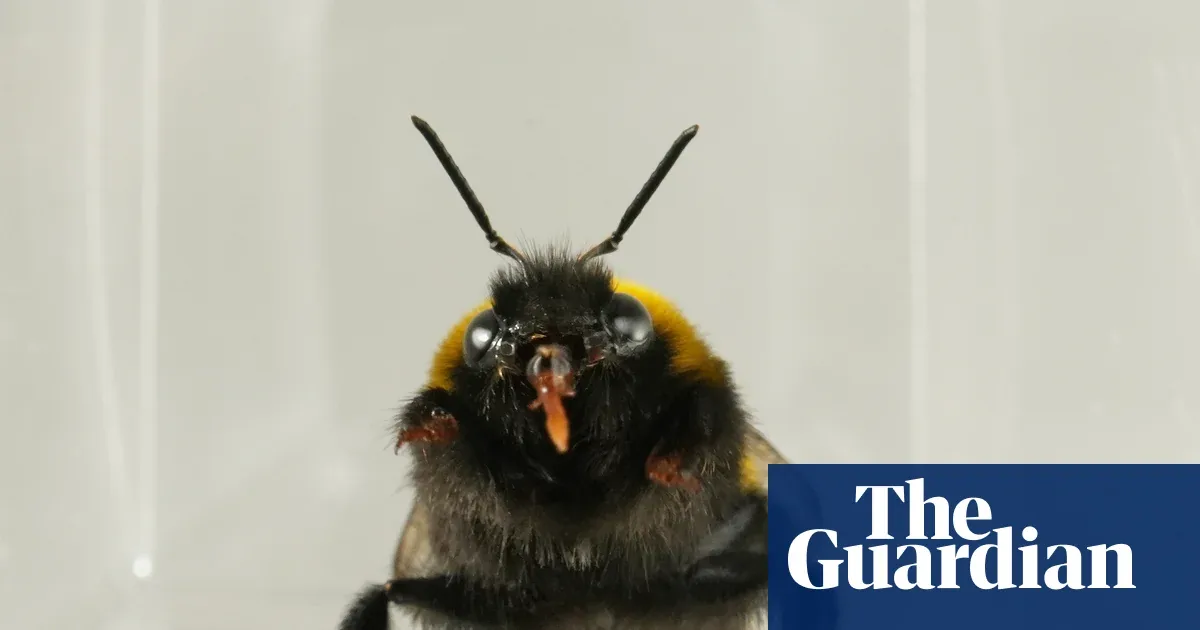
Scientists have captured subtle yet significant behaviors in bumblebees using slow-motion video, revealing reactions to tastes that researchers interpret as indicators of "liking" and "disliking." The findings, published in the journal Proceedings of the National Academy of Sciences, suggest that these insects may possess a rudimentary "inner life," challenging long-held views about insect cognition.
The study, a joint effort between Macquarie University and the Southern Medical University in China, involved presenting bumblebees with various liquid solutions, including high and low concentrations of sugar, plain water, salt, and quinine. Researchers meticulously recorded the bees' responses, particularly the movements of their mouthparts, known as the glossa.
When exposed to sweet solutions, bees exhibited what researchers termed "post-consumption glossa," a prolonged licking action after ingestion, analogous to mammals licking their lips. Conversely, after tasting unpleasant solutions like salt or quinine, the bees displayed behaviors such as head shaking and mouth wiping, actions similar to facial expressions of distaste in other animals.
Professor Andrew Barron, a researcher of insect behavior at Macquarie University and a co-author of the paper, explained the significance of these observations. "Facial expressions are an important window into the internal states of animals," Barron stated. "What we found is that bees show responses with their mouths to solutions that indicate their subjective like or dislike of those solutions. It tells us there is an inner life to the insect."
Establishing evidence of pleasure or pain in animals, especially those lacking complex language, often relies on observing behavioral markers. Previous research has documented similar "liking" and "disliking" expressions in mammals like primates and rats. For instance, rats that taste something aversive may wipe their mouths and whiskers. Barron noted, "And we see something similar in a bee." However, while such findings in mammals are widely accepted, applying the concept of an inner life to insects has remained a contentious issue.
Context and Alternative Explanations
To ensure these behaviors were not simply involuntary chemical reflexes, the scientists conducted rigorous tests across 18 bumblebee colonies under diverse conditions. They examined responses when bees were heat-stressed, satiated, or had ingested various drugs. Crucially, the bees' reactions varied with context. For example, heat exposure altered their responses to water and salty solutions from neutral or aversive to positive. Barron likened this to a human finding an electrolyte drink palatable only after intense physical exertion on a hot day.
Associate Professor Thomas White, an entomologist from the University of Sydney not involved in the study, commented on the rapid advancements in insect behavior research. He highlighted that this study's focus on positive experiences is particularly noteworthy, as much of the existing research tends to concentrate on negative sensations like pain or fear. "The picture is increasingly pushing towards a view that insects, or many insects, have some simple capacity to feel the world, not just to assess it and detect it and process information but to actually have a point of view," White said.
This perspective challenges common assumptions about sentience and the ethical considerations owed to different species. The idea that insects might experience subjective feelings complicates traditional boundaries drawn in the animal kingdom regarding pleasure and pain. "It cuts against a lot of people's intuition about where we might draw the line in the animal kingdom, as to what can feel pleasure and pain, and hence the kind of ethical and moral responsibilities we have towards those animals," White added.
Barron concluded by addressing the enduring dichotomy in how insects are perceived: as sentient beings or as mere biological machines. "There’s always been a tension between thinking of insects as animals, or some sort of mini robots," he said. "This is another step towards showing there’s an inner life to being a bee." The research on insect behavior and cognition continues to evolve, offering a deeper understanding of the complex inner worlds of even the smallest creatures.