
Ancient Otter-like Mammal Swam Mesozoic Rivers, Fossils Reveal
Fossil evidence reveals a small, otter-like mammal that swam ancient rivers and lakes during the age of dinosaurs, challenging previous understandings of mammalian evolution.

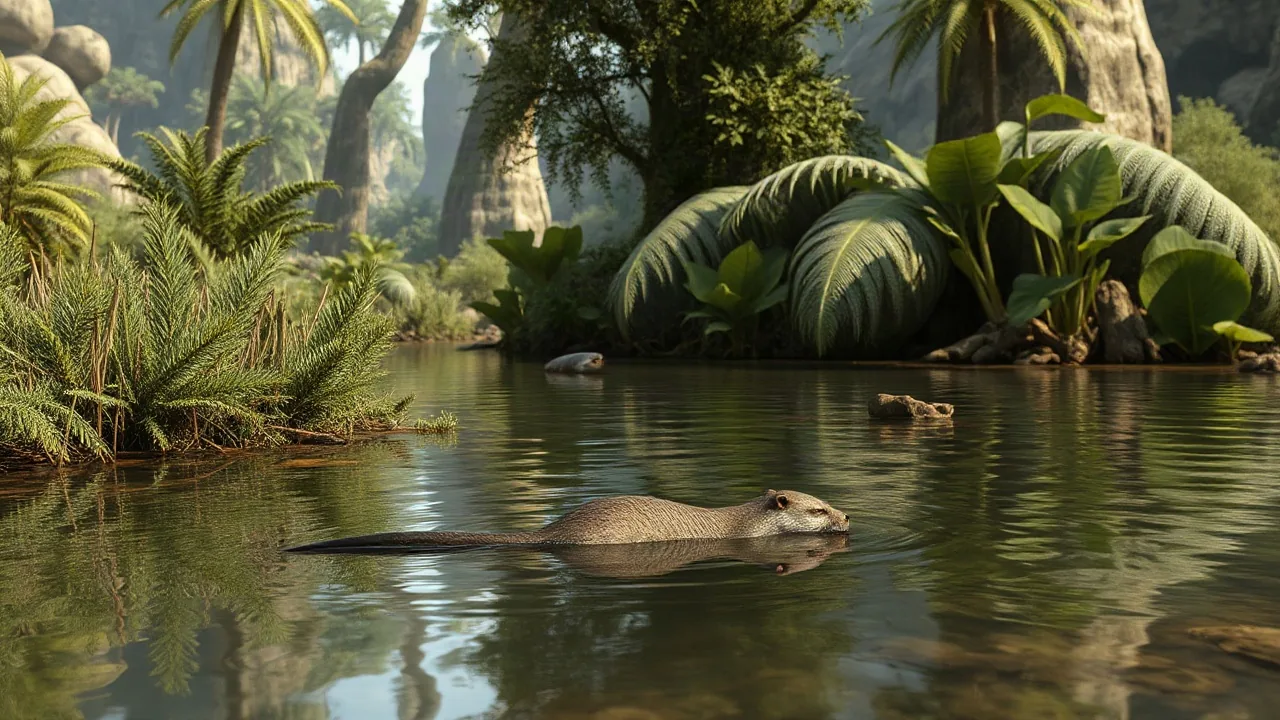
Scientists have unearthed fossilized remains of a remarkable mammal that navigated the waterways of the Mesozoic Era, a time dominated by dinosaurs. This ancient creature, described as otter-like, possessed unique adaptations for a semi-aquatic lifestyle, pushing back the timeline for such specialized mammalian traits. The discovery, detailed in the journal Nature, offers new insights into the diversity and adaptability of mammals during a period when reptiles were the planet's dominant life forms.
The fossil, found in China, belongs to a group of extinct mammaliaforms known as eutriconodonts. Named *Potamogale paradoxus* by researchers, this small mammal measured about 30 centimeters (12 inches) in length and exhibited a long, streamlined body and a paddle-like tail, suggesting it was well-suited for swimming. Its skeletal structure indicates powerful limbs adapted for propelling itself through water, while its teeth suggest a diet of fish and aquatic invertebrates.
Mammalian Adaptations Evolved Early
Perhaps the most significant finding relates to the evolution of the mammalian pharynx, the part of the throat behind the mouth. Analysis of the fossil's cranial features suggests that *Potamogale paradoxus* had a specialized pharyngeal structure that allowed for both breathing and swallowing simultaneously, a trait previously thought to have evolved much later in mammalian history. This complex anatomy is crucial for efficient aquatic feeding, preventing choking when submerged. Dr. Mei Ling Chen, lead paleontologist on the study from the Chinese Academy of Sciences, stated, "This discovery fundamentally alters our perception of early mammalian capabilities. We are seeing sophisticated adaptations for aquatic life and specialized feeding mechanisms far earlier than anticipated."
The discovery of *Potamogale paradoxus* also sheds light on the evolutionary pressures faced by early mammals. As dinosaurs ruled the terrestrial ecosystems, mammals often occupied smaller niches, with some venturing into aquatic environments to exploit different food resources. This ancient swimmer demonstrates that even in the shadow of giants, mammals were undergoing significant evolutionary diversification, developing complex adaptations to thrive in varied habitats. The fossil’s preservation offers a rare glimpse into the soft tissues of the throat, providing unprecedented detail about its respiratory and digestive systems. This level of detail is exceptionally rare for fossils from the Mesozoic Era.
Researchers employed advanced imaging techniques, including micro-CT scans, to reconstruct the intricate anatomy of the fossilized pharynx. The findings indicate that this ancient mammal had a specialized “gular pump” mechanism, enabling it to manage air and water flow while feeding underwater. This is a critical adaptation for any aquatic predator that needs to efficiently consume prey in its environment. The presence of a third set of teeth, typically used for crushing, further supports the hypothesis of a varied diet that included hard-shelled aquatic creatures. The fossil record has long been incomplete regarding the soft tissues of ancient mammals, making this find particularly valuable.
The implications of this discovery extend beyond just understanding early mammals. It suggests that the evolutionary pathways leading to modern semi-aquatic mammals, such as otters and seals, may have roots stretching back to the age of dinosaurs. This ancient swimmer was not a direct ancestor to modern forms but represents a separate evolutionary experiment in aquatic adaptation, highlighting convergent evolution. The study underscores the complexity and richness of mammalian evolution, revealing that our ancestors were far more diverse and adaptable than commonly assumed, even during periods of extreme environmental dominance by other species. The researchers plan further analysis of the fossil and hope to find more specimens to build a more complete picture of this fascinating ancient mammal.