
Marine Amphibian Fossils Reveal Ancient Seafloor Dweller
Fossils discovered in China suggest an ancient amphibian species, dating back 237 million years, lived exclusively in marine environments. This finding challenges previous understandings of early amphibian evolution and their adaptation to aquatic life.

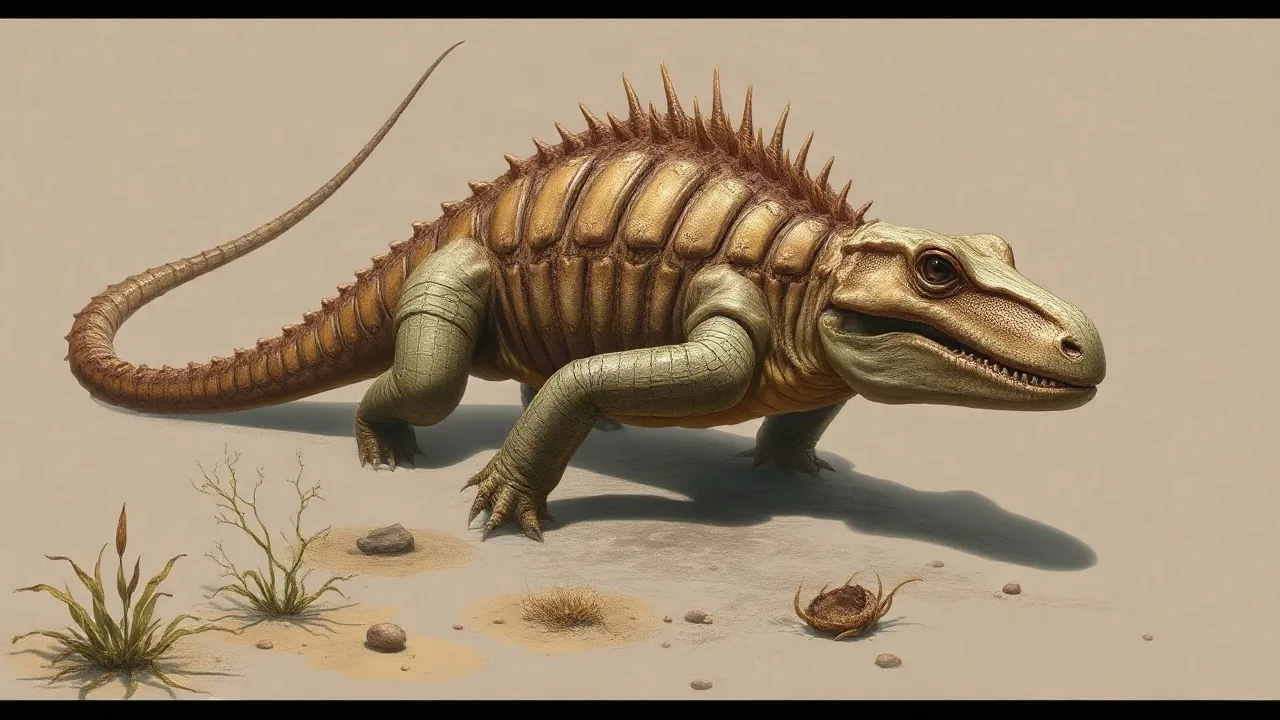
Paleontologists have identified an ancient amphibian species that spent its entire existence in the sea, with fossil evidence pointing to its life 237 million years ago during the Late Triassic period. The remarkably preserved skeleton, unearthed in China in 2004, offers new insights into the evolutionary paths of early amphibians and their unexpected adaptation to fully marine lifestyles.
This unique creature, part of the stem amphibian lineage, possessed a robust, bony body and is believed to have navigated the seafloor. Its discovery fills a significant gap in our understanding of amphibian diversification and their ability to exploit diverse ecological niches, including the challenging marine realm, long before the rise of many other familiar aquatic vertebrates.
Ancient Marine Adaptation
The findings, published in the journal Nature, highlight the significant evolutionary pressures and opportunities present during the Triassic. While many amphibians today are primarily freshwater or terrestrial, this ancient species, tentatively named Chongyiichthys yuani, demonstrates that early amphibians were capable of a complete transition to saltwater environments. The fossil's skeletal structure suggests adaptations for buoyancy and possibly locomotion on soft marine sediment, distinguishing it from its freshwater relatives.
Dr. Chun Li of the Institute of Vertebrate Paleontology and Paleoanthropology in Beijing, who led the research, stated, "This specimen represents the earliest known fully marine stem amphibian. Its anatomy provides crucial clues about how these early tetrapods adapted to life in the ocean." The research team analyzed the skeletal morphology to infer its lifestyle, noting the absence of features typically associated with a terrestrial existence, such as robust limb structures for weight-bearing on land.
Prior to this discovery, the fossil was an enigma, its specific identity and ecological role unclear. However, detailed comparative anatomy with other Triassic vertebrates and amphibians has now allowed scientists to place it definitively as an early amphibian adapted to a marine existence. This suggests that the evolutionary experiments of early tetrapods were more varied than previously assumed, with multiple lineages exploring marine waters.
The implications of this discovery extend to understanding the broader ecosystem of the Late Triassic oceans. The presence of a relatively large, bottom-dwelling amphibian indicates a complex food web with available prey and a stable marine environment capable of supporting such life. It also raises questions about the environmental conditions that may have driven amphibians away from freshwater habitats and into the sea. Some researchers propose that increased competition or predation in freshwater systems could have pushed certain groups to explore new territories.
The specific geological formation where the fossil was found in the Guizhou Province of China has yielded other significant marine vertebrate fossils, providing a valuable snapshot of life during this geological epoch. The fine-grained sedimentary rock preserved the delicate skeletal details, making it an invaluable specimen for scientific study. Further analysis of the fossil's bone microstructure and the surrounding sedimentary matrix is ongoing to provide more detailed information about its growth, diet, and the environment it inhabited.