
Dante's Inferno Geometry Matches Planetary Impact, Study Suggests
A new study proposes that the structure of Hell in Dante Alighieri's "Inferno" mirrors planetary impact craters, suggesting the poet may have intuitively grasped geophysical phenomena centuries before modern science.

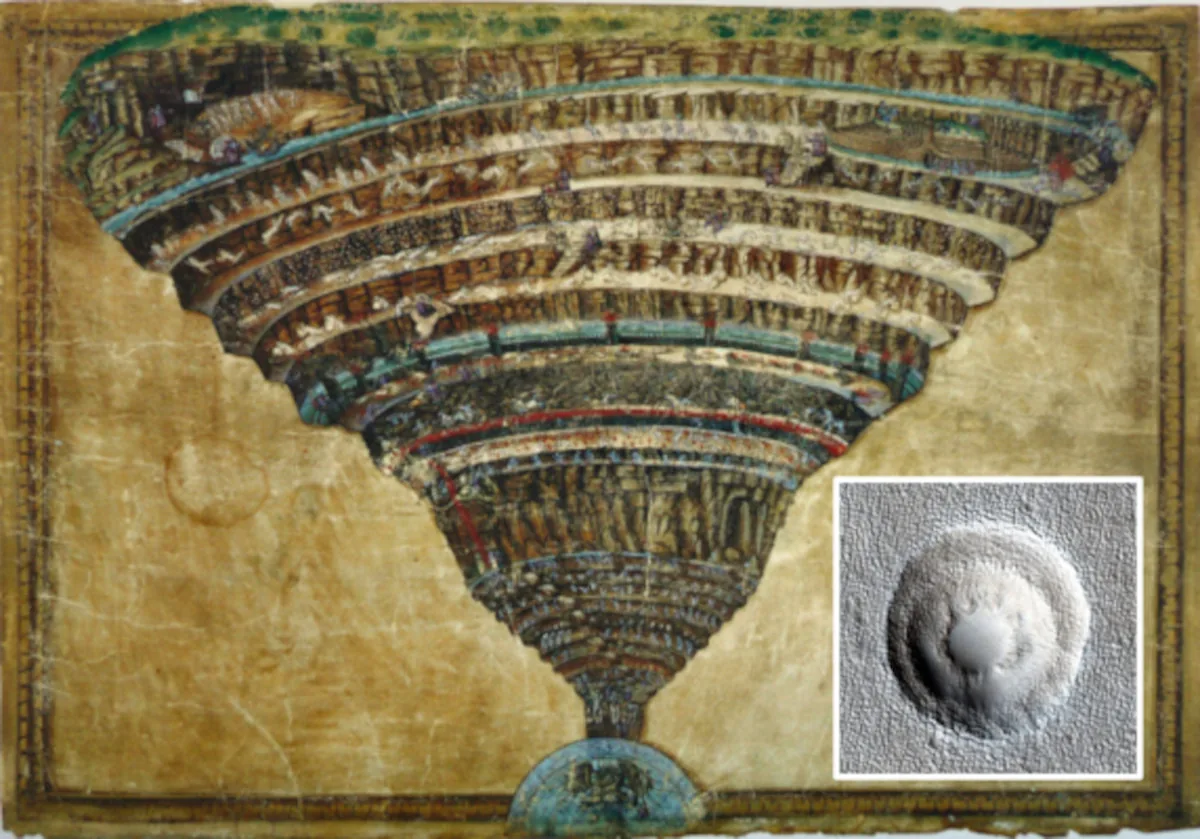
A striking new study presented at the European Geosciences Union (EGU) General Assembly in Vienna posits that the chilling architecture of Hell as depicted in Dante Alighieri's "Inferno" bears a remarkable resemblance to the physical structure formed by a massive planetary impact event. Researchers, led by Dr. Iain Stewart of the University of Plymouth, argue that the 14th-century masterpiece may have encoded sophisticated geophysical knowledge, predating modern scientific understanding by approximately 500 years.
Dante's "Inferno" famously portrays Hell as an immense, inverted conical pit descending through nine concentric circles into a frozen core. The study's analysis suggests this geometry aligns with what contemporary planetary scientists term a "complex impact crater." These features arise when an asteroid of significant size collides with a celestial body, causing the rock to behave akin to a fluid. Key characteristics of such craters include terraced inner walls, a central uplift, and a broad, relatively flat floor—elements that the research indicates map with surprising fidelity onto Dante's layered underworld.
Geophysical Echoes in Medieval Literature
The nine circles of Hell, as described by Dante, show striking parallels to the terraced ridges observed in large meteor strikes on planets like Mars, such as the impact crater in Arcadia Planitia. The study highlights that Dante was deeply immersed in the natural philosophy of his era, drawing from the works of Aristotle and the Arabic scholars who preserved classical learning for medieval Europe. The research proposes that Dante, consciously or not, captured the essential morphology of a large impact structure, a description that geologists would formally articulate only half a millennium later.
Scientists have previously explored ancient and medieval texts for evidence of advanced natural knowledge. For instance, researchers have suggested that ancient civilizations at sites like Göbekli Tepe may have tracked cometary activity, and that global myths preserve recollections of catastrophic impact events. This new study fits within this broader field of "archaeo-geophysics," which seeks to uncover scientific understanding embedded within pre-modern cultural artifacts. Dr. Stewart presented these intriguing findings at the EGU General Assembly, one of the world's foremost congregations of earth and planetary scientists.
The researchers point to the Chicxulub impact crater, the 66-million-year-old scar beneath the Gulf of Mexico left by the asteroid responsible for the extinction of the dinosaurs, as a prime example. Chicxulub stands as one of the most extensively studied complex impact craters on Earth. Its internal structure—featuring a peak ring, terraced walls, and a central basin—provides a tangible terrestrial analogue for the geometry described in Dante's Hell. While the study does not assert that Dante possessed direct knowledge of Chicxulub, it contends that the physical intuitions derived from classical philosophy may have guided him toward a geometrically accurate model of a large impact structure.
The authors acknowledge that the scale of Dante's Hell, estimated to be roughly the size of the Mediterranean basin, could be coincidental rather than direct evidence of planetary impact knowledge. However, as Heritage Daily reported on the study, it "raises the intriguing possibility that Dante's vision of Hell was not purely theological but also reflected an intuitive grasp of planetary physics." This perspective positions the "Divine Comedy" as a work potentially remarkable for its scientific prescience as much as for its poetic brilliance.
The work, while not yet published in a peer-reviewed journal, remains speculative. Nevertheless, the researchers maintain that Dante's profound spatial imagination, combined with the physical principles inherited from classical philosophy, resulted in a depiction of Hell that closely corresponds to the structure of a large impact crater. This hypothesis suggests that the legendary poet might have been centuries ahead of his time in his intuitive understanding of geophysical processes, offering a fascinating intersection of literature, history, and science.