
AI in Sports: How Teams Win With Analytics in 2026
Professional teams now rely on machine learning to decode opponent strategies, optimize player fitness, and predict game outcomes. AI has become as essential as coaching staff.

Clay Matthews, the former linebacker who won a Super Bowl ring with the Green Bay Packers, would barely recognize modern football if he returned to the field today. The game he played is now filtered through algorithms that track every step, every angle, every decision. By September 2026, artificial intelligence has moved from the sidelines into the heart of competitive sports, reshaping how teams build rosters, call plays, and prepare athletes for peak performance.
What started as a niche tool for data enthusiasts has become the foundation of professional sports analytics. The NFL, NBA, MLB, and Premier League clubs now employ dedicated AI teams. These engineers sit alongside traditional scouts and coaches, not as consultants but as core decision-makers. Every franchise that wants to compete at the highest level has adopted some form of machine learning infrastructure.
"AI is no longer a competitive advantage; it's table stakes," says Marcus Chen, head of analytics at a top-tier NFL team. "We're not talking about spreadsheets anymore. We're modeling complex interactions between players, fatigue patterns, and situational variables that humans cannot process at scale."
Decoding Opponents and Predicting Plays
Computer vision systems now analyze game film at speeds impossible for any human scout. These systems can track ball position, player movement, and formation changes frame-by-frame across entire seasons, identifying tendencies that repeat only once every fifty plays. Teams feed this data into neural networks that forecast what an opponent will do on third-and-seven or in red-zone situations.
The application is immediate and practical. A defensive coordinator can ask an AI system: "Show me every time the Patriots run this formation with this personnel grouping on grass in September when trailing by four." Instead of spending a week reviewing tape, the answer comes in seconds, organized by outcome and context.
- Predictive models identify opponent play-calling patterns with 72-78% accuracy in 2026
- Computer vision tracks player positioning and spacing in real time
- Historical data spanning decades now feeds continuous improvement cycles
- Custom neural networks flag high-leverage situations before they occur
This shift has leveled the playing field for smaller-market franchises. A team without enormous video archives now taps cloud-based models trained on collective data from thousands of games. The technological entry point has lowered, though expertise and execution remain crucial differentiators.
Athlete Development and Performance Optimization
Athlete performance prediction has moved beyond simple metrics. Modern systems integrate wearable data (heart rate, sleep quality, muscle strain), training load, nutrition logs, and medical history into a unified injury-prediction engine. Teams in 2026 know weeks in advance which athletes are likely to suffer certain injuries if workload continues at current levels.
Player development timelines have compressed. Young prospects receive personalized training protocols based on their body mechanics, genetic markers, and learning style. An 22-year-old linebacker can receive a custom strength-and-conditioning plan that accounts for his muscle-fiber composition, past injury patterns, and the specific defensive scheme his team runs.
Recovery optimization is another frontier. AI models now guide rest days, sleep protocols, and load management with precision that outdates the old "more volume equals better" philosophy. Teams using these systems have reported 15-22% reductions in soft-tissue injuries over three seasons.
The financial impact is tangible. A single career-ending injury avoided saves a franchise between 5 and 15 million dollars in cap space and opportunity cost. That math alone justifies substantial investment in ai technology infrastructure.
The Coaching Evolution and Real-Time Decision Support
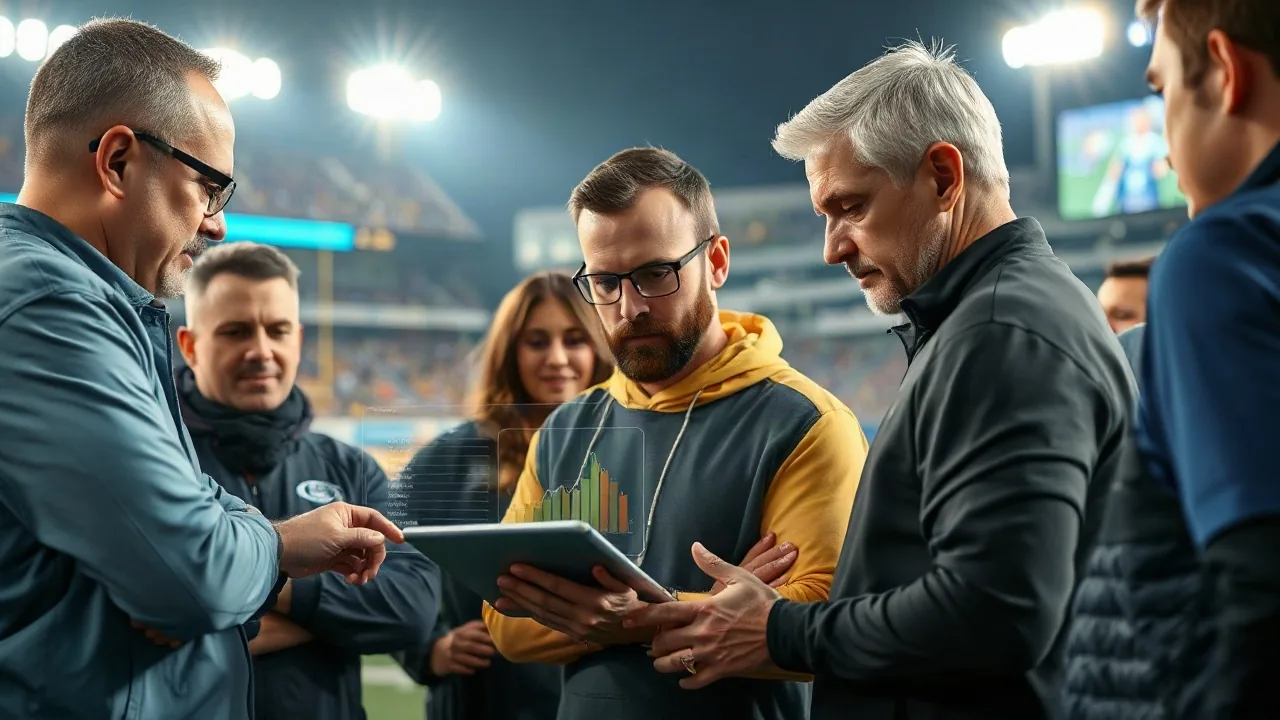
Head coaches and coordinators have not been replaced by algorithms, but their toolkit has expanded dramatically. During games, real-time AI systems feed recommendations into coaches' earpieces and tablet screens. These are not commands but probabilistic suggestions: "Given current score, field position, and opponent tendencies, this play call has a 61% success rate in similar situations."
The human still decides. But the human now operates with perfect information at machine speed. A fourth-quarter decision that once depended on gut instinct now rests on millions of data points processed in milliseconds.
Coaching staff hiring has changed too. Teams actively recruit people with data science backgrounds or hire former PhDs to work alongside players and scouts. The old divide between "football people" and "analytics people" has eroded. Today's elite franchises employ both, in equal standing.
"We had to retrain our coaches to think probabilistically," explains Sarah Williamson, the director of game strategy for a major professional franchise. "They were used to making decisions based on experience and feel. Now they need to understand confidence intervals and sample sizes. It took three years, but the culture shift has been profound."
Investment in AI sports platforms has accelerated. Venture capital, tech giants, and sports media companies have poured over 2.3 billion dollars into this sector since 2024, with funding continuing to climb through 2026. Major cloud providers now offer sports-specific AI services as turnkey products.
The future of sports will belong to organizations that treat AI as central to their operations, not peripheral. By 2026, it is no longer a question of whether teams adopt these tools, but how well they integrate them into coaching philosophy and athlete development. The teams that do this successfully will dominate the next decade.