
Sun's Surface Revealed in Unprecedented Detail by New Telescope Images
Scientists have captured the most detailed images of the sun's surface ever, thanks to the Daniel K. Inouye Solar Telescope. The new visuals reveal dynamic, feathery patterns on the solar shell.

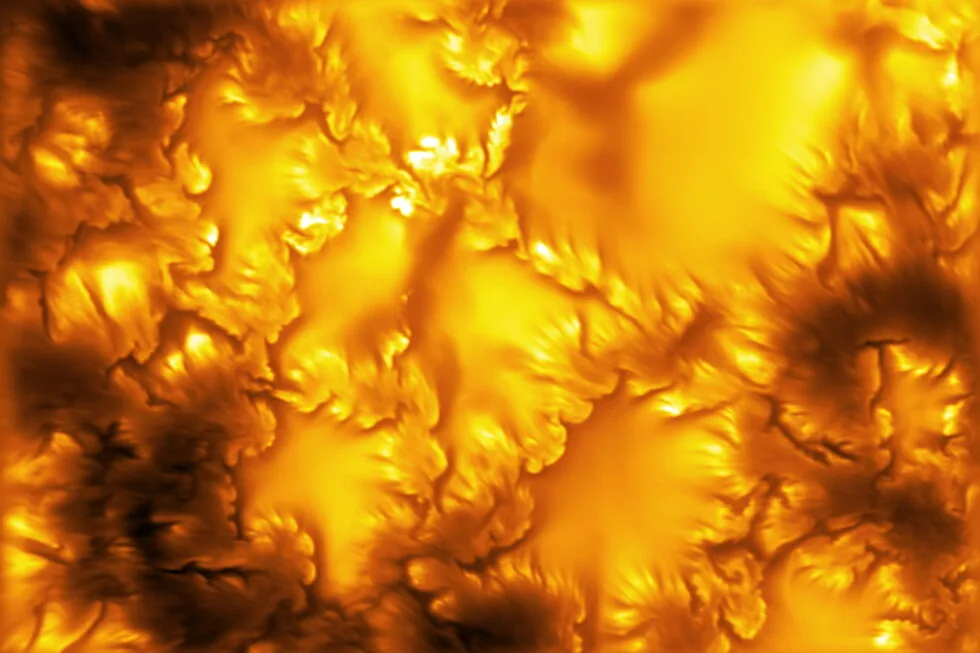
Scientists have captured unprecedentedly detailed images of the sun’s surface, revealing a dynamic and complex facade never before seen so clearly. These groundbreaking visuals were obtained using the National Science Foundation’s Daniel K. Inouye Solar Telescope, situated atop Haleakalā on the island of Maui, Hawaii. While the sun is an object of immense scientific interest, direct observation without protective equipment is perilous. The images were initially taken to test and calibrate the telescope's advanced capabilities.
Upon reviewing the data, researchers were astonished to find they had photographed the sun’s brilliant outer layer at a resolution surpassing all previous attempts. The new imagery showcases strange, feathery patterns rippling across the solar surface, prompting comparisons to the swirling, artistic skies depicted in famous artworks. Solar physicist Ruizhu Chen of Stanford University, who was not part of the research team, remarked, "That reminds me of famous paintings, like the swirling skies in Van Gogh’s Starry Night."
These observed ripples are indicative of instabilities on the sun’s surface, driven by magnetized plasma elements moving at varying speeds. This phenomenon is analogous to the way air currents create waves on water. While similar fluid dynamics have been observed on Earth and other celestial bodies like Jupiter and Saturn, their manifestation on the solar surface at this granular level is a novel discovery. According to study co-author Friedrich Wöger of the National Solar Observatory, "it has not been observed ever at that level on the solar surface." The findings were officially published on Wednesday in the scientific journal Nature.
Understanding Solar Dynamics for Earth's Protection
The curiosity surrounding the sun's intricate workings stems from the desire to improve the tracking of powerful energy releases known as coronal mass ejections (CMEs). These immense bursts of solar plasma and magnetic field can be hurled into space and, upon reaching Earth, have the potential to trigger geomagnetic storms. Such storms can disrupt critical infrastructure, including GPS navigation systems, and are also responsible for the breathtaking auroras visible at high latitudes.
The Daniel K. Inouye Solar Telescope, operational since 2020, is the most powerful solar telescope ever built. Its primary mirror measures 4 meters (13 feet) in diameter, allowing it to collect significantly more light than previous instruments. This enhanced light-gathering capability, combined with advanced adaptive optics, enables the telescope to achieve the high-resolution imaging that has now yielded these remarkable results. The ability to study the solar surface in such fine detail is crucial for understanding the fundamental physics driving solar activity.
By observing phenomena like the Kelvin-Helmholtz instability occurring in solar plasma, scientists aim to refine models that predict CME behavior. This improved predictive capability is essential for space weather forecasting, allowing authorities to prepare for and mitigate the impacts of solar storms. Understanding the granular behavior of magnetized plasma near the sun’s surface could unlock new insights into how energy is stored and released, contributing to a more comprehensive picture of the star that governs our solar system. The detailed analysis of these new images is expected to fuel solar physics research for years to come, providing a vital observational basis for theoretical advancements in understanding stellar behavior and its effects on Earth.