
SpaceX Roman Space Telescope Launch Window Set for Late 2026
NASA and SpaceX have finalized plans to launch the Nancy Grace Roman Space Telescope in late 2026 aboard a Falcon Heavy rocket. The mission promises unprecedented infrared imaging of distant galaxies and exoplanets.

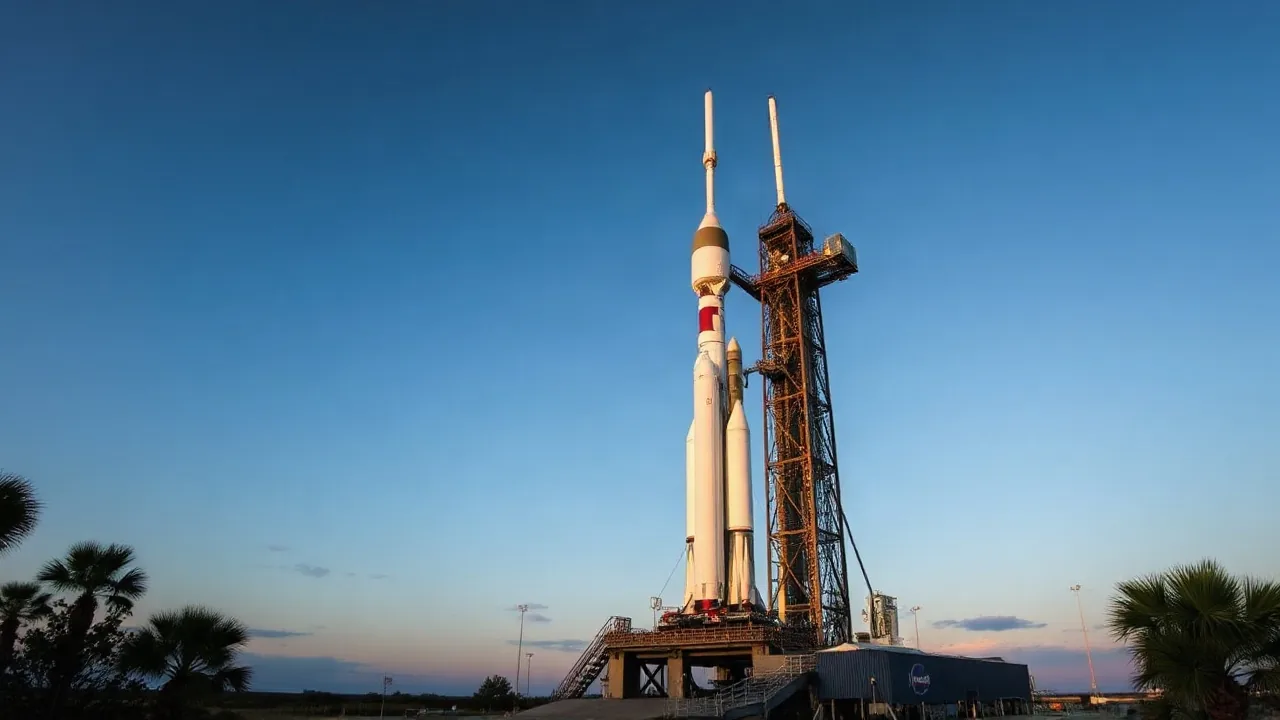
SpaceX is preparing to launch NASA's Nancy Grace Roman Space Telescope in the final months of 2026, marking a pivotal moment for infrared astronomy. The launch will use a Falcon Heavy rocket from Kennedy Space Center, delivering one of the most advanced observatories ever built to a vantage point nearly 1 million miles from Earth.
The Roman Space Telescope, named after pioneering NASA astrophysicist Nancy Grace Roman, represents a major step forward in understanding the universe's structure and the search for habitable worlds. Scheduled for delivery to orbit in October or November 2026, the mission will operate at the second Lagrange point, where gravitational forces from the Sun and Earth maintain a stable observation platform.
"The Roman mission will revolutionize our understanding of dark energy, the formation of galaxies, and the potential for discovering exoplanets in ways that ground-based telescopes simply cannot achieve," said Thomas Zurbuchen, associate administrator for NASA's Science Mission Directorate, in a statement released in August 2026.
Technical Capabilities and Scientific Goals
The Roman Space Telescope carries a 2.4-meter primary mirror and operates primarily in infrared wavelengths, allowing it to peer through cosmic dust clouds where visible light cannot penetrate. Its Wide Field Instrument and Coronagraph Instrument represent technological leaps in sensitivity and resolution compared to existing space observatories.
Primary mission objectives include:
- Mapping 200 million galaxies to trace the large-scale structure of the universe and study dark energy
- Detecting and characterizing exoplanets using advanced astrophysics techniques
- Studying the evolution of stellar populations in nearby galaxies
- Searching for supernova remnants and other transient cosmic events
The Coronagraph Instrument, a specialized component that blocks direct starlight, will enable Roman to photograph planets orbiting distant stars. This capability addresses a decades-long challenge in astronomy: directly imaging worlds beyond our solar system.
NASA has invested approximately 2.4 billion dollars in the Roman mission's development and construction over the past 15 years. The partnership with commercial partners like SpaceX reduces launch costs compared to traditional government-managed space transportation, freeing resources for scientific instrumentation.
SpaceX Launch Preparations and Mission Architecture
SpaceX's Falcon Heavy rocket provides the lift capacity needed to reach the second Lagrange point, located approximately 930,000 miles from Earth on the side opposite the Sun. This destination requires sufficient velocity and payload capacity that only the most powerful operational rockets can deliver.
The launch team has completed critical thermal and vibration testing of the observatory at the Goddard Space Flight Center in Maryland. Integration of the telescope with its launch vehicle adapter is scheduled for completion by late August 2026, positioning the mission for the planned October or November launch window.
"SpaceX has demonstrated exceptional reliability with Falcon Heavy missions dating back to its 2018 inaugural flight," said Jennifer McArthur, chief of space launch operations at NASA's Kennedy Space Center, during an agency briefing in September 2026. "We are confident in their ability to deliver Roman safely to its operational orbit."
The Falcon Heavy will lift the 3,650-pound observatory and its solar panels, deployment mechanisms, and fuel from the historic Launch Complex 39A. After achieving Earth orbit, the rocket's upper stage will perform a burn lasting approximately 25 minutes to place Roman on its trans-Lagrange trajectory.
Historical Context and Scientific Impact
The Roman mission completes a technological bridge between the 1990 launch of the Hubble Space Telescope and next-generation infrared observatories. While Hubble revolutionized visible-light astronomy, Roman will occupy an entirely different spectral range, complementing rather than duplicating Hubble's capabilities.
The astronomy community has prioritized Roman since the 2010 Decadal Survey identified it as a cornerstone mission for the decade ahead. Numerous peer-reviewed studies have already outlined the questions Roman will address: How did galaxies form in the early universe? Are there Earth-like planets around nearby stars? What role do black holes play in galactic evolution?
International collaboration extends the mission's scope. Scientists from Canada and the European Space Agency contributed components and will receive dedicated observation time. The mission's data archive, managed by NASA's Space Telescope Science Institute in Baltimore, will be open to researchers worldwide.
Launch delays, a common feature of complex space mission development, have pushed the original 2024 schedule back by two years. However, NASA engineers emphasize that the additional time has strengthened the final spacecraft, reducing risk of post-launch anomalies.
The Roman Space Telescope will operate for a planned five years, with potential for extension if performance metrics are met. Its infrared data will feed directly into ground-based observatories and future missions, creating a comprehensive observational ecosystem for astronomical discovery through the 2030s.