
SpaceX Rocket's Moon Impact Offers Lunar Science Opportunity
A SpaceX Falcon 9 rocket's upper stage intentionally crashed into the Moon, creating a new crater and providing scientists with a valuable chance to study lunar geology and impact dynamics.

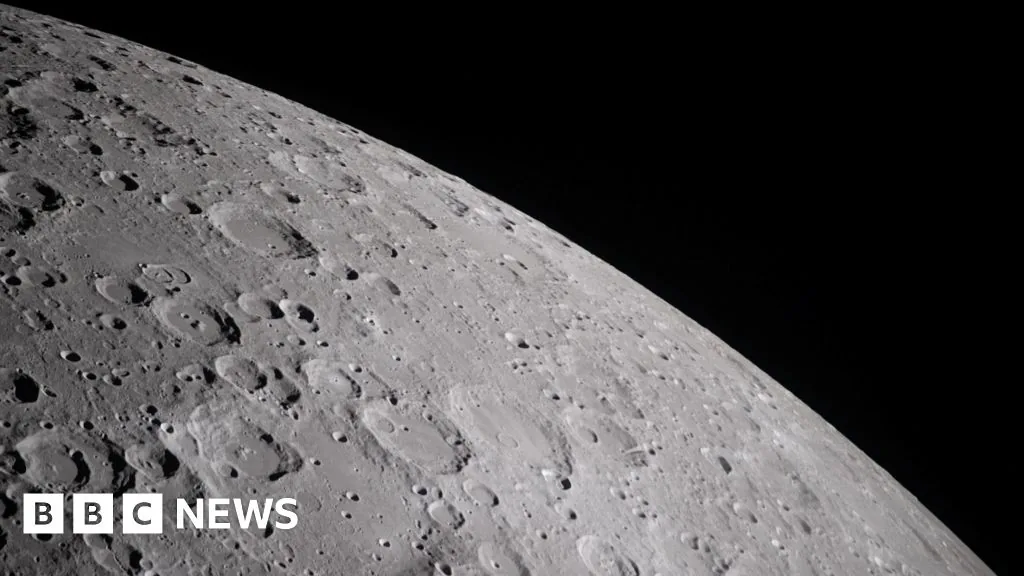
An unoccupied upper stage of a SpaceX Falcon 9 rocket intentionally collided with the Moon on Wednesday, generating a new crater near the renowned Einstein crater and presenting planetary scientists with a unique research opportunity. The impact occurred at approximately 5,400 mph (8,700 km/h), creating a brief flash of light that was challenging for even advanced amateur astronomers to detect.
The spent stage, described as being roughly the size of a five-story building and weighing at least 4,000 kilograms, had been drifting in a long orbit for months after its mission to propel lunar landers out of Earth's orbit. Over an 18-month period, subtle gravitational pulls from Earth, the Moon, and the Sun, along with solar radiation pressure, gradually altered its trajectory. Astronomers tracking the rocket's path eventually determined that these small forces had set it on a collision course with the Moon, with its speed increasing daily.
The precise moment of impact, around 07:35 BST on Wednesday, occurred in daylight for much of the globe. The resulting flash was too brief and faint for most telescopes to capture effectively, especially given its occurrence on the sunlit side of the Moon. Similarly, observers in darkness would have had minimal chance of witnessing the event, which produced a dust plume potentially stretching up to 100 kilometers and lasting several minutes.
New Crater Offers Scientific Insights
Even spacecraft in lunar orbit were not optimally positioned to record the impact live. South Korea's Danuri orbiter passed near the crash site shortly before the event, and its mission team is currently analyzing any potential footage before its release. In the coming days, NASA's Lunar Reconnaissance Orbiter (LRO) is expected to photograph the impact area, enabling comparisons between pre- and post-impact imagery.
Scientists anticipate that powerful telescopes in the Americas, where the sky remained dark, will provide the first crucial data and images. While detecting a 14-meter object striking the lunar surface from approximately 385,000 kilometers away is a significant challenge, it is not insurmountable. The resulting new crater is eagerly awaited, offering direct visual evidence of the collision.
This accidental impact has been described by researchers as a "dream moment" for planetary science. Because the exact size, speed, and impact location of the SpaceX rocket are known, the collision can be treated as a rare, quasi-controlled experiment. This allows scientists to test and refine their models of how impacts excavate craters, distribute ejecta, and generate seismic waves within the Moon's interior.
Understanding the volume of material displaced by the impact will provide valuable data for engineers designing future lunar landers and bases. It can help predict the range of flying debris and assess potential ground shaking effects on nearby equipment or structures. Furthermore, the analysis of subsurface material brought to the surface offers fresh geological clues, potentially enhancing our understanding of the Earth-Moon system's formation approximately 4.5 billion years ago. This event underscores the unexpected scientific contributions that even discarded space hardware can provide to our knowledge of the cosmos.