
SpaceX Rocket Debris Leaves Crater on Moon, South Korea Shares Images
South Korea's space agency, KASA, released images from its Danuri orbiter showing the Moon's surface after debris from a SpaceX Falcon 9 rocket impacted it. The crash created a new crater on the lunar landscape.

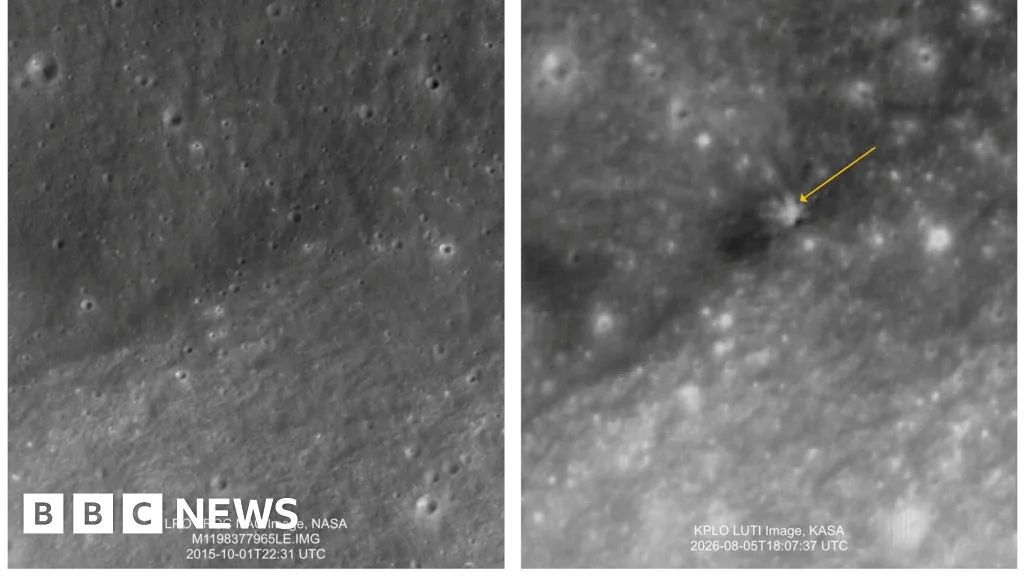
South Korea's space agency, the Korean AeroSpace Administration (KASA), has released striking images capturing the aftermath of a SpaceX rocket debris impact on the Moon. The lunar orbiter Danubri, operated by KASA, photographed the Moon's surface shortly after the collision, providing a visual record of the event. The images reveal the Moon's appearance before and after the approximately 4,000 kg (630 stone) upper stage of a Falcon 9 rocket struck its surface on Wednesday. The debris hit the Moon at an estimated speed of 5,400 mph (8,700 km/h), creating a noticeable impact site.
The Falcon 9 rocket, a workhorse for SpaceX missions, is designed for reusability, with some sections returning to Earth and others being discarded in space. The specific upper stage that impacted the Moon had been in orbit since January 2025, following its launch from Florida. Its original mission was to propel two lunar landers out of Earth's orbit and towards the Moon. After completing its task, the spent stage was left to drift in an elongated orbit influenced by the gravitational pull of Earth, the Moon, and the Sun.
Space Debris Concerns Grow
Over approximately 18 months, subtle gravitational nudges and solar radiation gradually altered the rocket stage's trajectory, leading astronomers to predict its eventual collision course with the Moon. While the impact itself posed no danger to Earth, the incident highlights growing concerns among scientists about the proliferation of space debris. "Space is getting more and more crowded," noted Matt Bothwell, an astronomer at the University of Cambridge. "It could feasibly be within a few decades that it's actually quite hard to get past Earth's orbit because space is so crowded," Bothwell warned, citing the increasing number of objects launched into orbit each year.
The visible aftermath of the crash, a short but intense flash on the lunar surface, would have been extremely difficult for amateur astronomers to observe, even with powerful telescopes. However, major observatories, including KASA, are now analyzing the data collected by the Danuri orbiter. This analysis will provide valuable insights into the physics of hypervelocity impacts on the lunar regolith and potentially help track other orbital debris. The event underscores the challenges of managing near-Earth and cislunar environments as space activities, including satellite constellations and lunar missions, continue to expand. KASA's images serve as a stark reminder of the tangible effects of humanity's reach into space.
This incident is particularly noteworthy as SpaceX prepares for another launch on August 10th, involving the same booster section from the January 2025 mission, scheduled for its 18th flight. That mission aims to deploy 29 Starlink satellites into low-Earth orbit. The continuous cycle of launches and the associated shedding of rocket components necessitate ongoing vigilance and potential development of debris mitigation strategies to ensure the long-term sustainability of space exploration and utilization.