
SpaceX Rocket's Predicted Moon Impact Confirmed by Telescope Debris
A SpaceX rocket's upper stage, adrift for a year, has crashed into the moon as anticipated. Scientists using a telescope in Chile detected a debris plume, confirming the impact and highlighting the growing issue of lunar litter.

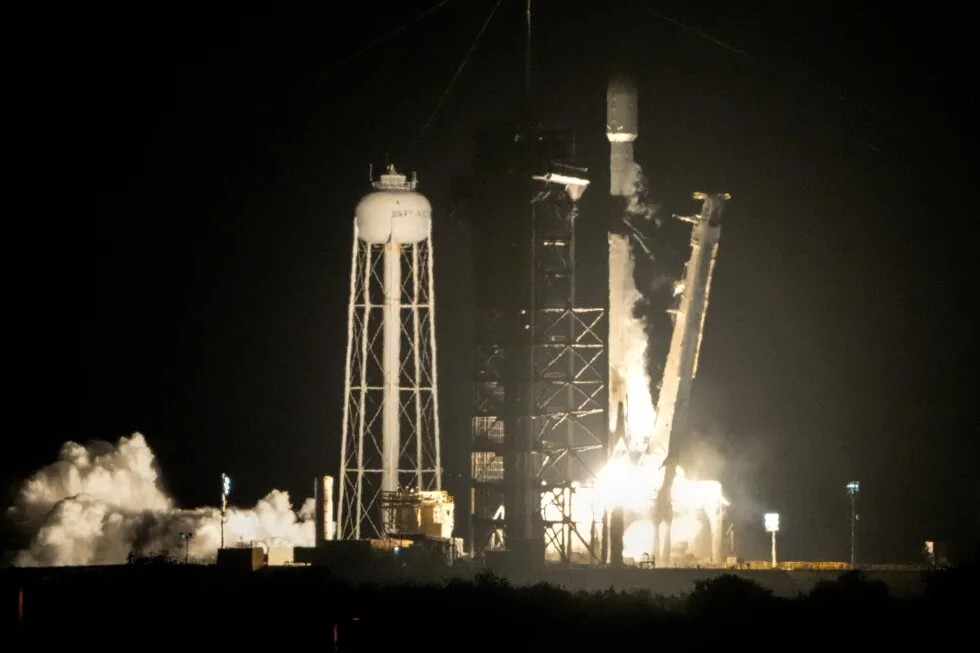
A SpaceX rocket's upper stage, which had been drifting off course for approximately a year, has made an unexpected but predicted impact with the moon, scientists reported on Wednesday. While the collision itself was not directly observed, astronomers identified a plume of debris captured by a telescope in Chile, confirming the event. Space tracking experts stated the crash was an inevitability for the stray rocket segment. This incident marks another piece of space junk landing on the lunar surface, a concern many believe will escalate as nations like the U.S. and China intensify their efforts to establish human presence on the moon. In a similar event in 2022, a Chinese rocket unintentionally impacted the moon following a mission, and it is suspected that numerous other rocket fragments may have struck the moon in past decades without scientific detection.
SpaceX representative Julianna Scheiman stated this week that the company is collaborating with NASA to prevent similar future incidents, emphasizing that this particular crash was accidental. She explained that a combination of solar activity and lunar gravity inadvertently directed the rocket stage towards a collision course with the moon. Dr. Carl Schmidt from Boston University expressed "100% certainty" that his team’s observations provided evidence of the lunar impact. The European Southern Observatory's Very Large Telescope recorded a stream of sodium and lithium extending for miles into space, lasting between five and 10 minutes post-impact, he detailed in an email. "We don’t have images of the impact" but the telescope data is conclusive, Schmidt added.
Growing Concerns Over Lunar Space Debris
Even before the debris plume was detected, retired astrophysicist Jonathan McDowell had observed that the 4-ton upper stage was on a direct trajectory towards the moon. The predicted impact zone was described as a desolate area near Einstein Crater on the moon's western edge, a region notoriously challenging to observe from Earth. "There’s no doubt in my mind" that the rocket has now been broken into countless pieces scattered across the moon near Einstein Crater, McDowell informed The Associated Press. "As a physicist, I know that what goes up must come down," he further remarked. Ground-based observers anticipated difficulties in spotting the dust and rock ejected from the impact site, let alone any flash of light. Orbiting spacecraft were considered to have the best chance of witnessing the event or analyzing the resulting crater afterward. Dutch scientist Marco Langbroek, who monitored the moon with his telescope at the expected time, reported no visual confirmation. "We knew this would be a long shot," Langbroek commented. Like McDowell, Langbroek conveyed his "no doubt" that the rocket had met its end. Definitive visual confirmation, according to McDowell, will likely come from NASA's Lunar Reconnaissance Orbiter, which is expected to photograph the impact crater next week.
The Falcon rocket's upper stage, a cylindrical component measuring over 40 feet in length, was originally launched on January 15, 2025, carrying two private lunar landers: Firefly Aerospace's Blue Ghost and ispace's Resilience. After successfully deploying the landers on their trajectories, the stage became adrift. While the ispace Resilience lander unfortunately crashed, the Firefly Blue Ghost lander successfully achieved a lunar touchdown, marking a significant milestone as the first private spacecraft to do so. The moon is increasingly becoming a focal point for space exploration, with NASA planning for a series of robotic missions in the coming years to lay the groundwork for a sustainable lunar base. Major private entities, including SpaceX and Blue Origin, are slated to provide landers for NASA's upcoming Artemis astronaut missions. SpaceX's Starship program continues its test flights from Texas, while Blue Origin's Blue Moon lander is yet to launch. It is anticipated that one or both of these landers will participate in the Artemis III mission, a rehearsal for lunar docking maneuvers scheduled in Earth's orbit. The first human lunar landing since the Apollo era could potentially occur as early as 2028. "Things are going to get a lot busier near the moon," McDowell cautioned. "At that point an impact like this on the lunar surface plowing up huge amounts of dust going for hundreds of miles around is not going to be acceptable." The growing activity underscores the immediate need for strategies to manage space debris, both in Earth orbit and on celestial bodies like the moon.