
SpaceX Launch Creates 'Space Jellyfish' Phenomenon Over US East Coast
A recent SpaceX rocket launch produced a stunning 'space jellyfish' effect, captivating onlookers across the US East Coast. The visual spectacle resulted from the rocket's upper-stage engine firing.

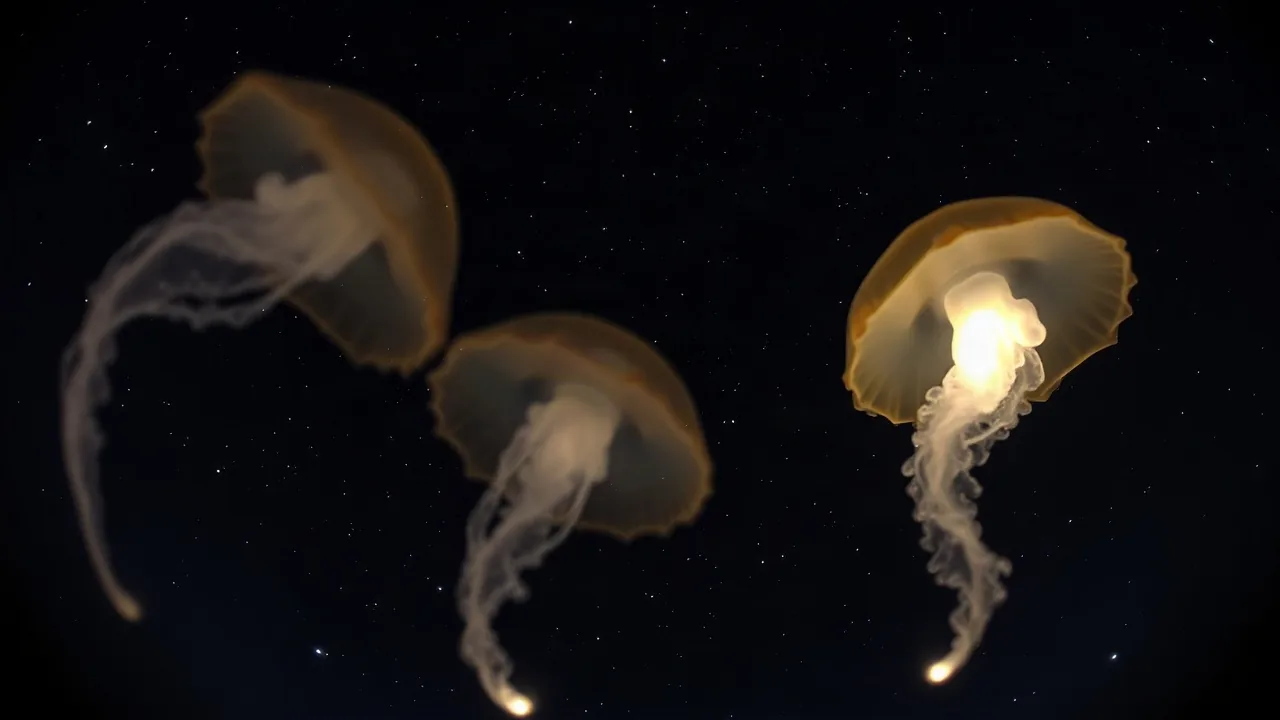
A spectacular celestial display, dubbed the 'space jellyfish,' captivated residents along the U.S. East Coast on October 13, 2026, following a SpaceX rocket launch. The phenomenon occurred when the upper-stage engine of a Falcon 9 rocket ignited, creating luminous tendrils that stretched across the night sky.
The SpaceX CRS-35 mission, carrying vital supplies to the International Space Station, lifted off from Kennedy Space Center in Florida. As the rocket ascended, its second stage performed a propulsive maneuver, expelling excess fuel that then interacted with the atmosphere at high altitudes. This interaction illuminated the gas, forming an ethereal, bioluminescent-like cloud reminiscent of a jellyfish.
Eyewitnesses from Florida to New England reported seeing the unusual sight, with social media platforms quickly filling with photos and videos. In Pittsburgh, the glowing trail was visible for several minutes, prompting awe and speculation among local observers. Similarly, residents in the Tampa Bay area and Central Florida described the event as a surreal and beautiful addition to the night sky.
Background of the Phenomenon
This 'space jellyfish' effect is not an entirely new occurrence but is a relatively rare visual consequence of rocket launches. It happens when the engine of the rocket's upper stage ignites at high altitude, typically between 150 and 400 miles above Earth. The exhaust plume from the engine, combined with residual propellant that is intentionally vented, interacts with the thin upper atmosphere. Sunlight, even after sunset on the ground, can illuminate this plume, creating the striking, translucent visual.
The specific conditions for such a display include the angle of the sun relative to the observer and the rocket, the altitude of the engine burn, and the composition of the exhaust. While the primary purpose of the engine firing is to adjust the trajectory or prepare for payload deployment, the resulting visual is often a breathtaking bonus. This particular launch, the 35th Commercial Resupply Services (CRS) mission for NASA, underscores the ongoing partnership between SpaceX and the space agency in maintaining the orbiting laboratory.
NASA provided coverage for the SpaceX 35th Station Resupply Launch and its subsequent arrival. The CRS missions are crucial for delivering scientific experiments, technology demonstrations, and essential cargo that keeps the ISS operational and its research capabilities active. The successful launch and the subsequent atmospheric display highlight the dual nature of space exploration: the rigorous science and engineering involved, and the profound, often unexpected, beauty it can reveal.
The event served as a stark reminder of humanity's increasing presence in low Earth orbit and the visible traces left behind by these complex operations. As more launches occur and technology advances, the potential for unique and memorable visual phenomena like the 'space jellyfish' is likely to continue, offering fleeting moments of cosmic wonder to those on the ground.