
Perseid Meteor Shower Peaks With Partial Solar Eclipse View
The annual Perseid meteor shower reaches its peak viewing period between August 12-13, coinciding with a partial solar eclipse. Canadians can look forward to this celestial event, with Newfoundland and Labrador expected to have the best view of the eclipse.

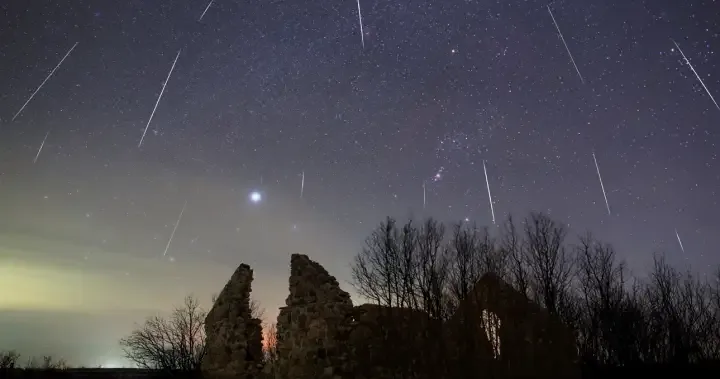
Stargazers across North America can anticipate a spectacular celestial display next week as the highly anticipated Perseid meteor shower reaches its peak, coinciding with a partial solar eclipse. The peak viewing window for the Perseid meteor shower is set for August 12 to 13, an event that NASA describes as debris left by Comet Swift-Tuttle entering Earth's atmosphere. "You have to be patient, but it’s a great spectacle if you’re lucky to be in a region where you can see it," said Pierre Langlois, manager for space astronomy and planetary science missions at the Canadian Space Agency (CSA).
The Perseids are a reliable yearly shower, with the celestial fragments entering Earth's atmosphere at approximately 59 kilometers per second. "These bits of debris enter Earth’s atmosphere at a very fast 59 kilometers per second, vaporizing about 80 to 90 kilometers altitude and leaving behind streaks of light we call meteors or shooting stars," explained a NASA spokesperson in a statement to Global News. Langlois likened the phenomenon to driving through snow, where snowflakes appear to come from all directions. "That’s exactly what’s happening with these meteor showers," he said, noting that the Perseids are "much easier to predict" than other meteor events.
Eclipse Adds to Astronomical Excitement
Adding to the cosmic lineup, the meteor shower aligns with a partial solar eclipse, offering a dual astronomical treat. A partial solar eclipse occurs when the Moon passes between the Sun and Earth, but without perfect alignment. "Only a part of the Sun will appear to be covered, giving it a crescent shape," according to NASA. While the most dramatic views of the eclipse will be in Spain and Iceland, Newfoundland and Labrador in Canada is expected to have the clearest vantage point for the partial event. "They’re [Newfoundland and Labrador] still not getting the full eclipse, but they’re getting the most out of all of us," Langlois noted.
To safely observe the solar eclipse, Langlois strongly advises using certified solar eclipse glasses to prevent eye injury. "You want to have solar eclipse glasses to ensure that you don’t injure your eyes," he cautioned.
For the best viewing experience of the Perseid meteor shower, experts recommend heading away from city lights. "The further you are from big cities, the best chance you have" of seeing the meteors, Langlois advised. The optimal viewing time is expected to be after sunset, particularly between 10 p.m. and 2 a.m., when the sky is at its darkest. NASA suggests finding a dark, open location, lying on your back, and looking up to take in the widest possible expanse of the night sky. "Give your eyes at least 30 minutes to adapt to the dark and try not to look at your cell phone, as the bright screen ruins night vision," the agency recommends.
While no special equipment is necessary to view the shooting stars, photography enthusiasts might consider a camera with a long lens. Langlois added a touch of humor, suggesting, "The best technology would be a heating blanket and a hot chocolate dispenser, if possible," for maximum comfort during the viewing.