
NASA's Roman Space Telescope Blasts Off to Uncover Dark Universe
NASA's new Roman Space Telescope launched Sunday atop a SpaceX Falcon Heavy rocket. The $4.3 billion observatory will spend three months journeying to a unique orbit to study dark energy, dark matter, and thousands of exoplanets.

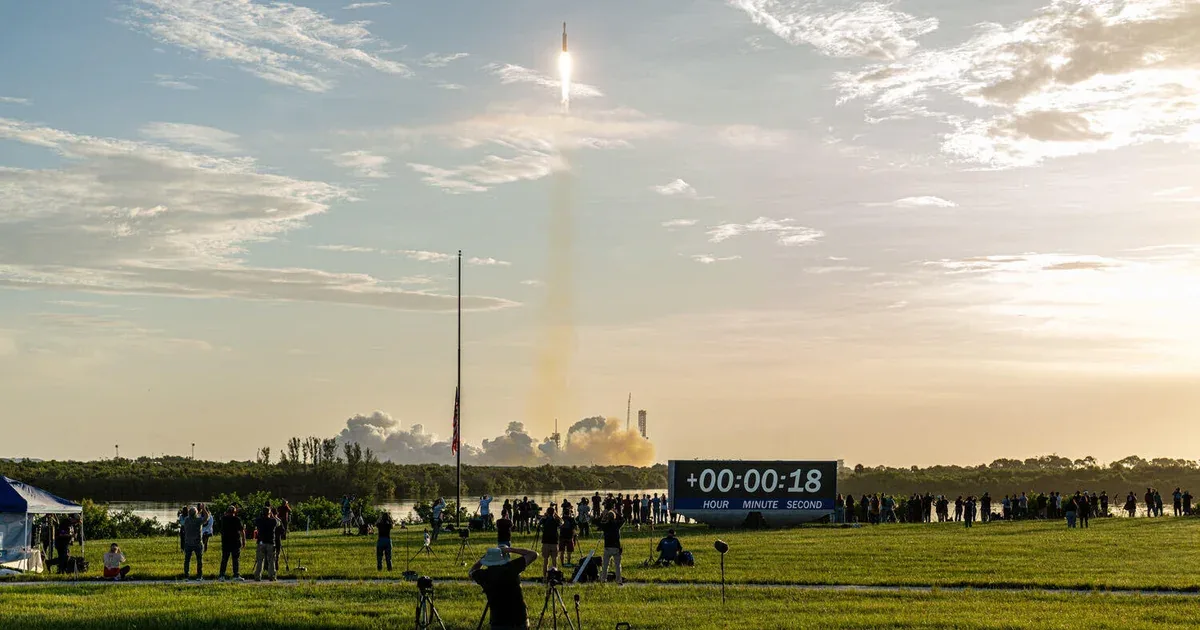
NASA's Nancy Grace Roman Space Telescope, a $4.3 billion observatory poised to revolutionize astronomical understanding, successfully launched Sunday from Florida's Kennedy Space Center atop a powerful SpaceX Falcon Heavy rocket. The telescope will embark on a three-month journey to a gravitationally stable point a million miles from Earth, known as Lagrange Point 2 (L2), where it will begin its mission to map the cosmos and unravel some of the universe's most profound mysteries.
The Roman observatory is equipped with two key instruments designed for unprecedented cosmic exploration. Its primary 300-megapixel wide-field camera, utilizing a mirror originally built for a spy satellite, will survey vast swathes of the sky. This camera aims to provide detailed maps of the large-scale structure of the universe, cataloging an estimated 20 billion stars and over 2 billion galaxies. A significant focus will be on discovering exoplanets. While approximately 6,200 exoplanets have been identified to date, Roman is expected to dramatically expand this count, potentially identifying well over 100,000 by the end of its mission.
Probing Cosmic Mysteries
Beyond cataloging celestial bodies, Roman's mission delves into the fundamental nature of the universe itself. It will search for clues about dark energy, the enigmatic force driving the accelerating expansion of the cosmos, and dark matter, the invisible substance that binds galaxies together and constitutes the majority of the universe's mass. The telescope's observations are expected to shed light on the ongoing cosmic struggle between dark matter's attractive force and dark energy's repulsive push.
"Roman is going to revolutionize the way we look at our universe," stated NASA science chief Nicky Fox following the successful launch. "It is going to measure dark matter, which is like the fabric of the universe; it's the thing you can't see, but we know it's there. It's going to measure dark energy, which kind of powers the universe."
A second instrument aboard Roman is an experimental coronagraph, featuring shape-shifting mirrors. This advanced technology is designed to block the intense glare of distant stars, enabling astronomers to directly study the faint light reflected from exoplanets. The coronagraph is specifically engineered to analyze Jupiter-size planets orbiting other stars, potentially revealing details about their atmospheric composition. This capability is a crucial step towards understanding planetary habitability beyond our solar system.
The observatory's journey to L2 is reminiscent of the deployment of the James Webb Space Telescope, which also resides in this stable orbital region. Once operational, Roman's data will be crucial for testing and refining the standard model of cosmology. Scientists anticipate that Roman's findings may challenge current cosmological models, potentially revealing that dark energy is not a constant force but one that changes over time. "We're probably not going to confirm the standard model of how the universe works," explained Julie McEnery, Roman Space Telescope senior project scientist. "We're very likely to demonstrate that our standard model is wrong, and to set ourselves on a path to figuring out how does our universe really work."
The launch itself was a spectacle, with the Falcon Heavy rocket's three core stages, powered by nine Merlin engines each, generating over five million pounds of thrust. This marked only the 13th flight for SpaceX's most powerful operational rocket, providing a stunning display for observers at the Cape Canaveral Space Force Station and surrounding areas. The mission's success represents a significant milestone for NASA's ambitious space exploration program, promising a new era of discovery in understanding the vast and mysterious universe.