
NASA's Roman Space Telescope Launch Set to Transform Exoplanet Discovery
NASA's Roman Space Telescope is preparing for launch in 2026 to survey billions of stars and search for distant exoplanets. The mission will revolutionize understanding of planetary systems beyond Earth.

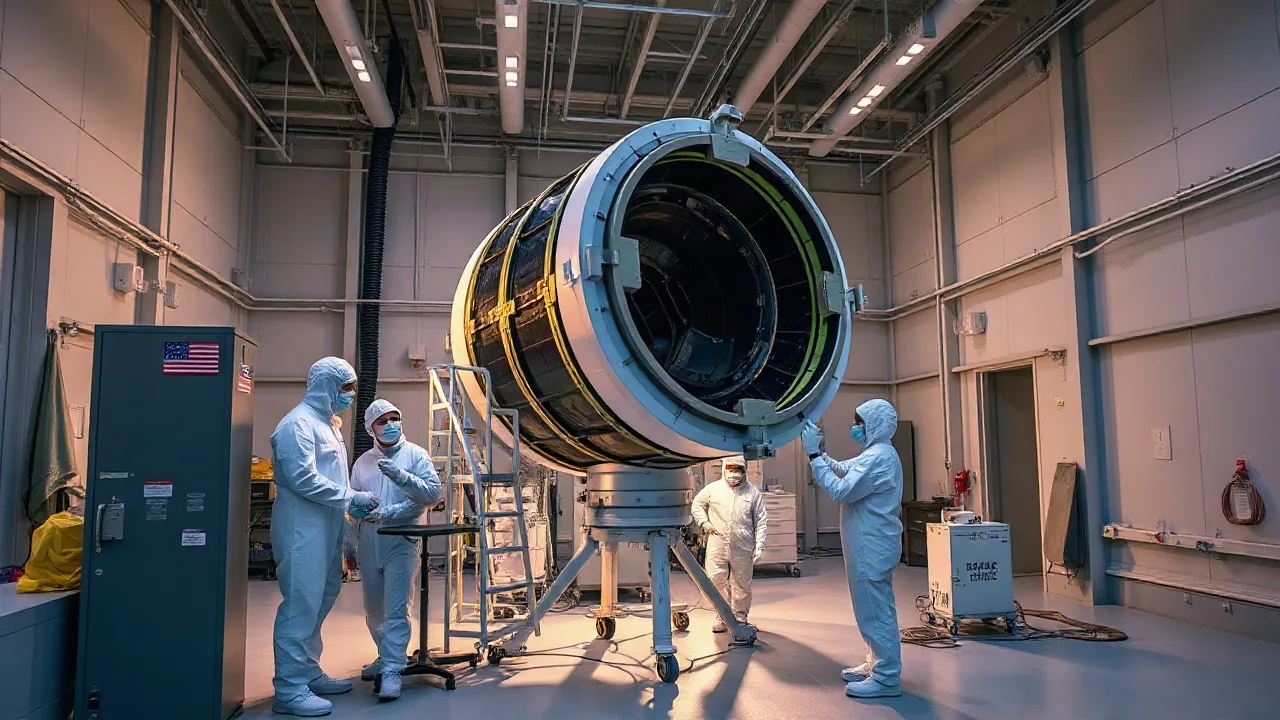
NASA's Roman Space Telescope stood poised for launch in late 2026, marking one of the most ambitious infrared astronomy missions to date. The telescope, named after astrophysicist Nancy Grace Roman, represents a massive leap forward in humanity's ability to detect and characterize planets orbiting distant stars.
The Roman Space Telescope carries instruments designed to survey billions of stars across a field of view 100 times larger than the Hubble Space Telescope. Mission planners at NASA's Goddard Space Flight Center estimate the observatory will identify thousands of exoplanets and characterize their atmospheric compositions, fundamentally reshaping exoplanet science.
Thomas Zurbuchen, associate administrator for NASA's Science Mission Directorate, stated in a September 2026 briefing: "Roman will give us an unprecedented census of planetary systems. We're not just looking for a few planets anymore—we're mapping the landscape of worlds that exist across our cosmic neighborhood."
Scientific Objectives and Capabilities
Roman's primary mission centers on three core scientific goals. First, the telescope will conduct a comprehensive exoplanet survey using gravitational microlensing, a technique that detects planets by observing the bending of light around distant stars. This method proves especially effective at finding Earth-sized and larger planets at distances where traditional direct imaging fails.
Second, Roman will measure the expansion rate of the universe with unprecedented precision. By observing distant supernovae and galaxy clusters, the mission aims to refine our understanding of dark energy and the cosmos's ultimate fate.
Third, the telescope will capture high-resolution images of nearby galaxies, star-forming regions, and stellar coronae. Key capabilities include:
- A 2.4-meter primary mirror operating primarily in infrared wavelengths
- Wide Field Instrument covering 0.28 square degrees per observation
- Coronagraph able to detect planets 10 billion times dimmer than their host stars
- Spectroscopic capability to analyze planetary atmospheres for potential biosignatures
The mission design reflects 15 years of development and billions of dollars in investment. Roman will operate at the L2 Lagrange point, approximately one million miles from Earth, where gravitational forces allow the telescope to maintain stable orientation while observing deep space.
Launch Timeline and Partnership with SpaceX
SpaceX will carry Roman into orbit aboard a Falcon Heavy rocket scheduled for late 2026. The partnership follows successful deployments of other major space observatory missions, including the James Webb Space Telescope, which launched in December 2021.
NASA and SpaceX completed critical vehicle readiness reviews in August 2026, confirming the Falcon Heavy's capability to deliver Roman's approximately 2.1-metric-ton payload to the L2 point. The launch window extends across several weeks, providing flexibility to accommodate weather and technical requirements.
Pre-launch testing continues at NASA's Goddard Space Flight Center and contractor facilities through September 2026. Engineers verify thermal systems, optical alignment, and communications equipment to ensure Roman's survival during the intense vibrations and stresses of launch.
Why Roman Matters for Future Astronomy
Roman arrives at a pivotal moment in space mission history. The James Webb Space Telescope, operational since 2022, demonstrated the scientific power of advanced infrared observatories. Roman builds on those successes while addressing questions Webb cannot answer due to its smaller field of view and different design priorities.
The exoplanet question proves especially urgent. Ground-based surveys and the retired Kepler mission identified roughly 5,500 confirmed exoplanets by 2026, yet astronomers estimate billions exist. Roman's census will reveal the true statistical distribution of planetary masses, orbital periods, and compositions across the galaxy.
For NASA, Roman also represents a commitment to answering humanity's most profound questions: Are we alone? How did our solar system form? What does the universe's ultimate fate hold? The mission's data will fuel decades of discovery, with predictions suggesting Roman observations will remain scientifically productive through the 2030s.
International collaboration strengthens Roman's reach. Partners from the European Space Agency and Japanese space agencies contributed specialized instruments and expertise, embedding the mission within the broader framework of global scientific cooperation.
As launch approaches in 2026, anticipation builds among the astronomical community. Roman promises transformative insights into planetary science, cosmology, and the fundamental nature of existence itself. The 18-month journey from Earth to L2 will test every system, but if all performs nominally, the Roman Space Telescope will reshape our understanding of the universe for generations to come.