
NASA Astronauts Complete Spacewalk for ISS Solar Array Upgrade
Two NASA astronauts successfully completed a 6.5-hour spacewalk on August 6, installing crucial hardware for the International Space Station's upcoming solar array upgrades. The mission advances the station's power capabilities for future long-term operations.

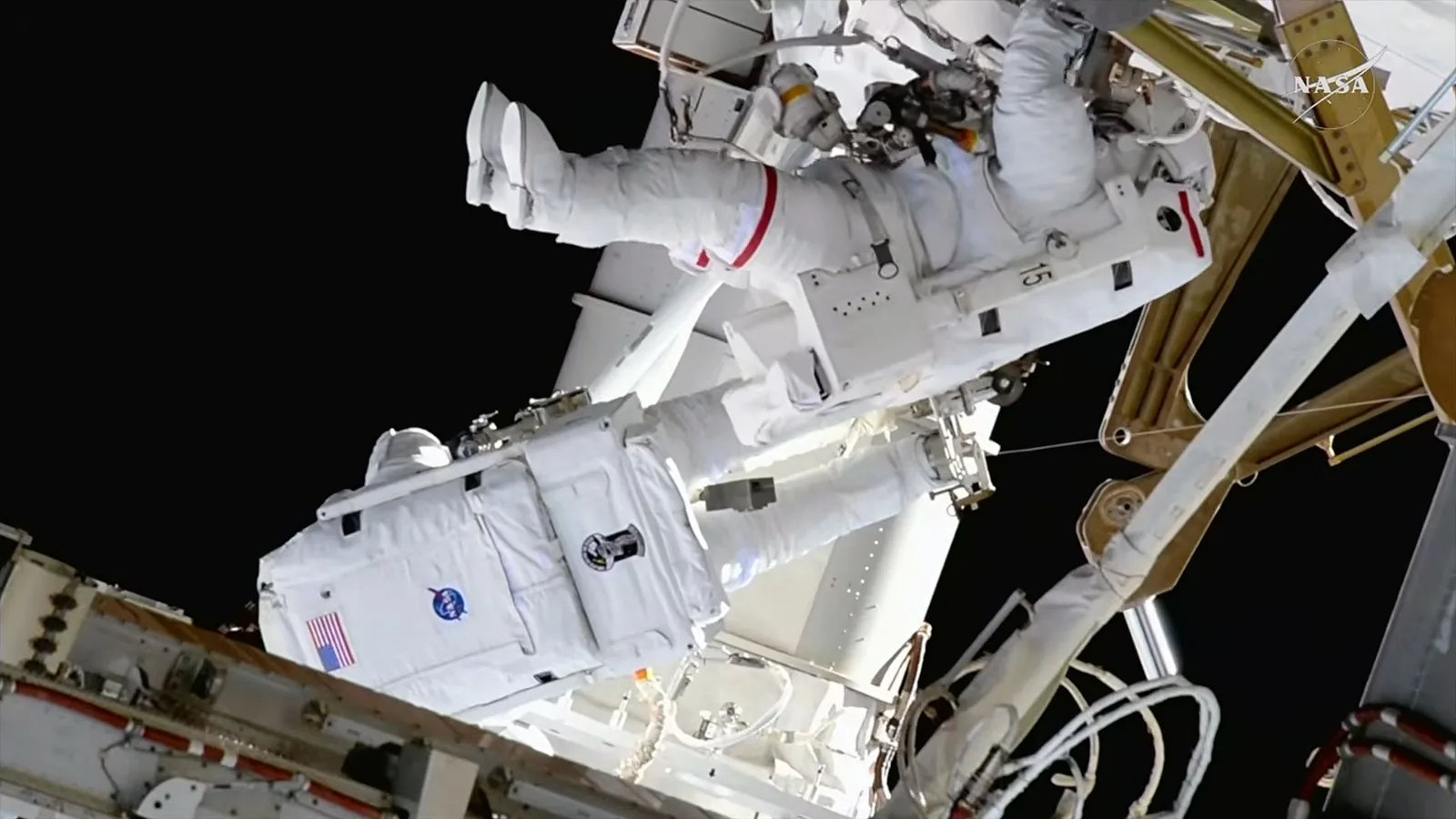
Two NASA astronauts successfully concluded a 6.5-hour spacewalk outside the International Space Station on Thursday, August 6, installing the final set of mounting hardware needed to prepare the orbiting laboratory for enhanced solar power capabilities. Astronauts Jessica Meir and Anil Menon worked to assemble modification kits for one of the station's eight power channels, paving the way for the future integration of new iROSA (ISS Roll-Out Solar Array) units.
This spacewalk marks a significant step in the ongoing effort to bolster the ISS's power generation. Since 2021, six of the iROSA assemblies have been deployed by astronauts during previous excursions, with two more awaiting delivery later this year. Meir and Menon focused their efforts on the 3B power channel, located on the starboard segment of the station's main truss. They meticulously assembled and secured triangular brackets, likened to building with a large erector set, onto the mast canister.
Following the structural assembly, the astronauts routed essential cabling designed to channel electricity from the future iROSA arrays into the existing 3B power system. To safeguard this new infrastructure from the harsh environment of space, including potential micrometeoroid impacts, they also applied multi-layer insulation to the struts. The new iROSA wings are designed to augment, not replace, the station's original solar arrays, which have begun to show degraded power output after exceeding their initial 15-year lifespan. When fully integrated, the upgraded system is projected to increase the ISS's overall electricity supply by 20% to 30%.
Expanding Power for Future Missions
The successful spacewalk not only addresses the immediate need for increased power but also supports the station's role as a vital platform for scientific research and the development of technologies essential for future deep-space exploration. The installation on the 3B power channel is one of two remaining channel preparations for iROSA deployment. The 2A power channel on the port side of the station is the other location awaiting its solar array upgrade.
During a brief pause in their demanding work, Meir and Menon shared a moment of reflection, observing Earth and celestial bodies. Meir noted the presence of the moon, drawing a connection to NASA's ambitious Artemis program, which aims to return humans to the lunar surface. Menon agreed, expressing a vision of a future lunar base. Meir then turned her thoughts to Mars, referencing the 10th anniversary of the successful landing of NASA's Curiosity rover in 2012, which confirmed Mars's past potential for life. "One day, humans will visit Curiosity, propelled by the groundbreaking science, technology demonstrations and operations conducted here on the International Space Station for almost 26 years now," she stated.
Meir concluded the spacewalk's operational segment with a forward-looking statement. "Today, we made one more step toward expanding the ISS power system, further sustaining our human presence in low Earth orbit, as we prepare to take those next steps," she said. These words underscore the incremental yet crucial progress being made in space exploration, with the ISS serving as a testbed for technologies and procedures needed for longer-duration missions.
The spacewalk, officially classified as an extravehicular activity (EVA), commenced at 8:33 a.m. EDT (1233 GMT) and concluded at 3:00 p.m. EDT (1900 GMT), totaling 6 hours and 27 minutes. This marked the 96th U.S. EVA and the 281st spacewalk in the history of the International Space Station's assembly, maintenance, and enhancement. For Anil Menon, this was his first career spacewalk, while Jessica Meir added this to her sixth EVA, bringing her cumulative spacewalking time to an impressive 42 hours and 33 minutes.